
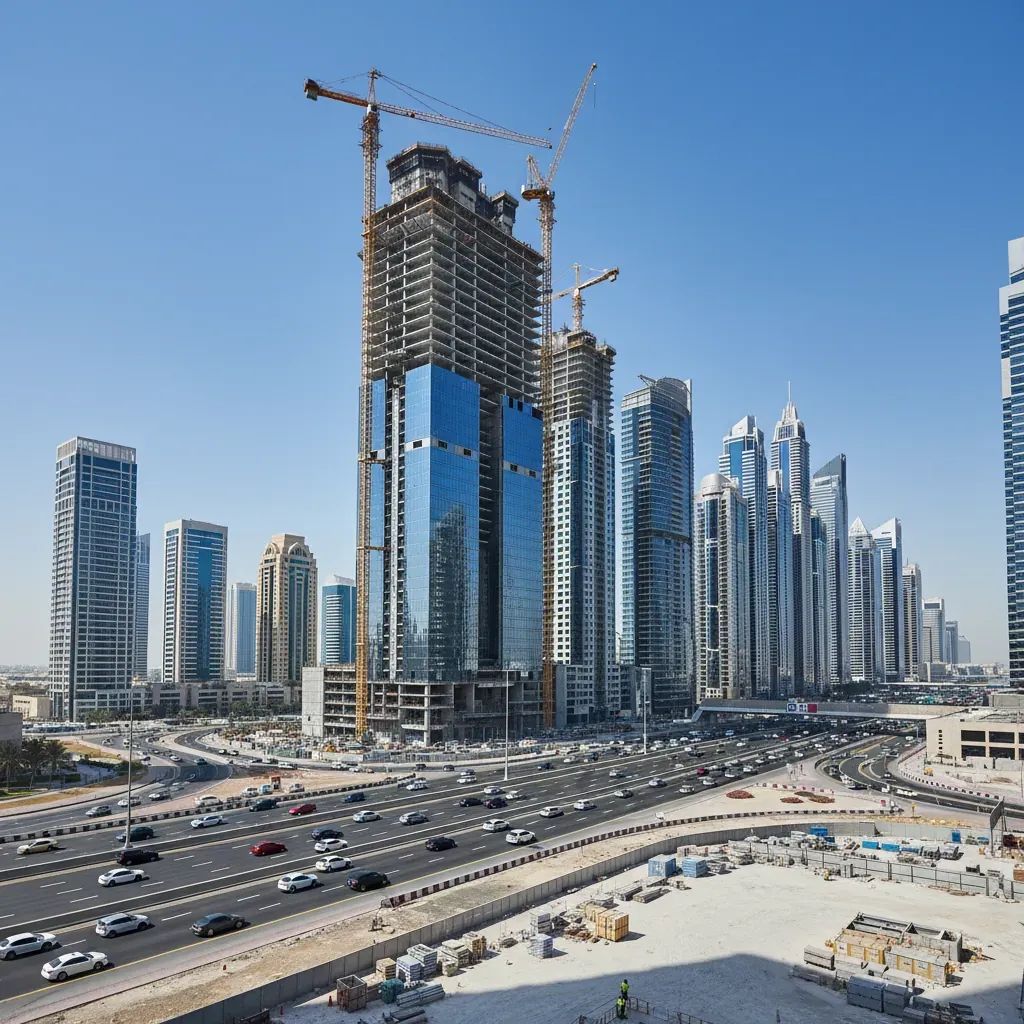
The United Arab Emirates commercial property sector has notched another milestone: AHS Properties has confirmed its 69-storey office tower on Sheikh Zayed Road has sold every unit during the development phase, generating over $700 million in sales—a figure that underscores the intense appetite for premium workspace in Dubai as completion approaches in Q4 2026.
Why This Matters:
• Grade A+ office scarcity: Vacancy rates for top-tier spaces in Dubai's core business districts have dropped below 5%, pushing rents and sale prices to record levels.
• Metro-connected prestige: AHS Tower offers direct access to Dubai Metro and sits adjacent to the Dubai International Financial Centre (DIFC), the region's most expensive office submarket at AED 537 per sq. ft. for fitted space.
• Flight to quality: Multinational firms and regional headquarters are prioritizing tech-enabled, amenity-rich buildings over older stock, fueling demand for towers like AHS that blend design pedigree with wellness features.
• Price benchmark: At approximately AED 4,000 per sq. ft., the tower slots into the ultra-luxury tier—above Business Bay averages but below the AED 7,000 per sq. ft. peaks recorded by comparable projects.
What Drove the Sell-Out
Dubai's commercial real estate market is experiencing a structural supply-demand imbalance that has turned Grade A office towers into scarce commodities. The city's economy is projected to expand by 4.5% in 2026, maintaining the pace set in 2025 and outstripping global averages, with the non-oil sector contributing over 75% of GDP. Finance, technology, business services, and digital sectors are growing rapidly—business services alone accounted for 38% of total office demand in the first half of 2025.
Government policy has amplified this momentum. The Dubai Economic Agenda D33 aims to double the emirate's economy by 2033, while initiatives such as 100% foreign ownership for most onshore companies, the Golden Visa long-term residency program, and streamlined "Instant License" registration have made the city a magnet for multinational headquarters. Company registrations at DIFC surged 32% year-on-year in 2024, with finance, legal, and advisory firms leading the charge. High-value office transactions exceeding AED 10 million jumped sharply in the first half of 2025, signaling robust investor confidence.
Population growth is the quieter multiplier. Dubai's population surpassed 4 million in 2025—a 5.4% year-on-year increase—with projections targeting 5.8 million by 2040. This demographic expansion fuels demand for services, talent, and workspace, creating a self-reinforcing cycle of economic activity.
What Sets AHS Tower Apart
AHS Tower was designed by Killa Design, the firm behind the Museum of the Future, with interiors curated by AHS Atelier. The 69-storey structure (some sources cite 71 or 72 floors) offers half-floor offices ranging from 2,964 to 3,625 sq. ft. starting at approximately AED 11.78 million, and full-floor options spanning 6,278 to 6,695 sq. ft.. Buyers secured units with a payment plan of 60% during construction and 40% on completion.
The amenity package spans two dedicated floors and includes a private fitness and wellness center, executive lounges, curated dining concepts, meeting rooms, exhibition spaces, a hospitality lounge, a members' club, a sky gallery, and a winter garden with a cocktail bar and restaurant. Seventeen high-speed elevators and over 500 parking spaces complete the infrastructure. Panoramic views stretch from the city skyline to the Arabian Gulf, reinforcing the tower's positioning as a "vertical ecosystem of exclusive amenities" for global enterprises.
Market Context and Pricing Dynamics
AHS Tower enters a market where prime office occupancy has reached near-capacity levels. DIFC occupancy hit 98% in Q1 2025, while Business Bay and Downtown Dubai are similarly constrained. Average office rents across key submarkets reached AED 233 per sq. ft. in Q3 2025, reflecting a 35% year-on-year increase from Q3 2024. Dubai now ranks 8th globally for total prime office occupancy costs, averaging $148.90 (AED 546.91) per sq. ft. per annum in Q1 2025.
In the sales market, Downtown Dubai commands the highest prices, exceeding AED 5,000 per sq. ft., while Business Bay averages surpass AED 2,000 per sq. ft. The average office sale price in the secondary market reached AED 1,685 per sq. ft. in Q3 2025. AHS Tower's pricing of approximately AED 4,000 per sq. ft. positions it as a premium offering, competitive within the ultra-luxury segment but below the stratospheric levels seen in projects like OMNIYAT's Enara in Business Bay, where starting prices hit AED 79.98 million and per-square-foot pricing has touched AED 7,000 for record-breaking transactions.
By comparison, Beyond's "31 Above" in Dubai Maritime City offers offices at AED 3,400 to AED 3,500 per sq. ft., targeting a slightly different segment by delivering quality space in an emerging commercial district rather than the hypercompetitive core. AHS Tower's adjacency to DIFC and direct Metro connectivity provide a locational advantage that justifies its premium over mid-tier projects while undercutting the absolute top end.
Supply Shortfall and the Flight to Quality
Total office space in Dubai is projected to reach 9.7 million square meters by the end of 2026, up from 6.26 million square meters currently, with approximately 230,000 square meters of new space expected this year. Yet the majority of this incoming supply is already earmarked as premium Grade A, and much of it has been pre-sold or pre-leased during development. The shortage of Grade A assets is expected to persist until at least 2027 or 2028, sustaining upward pressure on rents and sale prices.
Companies are prioritizing flexible layouts, co-working options, energy-efficient systems, and smart building features as workplace trends shift toward "Hybrid 3.0" models—activity-based zones for focus, collaboration, and socializing, with fewer fixed desks and more hot-desking and meeting pods designed for hybrid meetings. Sustainability credentials, including low-VOC materials, energy-efficient systems, and alignment with UAE Net Zero 2050 initiatives, have become standard requirements. IoT sensors and smart systems for optimizing space utilization are also increasingly expected.
This shift explains why older, less flexible office stock is struggling to compete, even as headline vacancy rates suggest a balanced market. The real contest is for the newest, most amenity-rich towers, and in that race, AHS Tower's complete sell-out during development underscores the intensity of demand.
What This Means for Tenants, Investors, and Occupiers
For tenants and occupiers, the sell-out of AHS Tower is a signal that premium, centrally located office space will remain scarce and expensive through at least the end of the decade. Companies expanding or relocating to Dubai should factor in longer lead times for securing space and higher budgets for rent or purchase. The focus on wellness, design, and connectivity in new towers means older buildings may need to upgrade amenities or accept discounting to retain tenants.
For investors, the rapid absorption of AHS Tower's inventory at premium pricing validates the thesis that Dubai's commercial real estate market is in a multi-year upcycle driven by structural factors—population growth, economic diversification, and policy support—rather than speculative froth. The $700 million in sales during the development phase also demonstrates that buyers are willing to commit capital well ahead of completion, a vote of confidence in the developer, the location, and the broader market trajectory.
The broader Dubai real estate market in 2026 is characterized by a shift from rapid appreciation to more measured, sustainable growth. Residential property prices are approximately 15% higher year-on-year, with prime and luxury segments projected to grow 6-10% and mid-market areas seeing 2-7% growth. Rental yields remain attractive at approximately 7% for apartments and 5% for villas, positioning Dubai favorably in the global investment landscape.
The influx of thousands of residential units in 2026 is expected to moderate price escalation, particularly for apartments, but concerns about oversupply are mitigated by the gap between headline launch volumes and actual handovers. Luxury villas and premium homes continue to face supply constraints, maintaining strong demand and price resilience.
Implications for the Broader Commercial Landscape
The AHS Tower sell-out is not an isolated event but part of a broader recalibration of Dubai's commercial geography. As DIFC occupancy approaches saturation, developers and occupiers are looking at adjacent corridors along Sheikh Zayed Road and emerging districts like Dubai Maritime City to capture spillover demand. Yet proximity to the Metro, DIFC, and Downtown Dubai remains a decisive advantage, explaining why towers like AHS can command pricing premiums.
The emphasis on full-floor and half-floor configurations also reflects a shift in occupier preferences. Multinational firms establishing regional headquarters often prefer control over entire floors to design proprietary environments aligned with corporate culture and branding. This trend favors new towers offering larger floor plates and bespoke fitout flexibility over older buildings with fragmented tenancies.
For the United Arab Emirates government and regulators, the strength of the office market validates the economic diversification strategy and the effectiveness of policies designed to attract talent and capital. However, it also raises questions about affordability and accessibility for smaller enterprises and startups, which may struggle to compete for space in a market where prices are rising faster than in most global cities.
The rental market, while moderating after years of double-digit increases, is expected to see positive growth of around 6-8% in key communities in 2026, and buyer behavior is shifting toward a more analytical approach focused on long-term value, yield, and stability rather than speed-driven purchases. This maturation is a healthy sign for a market that has historically been prone to boom-bust cycles.
Looking Ahead
With AHS Tower set to hand over in Q4 2026, attention will turn to how quickly occupiers move in, how the building performs against its premium positioning, and whether its sell-out success prompts other developers to launch similar ultra-luxury projects. The broader question is whether Dubai's office pipeline can keep pace with demand without overshooting—a balancing act that will determine whether the current supply-demand dynamics persist or moderate over the next few years.
For now, the AHS Tower sell-out is a clear signal: the United Arab Emirates commercial property market is operating at full throttle, and the premium tier is where the action remains most intense.


