
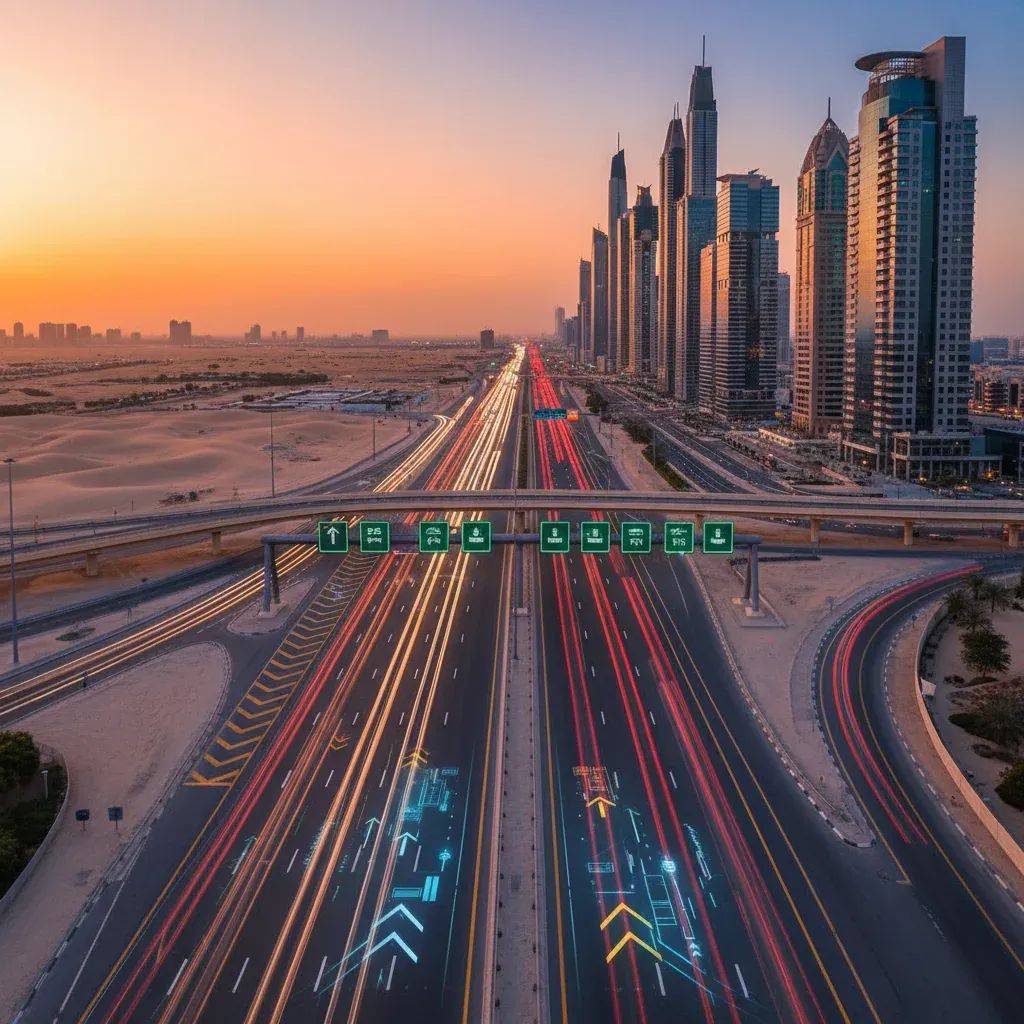
How Dubai's Transport Overhaul Will Actually Change Your Commute
In June 2026, the Roads and Transport Authority locked in a pair of agreements with Chinese technology firms that will reshape how the emirate manages everything from train schedules to traffic flow. These aren't just handshake deals—they represent the physical infrastructure that will underpin your daily movement across Dubai for the next several years and beyond.
Why This Matters
• AI testing hub arrives: A research lab linked to the Blue Line metro project will validate autonomous scheduling and predictive maintenance before they go live, accelerating the project timeline and reducing overseas testing costs.
• Traffic intelligence network: Huawei will build unified data systems that coordinate metro, bus, and emerging autonomous vehicle networks to support the 20-minute city vision—meaning essential services closer to home, fewer commutes.
• Timeline: What's coming when: The driverless transport zone launches in 2026, robotaxis hit streets in Q1 2026, and the Blue Line reaches completion by 2029, serving an estimated 320,000 daily passengers.
Why Chinese Expertise Matters for Dubai's Transport Problem
Spend an hour in Dubai traffic, and you understand the problem the RTA is trying to solve. The emirate's rapid expansion has outpaced its ability to predict congestion patterns, optimize train schedules, and respond to incidents before they cascade into citywide delays. China's approach isn't theoretical—it's been tested on systems that move 24 million people daily through Shanghai alone.
The RTA delegation, led by Director-General Mattar Al Tayer, traveled to China in late June 2026 to study how integrated command centers manage multiple transport modes simultaneously. What they observed in Shanghai's Municipal Transportation Commission was a single operation room where metro delays trigger automatic bus rerouting, which alerts taxi networks, which feeds back into traffic signal timing. That level of coordination doesn't happen by accident; it requires AI systems that can process millions of data points per second and make decisions faster than humans.
The gulf between Dubai's current system and that future state is precisely where these partnerships land.
What the CASCO SIGNAL Lab Actually Does (And Why It Matters)
The establishment of an R&D center in Dubai by CASCO SIGNAL LTD.—a firm specializing in metro signaling and control systems—solves a practical problem that most residents never think about. Currently, when the RTA tests new software for train dispatching or updates signaling protocols, they either conduct trials on live tracks during low-traffic hours or ship systems to foreign testing facilities. Both approaches are expensive and risky.
The new lab changes that equation. It will include a full-scale simulation environment that recreates actual operating conditions for the Blue Line—track geometry, switching systems, passenger loads, emergency scenarios, the whole picture. Engineers can run thousands of test scenarios without touching a single live train. They can crash-test new AI scheduling algorithms, see how the system responds to power failures, and validate that redundant communications systems actually work before passengers depend on them.
This matters because the Blue Line isn't a conventional metro line. It's being designed from the ground up as a fully driverless system. That means every decision about spacing between trains, dwell times at stations, and emergency response has to be encoded into software rather than entrusted to operator judgment. The lab provides the venue for getting that right.
Beyond the Blue Line itself, the facility becomes a testing ground for Dubai's broader metro ambitions. Future expansions—the Red Line extension, potential new corridors—can all be validated here before breaking ground. The RTA is effectively building a permanent innovation infrastructure rather than treating each project as a one-off challenge.
The Huawei Partnership: Connecting the Dots Across Transport Modes
If CASCO SIGNAL handles the mechanics of moving trains, Huawei's role is managing the bigger system—the entire ecosystem of how people move through Dubai. The agreement covers several interconnected areas that sound abstract but have very real implications.
Unified data platforms is the foundation. Right now, the metro system, the bus network, ride-hailing apps, and traffic management operate on separate systems. A resident trying to get from Al Jaddaf to Ibn Battuta Mall might use three different apps and three different mental calculations about timing. Huawei's platform integrates that data so apps can show you the fastest multimodal route: metro to here, bus to there, maybe a walk through a shaded pedestrian corridor. It's not revolutionary, but it's the minimum requirement for a functioning 20-minute city.
Real-time incident detection is the second layer. Computer vision systems fed by thousands of cameras across Dubai's roads, metro stations, and intersections will identify accidents, stalled vehicles, or suspicious activity within seconds. An AI decides: Is this a fender-bender that needs to be flagged? Is this a broken-down bus that requires rerouting? Should the police be dispatched? Instead of waiting for someone to call 999 and explain the situation, the system has already alerted traffic management, updated route guidance for affected areas, and coordinated emergency response.
The smart operations center coordinates all of this. Think of it as the nerve center where all transport signals converge into a single command interface. When the metro runs ahead of schedule, the system can delay a connecting bus. When a road accident blocks a commuter corridor, it can automatically prioritize bus lanes and alert autonomous shuttles to use alternate routes. This kind of orchestration requires both massive computing power and artificial intelligence trained to make millions of tiny decisions per day.
Digital redundancy ensures that if one data center fails, operations don't collapse. Dubai's transport network runs 24/7. A two-hour outage in the IT infrastructure could strand hundreds of thousands of people. Huawei's infrastructure design includes geographic distribution and automatic failover protocols so that even during a cyberattack or hardware failure, the system stays live.
How This Fits Into the Bigger Picture: Dubai 2040
These partnerships aren't random technology upgrades. They're building blocks of the Dubai 2040 Urban Master Plan, specifically the 20-minute city framework. That concept gets thrown around a lot, so here's what it actually means for someone living in Dubai:
Imagine your neighborhood has everything you need within a 20-minute radius—school, grocery, clinic, gym, restaurant. You don't need a car for daily errands; you walk or bike or take a bus that actually runs on a predictable schedule. That's the vision. But it only works if:
• Public transit is reliable: The metro and bus systems have to function with near-perfect timing. That's where the AI scheduling comes in.
• Routes are intuitive: The integrated data platform makes sure the fastest route is obvious and the travel times are accurate.
• Urban density is right: The RTA and urban planners are focusing development around five transit hubs: Deira and Bur Dubai, Downtown and Business Bay, Dubai Marina and JBR, Expo City, and Silicon Oasis. Each becomes a gravity well for services and employment.
The goal is for 55% of Dubai residents to live within 800 meters of a mass transit station by 2040. Compare that to today's sprawl where you might live 5 kilometers from the nearest useful public transport. That's a fundamental reshape of the city.
The Regional Competition Playing Out Right Now
Dubai isn't implementing this strategy in isolation. Across the Middle East, cities are racing to lock in Chinese technology partnerships before the landscape solidifies.
Saudi Arabia is spending over $500 million with Chinese firms, including a partnership between the Public Investment Fund and Dahua Technology to establish AIVisio, a joint venture for intelligent transportation systems. The NEOM megacity is being engineered as a fully autonomous ecosystem with underground transit and no traditional roads—designed by Chinese AI companies.
Qatar has partnered with XPENG, the Chinese electric vehicle maker, to introduce autonomous-capable EVs into the market. The country is also negotiating with Yutong Bus for next-generation public transit technology. Oman is installing 200 EV charging stations through a Chinese company, with plans for AI-powered mobility apps.
Egypt went further: its New Administrative Capital is being built from scratch as Africa's first smart city, with extensive Chinese involvement in everything from the light rail system to traffic management.
The pattern is clear: whichever cities establish these partnerships first will have first-mover advantage in deploying mature technology. Later adopters will face either higher costs or more limited vendor choices. For Dubai, the RTA's agreements are essentially securing access to proven technology that the company can refine and eventually export to other markets—creating a competitive moat.
What Residents Will Actually Experience
Breaking down the timeline for impact:
2026: The 15-square-kilometer driverless transport zone spanning Al Jaddaf Metro Station, Dubai Festival City, and Dubai Creek Harbour goes live. This means robotaxis, autonomous buses, and self-driving abras operate in a defined area, connected to the metro. If you live or work in this zone, you'll see autonomous vehicles as normal commute options, not novelties. Public robotaxi services from Baidu's Apollo Go begin in the first quarter, targeting 1,000 vehicles by 2028.
2026-2027: The CASCO SIGNAL lab becomes operational and proof-of-concept trials with Huawei systems ramp up. You might notice traffic signal timing improving subtly during peak hours. Bus route adjustments become more responsive to demand.
2028: Glydways, an autonomous electric vehicle network on dedicated guideways, goes into full service. Existing metro-to-metro connections now have a second option: driverless point-to-point travel on separate infrastructure. This is the moment the system starts becoming truly multimodal.
2029: The Blue Line metro project completes. This single metro extension will open up entire neighborhoods—Al Jaddaf, Dubai Creek Harbour, and areas south toward Jebel Ali—to efficient public transit. The line is expected to carry 320,000 passengers daily by 2040. The AI-powered scheduling deployed in the CASCO SIGNAL lab will keep trains spaced optimally and dwell times predictable.
2030: The broader AI Mobility (AIMobility) initiative using Vehicle-to-Everything (V2X) technology launches. This means your car, the traffic signal, the metro, and the bus network all communicate with each other in real time. Autonomous vehicles gain awareness of upcoming traffic patterns before they occur. Incidents are resolved faster because the system has already adapted.
For Expats and Investors, What This Means
If you work in Dubai or are considering relocating here, these partnerships signal something important: the emirate is investing heavily in infrastructure that will make daily life more efficient over the medium term. The commute problem—a frequent complaint—is getting concrete attention, not just rhetorical commitments.
For investors, the infrastructure spending represents sustained economic activity. The RTA's annual budget for projects like this is substantial, and it ripples through construction, technology services, and logistics sectors. The establishment of the CASCO SIGNAL lab also creates opportunities for tech talent to stay in Dubai rather than emigrating; there's now a permanent innovation center focused on metro technology.
The competitive positioning matters too. Dubai is positioning itself as the Gulf's testbed for Chinese smart mobility technology. As the technology matures and other cities want to deploy similar systems, Dubai-based expertise becomes exportable. This is how smaller economies create outsized economic leverage.
The Real Challenge Ahead
These partnerships solve the technical problem. They don't solve the behavioral problem. A 20-minute city only works if people actually shift from cars to transit. That requires not just functioning systems but also cultural acceptance of driverless technology, reliability over time, and equitable pricing so transit isn't just for the wealthy.
The RTA's AI Strategy 2030 includes 81 projects aimed at reducing travel times by 20-30% and boosting productivity by 25-40% through AI-driven tools. Those targets are ambitious but achievable if the Chinese partnerships deliver on schedule and the RTA executes the integration well. The fact that the RTA has run a Big Data Platform since 2017 supporting over 40 AI use cases suggests the organization has the institutional competence to absorb this new technology.
The Shanghai study tour in June 2026 gave the RTA a proving ground: they observed how a mature system operates at scale. Now they're importing not just the technology but the operational playbook for running it.


