
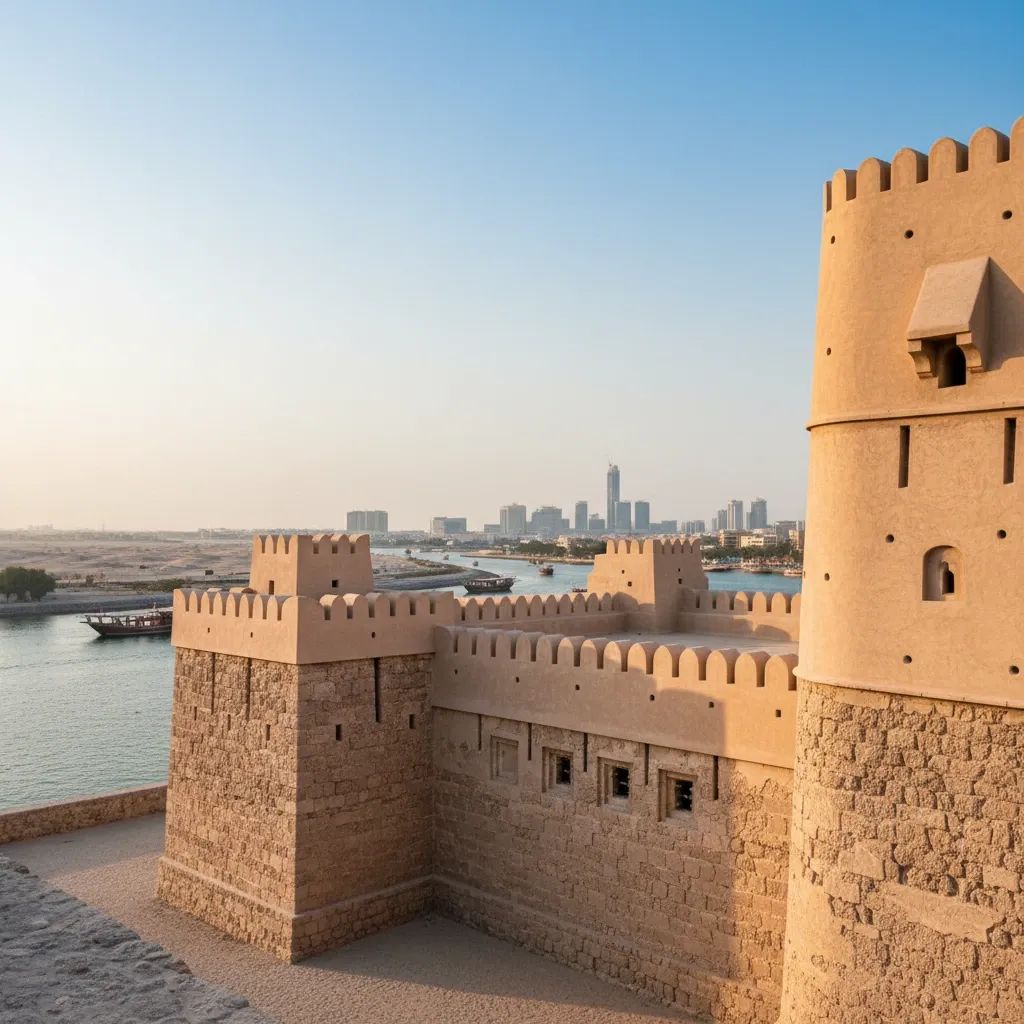
Dubai's oldest standing structure will reopen in early to mid-2026 after five years of closure, offering UAE residents their first chance to experience a fundamentally reimagined cultural institution. Al Fahidi Fort, built in 1787, has undergone comprehensive restoration that transforms it from a traditional museum into an interactive heritage experience with six themed galleries, 3D modeling, and soundscape installations. For residents seeking connection to Dubai's pre-oil past, this represents a rare opportunity to access authentic historical space rather than recreated environments.
Why This Matters for Residents
• Opening confirmed: Early to mid-2026 marks the return of a structure built in 1787, making it contemporaneous with early American independence and predating Dubai's oil discovery by nearly two centuries.
• Six-gallery experience: The museum's interior will distribute exhibits thematically rather than chronologically, letting visitors explore pearling, maritime trade, traditional domestic life, and governance structures through archival photographs, 3D modeling, and soundscape installations instead of static display cases.
• Neighborhood integration: Infrastructure improvements around Al Fahidi Historical Neighbourhood mean easier access to a functioning cultural district where visitors can walk from the museum into restored wind-tower houses, galleries, and cafes.
• Educational and research access: Residents researching family heritage can explore genealogical connections and trade records that document occupational histories. Schools will have access to educational programming about pre-oil Gulf society.
The Fortress Nobody Demolished
Most cities sweep away their oldest buildings to make room for new ones. Dubai didn't. When the Al Fahidi Fort rose from the banks of Dubai Creek in 1787, no one predicted it would still be standing. The structure was built from coral rock and marine mortar—a pragmatic choice for a coastal settlement where limestone and shells were abundant and transport infrastructure for other materials barely existed. The square footprint with towers at three corners reflected clear military intent: surveillance of approaching threats and defensible positions from which to mount resistance.
What kept the fort alive across centuries wasn't sentiment. It survived because it proved useful. The structure housed ruling families, served as an administrative center, functioned as a weapons storage facility, and occasionally confined prisoners. This functional multiplicity meant the fort remained integral to governance even as Dubai transformed around it. When the United Arab Emirates formally declared independence in 1971, the fort transitioned into the newly established Dubai Museum—a symbolic gesture anchoring the young nation's institutional identity to its pre-modern past.
That continuity mattered. Most of Dubai's physical landmarks date from after 1970. The fort offered something irreplaceable: unbroken connection to a specific place across multiple centuries. The walls themselves contained Dubai's compressed history.
What the Museum Was, and Why It Needed Changing
From 1971 until its closure in early 2021, Al Fahidi Fort operated as Dubai Museum, drawing millions of visitors seeking to understand how the city evolved from a trading settlement to a global financial hub. The museum's strongest asset was narrative accessibility. Reconstructed dioramas showed traditional wind-tower houses with their distinctive ventilation systems—architectural solutions to extreme heat that predate modern air conditioning by centuries. Display cases featured the diving weights, respiratory tubes, and oyster knives that defined the pearling industry, an occupation that generated wealth for merchant families but demanded extraordinary physical endurance from divers.
These exhibits accomplished their educational purpose, but by 2015 they felt increasingly dated. The dioramas, while historically accurate, used static figures and painted backdrops. Display information came from laminated cards. No digital context linked family genealogies to displayed artifacts. No audio reconstructed the soundscape of a 19th-century souq or the ambient noise of a pearling settlement. Visitors moved through the museum as they might through a historical warehouse—acknowledging the objects' significance without genuine emotional or sensory connection.
Crown Prince Sheikh Hamdan bin Mohammed bin Rashid Al Maktoum recognized this limitation. Heritage preservation, in his conception, required more than protecting physical structures. It demanded continuously evolving interpretive strategies that made history emotionally resonant for contemporary audiences. When he authorized the comprehensive restoration project in January 2021, the mandate encompassed both structural rehabilitation and complete conceptual redesign of how the fort's stories would be conveyed.
Five Years of Structural Reckoning
The restoration process revealed maintenance challenges accumulated across decades of climate exposure. Coral-stone buildings experience specific degradation patterns. Salt spray from nearby water corrodes mortar joints. Thermal expansion and contraction from extreme daily temperature swings—often exceeding 30 degrees Celsius between dawn and afternoon—creates stress on structural components. Humidity fluctuation accelerates deterioration of traditional lime-based mortar, which remains the structurally appropriate binding agent despite its maintenance demands.
The Dubai Culture and Arts Authority, under the leadership of Sheikha Latifa bint Mohammed bin Rashid Al Maktoum, commissioned detailed structural assessments using technologies unavailable during previous maintenance cycles. Laser scanning generated millimeter-precision maps of wall surfaces, identifying areas where mortar had weakened or stone had settled. Vibration monitoring sensors tracked microscopic movements in the structure caused by wind, traffic, and thermal stress—data that helped predict where failure might occur before it happened. Environmental data logging continuously recorded humidity and temperature fluctuations inside the fort, allowing restoration teams to understand how interior climate conditions affected material stability.
This information transformed restoration from reactive repair into proactive prevention. Rather than waiting for visible damage to necessitate intervention, teams could identify vulnerable areas and address them before structural integrity was compromised. The approach mirrors contemporary practice in regional heritage preservation. Saudi Arabia's restoration efforts at historic forts employ similar vibration analysis and seismic retrofit strategies. The Great Mosque of Samarra in Iraq utilized laser scanning to document damage patterns before reconstruction began. This technological sophistication represents a marked departure from traditional conservation, where specialists worked from visual inspection and accumulated experience.
The Museum That Emerged
When Al Fahidi Fort reopens, visitors will encounter six distinct gallery spaces organized thematically rather than chronologically. This structural choice matters. Instead of walking through a predetermined historical narrative—"settlement, then pearling, then oil, then modernization"—visitors can construct their own interpretive pathways. Someone interested in maritime trade routes might prioritize galleries addressing commercial networks. Someone researching family heritage might spend extended time with genealogical materials and trade records connecting individuals to specific occupations and geographic origins.
The galleries will incorporate archival photographs, many published publicly for the first time. These images document Dubai's transformation from the 1950s onward, capturing the transition period when oil wealth was beginning to reshape the physical landscape but traditional architecture and commercial patterns still dominated. Early aerial photographs show Dubai Creek lined with wooden dhows—traditional sailing vessels still used for regional trade in the 1960s—before the creek's function shifted toward recreational boating and tourism.
Digital installations will demonstrate structural and functional evolution. Three-dimensional models will allow visitors to see how the fort's interior layout changed across different historical periods. A gallery section might display the same physical space rendered in multiple configurations—fortress defensive layout, then royal residence arrangement, then administrative center organization, then museum configuration. This helps visitors understand how buildings adapt to changing purposes while maintaining physical integrity.
Audiovisual presentations will recreate sensory dimensions that static displays cannot convey. A gallery focused on the pearling industry might include recordings approximating the ambient soundscape of a diving settlement: the creaking of wooden boats, voices of merchants negotiating prices, the call to prayer from the nearby mosque, water lapping against the shore. These reconstructed soundscapes, developed from ethnographic recordings and historical documentation, provide emotional texture to historical understanding.
Interactive digital displays will allow visitors to explore trade records, genealogical connections, and archival documents that connect the fort's institutional history to specific family narratives still alive in the community. Someone whose ancestors worked in the pearling industry might locate their family name in trading records and understand their relationship to this specific place and time.
How This Fits Into Broader Heritage Strategy
The fort doesn't exist in isolation within Dubai's cultural preservation agenda. The reopening represents one element of a much larger initiative directed by Sheikh Hamdan. In 2022, he approved a second restoration phase encompassing 35 additional historic buildings and districts, most dating from the 1960s through 1990s. This decision reflects a deliberate choice to preserve not just Dubai's distant past but the architectural fabric of the oil-boom era itself—the period when traditional construction methods were being displaced by modernist designs.
Simultaneously, Sheikh Hamdan launched the "Erth Dubai" initiative, a community documentation project collecting oral histories, personal narratives, and lived experiences from residents, long-term expatriates, and migrant workers. This program operates from the principle that heritage encompasses not only physical structures but the subjective experiences of people living through transformation. An accompanying "Erth Dubai Award" recognizes excellence in cultural preservation work, professionalizing heritage conservation as a discipline rather than treating it as nostalgic hobby work.
This institutional framework signals that heritage preservation in the United Arab Emirates is treated as infrastructure for collective memory, not peripheral cultural activity. The investment in Al Fahidi Fort reflects the same logic as investment in water systems or road networks—it's understood as essential to how communities maintain coherence and identity across rapid change.
The Historical Neighborhood as Active Cultural Space
The fort's immediate surroundings matter enormously to its cultural function. The Al Fahidi Historical Neighbourhood, formerly called Al Bastakiya, comprises dozens of traditional Arabian houses with distinctive wind-tower architecture. These buildings underwent meticulous restoration during the same period as the fort, with work completed several years prior to the fort's current rehabilitation phase. The restoration preserved authentic materials and construction methods while updating structural integrity and basic utilities.
Rather than becoming a frozen historical museum, the neighbourhood has evolved into a functioning cultural district. Independent art galleries occupy restored buildings. Small museums dedicated to specific themes—maritime history, textile traditions, calligraphy—operate from wind-tower houses. Contemporary cafes and restaurants occupy ground-floor spaces. Artists maintain studios in upper rooms. This adaptive reuse has transformed heritage preservation from something done to a place into something that continuously happens within it.
When visitors exit Al Fahidi Fort, they can walk directly into this integrated historical environment. The experience gains coherence. The museum's narrative about traditional domestic architecture becomes tangible when stepping into restored houses with authentic wind towers. The explanation of merchant trade becomes concrete when passing shops operated by contemporary artisans. This model—heritage preservation that encompasses both individual monuments and their surrounding urban contexts—has become standard practice in successful regional projects.
Comparative Methods Across the Gulf
The Al Fahidi Fort restoration strategy shares elements with other significant Middle Eastern heritage projects while maintaining distinct emphases. Across the region, preservation efforts increasingly blend advanced technology with commitment to authentic materials and construction methods.
Saudi Arabia's historical fort restorations employ vibration analysis and seismic retrofitting while prioritizing traditional adobe reinforcement and preservation of intricate stonework. The approach acknowledges that heritage structures require contemporary engineering solutions alongside historical authenticity. Bahrain Fort's restoration utilized on-site materials like gypsum and coral stone alongside modern structural assessment, recognizing that material continuity itself carries historical value.
What distinguishes Al Fahidi Fort's approach is its emphasis on continuous environmental monitoring rather than singular restoration events. By maintaining real-time data on humidity, temperature fluctuations, and structural micro-movements, restoration teams can identify threats before they become damage. This proactive model represents contemporary best practice in heritage conservation globally, not merely in the Gulf region.
The integration of audiovisual installations, 3D modeling, and interactive digital displays also stands out. While many regional projects use laser scanning for documentation, fewer have as thoroughly conceived how cutting-edge storytelling technology can coexist with historical fabric without overshadowing it. The fort's thick coral walls and traditional wind towers remain the focal point; digital installations function as interpretive infrastructure supporting engagement rather than theatrical spectacle.
What Reopening Means for Residents
For United Arab Emirates residents, particularly Emiratis and long-term expatriates, the fort's return carries psychological and cultural significance beyond typical museum reopenings. Dubai's physical landscape transforms continuously. Most landmarks date from the current resident's lifetime. Most buildings will likely not survive the next 30 years unchanged. The fort offers something increasingly rare: unbroken connection to a specific place across centuries.
Walking through Al Fahidi Fort, residents encounter tangible evidence that Dubai had a coherent identity before oil, real estate speculation, or tourism became dominant economic forces. The structure itself embodies resilience—it was built to endure heat, salt spray, and political uncertainty. That resilience predates the city's current incarnation. For residents navigating rapid change, the fort functions as proof of continuity beneath transformation.
The reopened museum also serves practical cultural functions. Schools can use it for educational programming about pre-oil Gulf society. Researchers can access archival materials and trade records. Residents researching family heritage can explore genealogical connections and occupational histories. The digitized materials and interactive displays make historical information accessible rather than confined to academic specialists.
The project also demonstrates how Dubai understands its relationship to heritage. Rather than dismissing old structures as obstacles to development, the emirate is investing substantially in making them accessible and engaging. This has implications for how residents conceptualize their city—not as a place that erases history but as one that maintains connection to multiple temporal layers simultaneously.
The Reopening Timeline and What to Expect
Al Fahidi Fort will reopen in the first half of 2026, likely February through June based on current restoration timelines. Sheikha Latifa bint Mohammed bin Rashid Al Maktoum recently confirmed during site inspections that gallery installation was in final phases and the building's structural condition had stabilized.
For UAE residents planning a visit:
• Infrastructure improvements around the fort will include enhanced traffic management and expanded public spaces within the surrounding Al Fahidi Historical Neighbourhood, making access easier than during previous decades of operation.
• Practical facilities: Residents can expect improved parking access and enhanced pedestrian pathways connecting the fort to surrounding galleries and cafes.
• Admission and hours: While official pricing and operating hours have not yet been announced, they will likely follow the fee structure of other Dubai Culture and Arts Authority institutions. Educational discounts for school groups should be anticipated given the fort's educational focus.
• Advance planning: Residents interested in visiting during opening weeks may want to monitor Dubai Culture and Arts Authority announcements for potential soft opening periods or resident preview opportunities before full public launch.
• Family visits: The interactive gallery design with multiple thematic pathways makes the experience accessible for both children and adults, with particular appeal for families researching generational history.
The Fort as Temporal Bridge
In a city that reinvents its skyline annually and measures its history in decades, Al Fahidi Fort occupies unique cultural space. It is not a recreation of historical atmosphere. It is the actual physical location where governance occurred, where families lived, where weapons were stored, where economic decisions were made. The walls themselves have witnessed nearly 240 years of continuous presence in the same location.
That continuity matters in ways that pristine new constructions cannot replicate. The fort's weathering, its visible repairs, its adaptation to changing purposes—these are not defects but evidence. They testify to survival across transformative historical periods. When residents stand within its walls in 2026, they occupy the same physical space as merchants conducting trade in 1850, as administrators governing the emirate in 1920, as museum visitors in 1985. That temporal layering—the ability to access multiple historical moments simultaneously within a single location—is something most contemporary cities have systematically destroyed through renovation and replacement.
The reopened museum's conceptual framework acknowledges this. Rather than treating historical authenticity and contemporary storytelling as contradictory goals, the project integrates both. The fort remains itself—coral walls, traditional geometry, accumulated weathering—while simultaneously serving as a sophisticated communication platform for understanding the transformation it has witnessed. When Al Fahidi Fort reopens in 2026, it will offer something increasingly precious: the chance to stand in a place that connects past and present not through digital recreation but through uninterrupted physical presence.


