
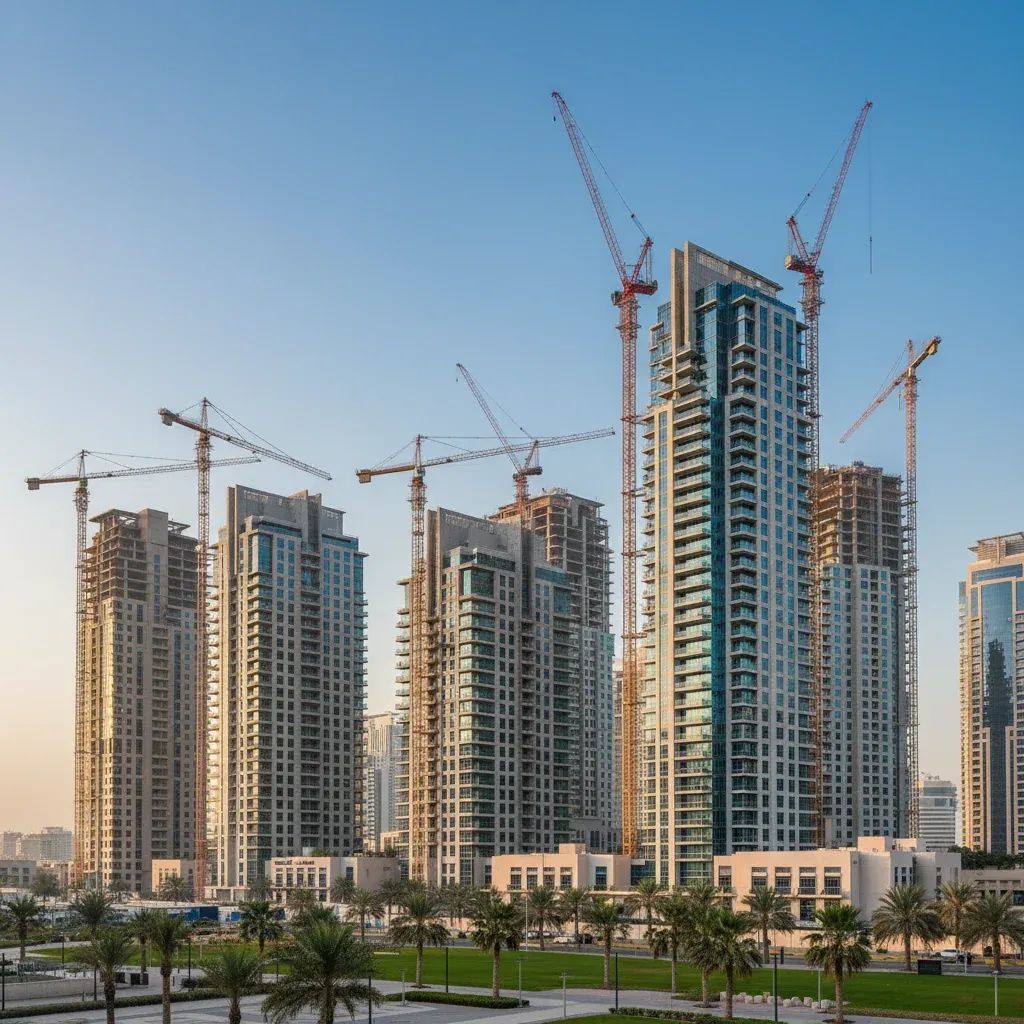
Dubai's Real Estate Engine Downshifts—But the Mechanics Still Work
The United Arab Emirates real estate sector is undergoing a significant recalibration. Mohamed Alabbar, the founder of Emaar Properties, has publicly acknowledged what market data confirms: property values are holding steady, but the explosive growth that defined 2025 is giving way to a more measured trajectory. This isn't alarm—it's arithmetic. After a year when residential prices surged nearly 20%, the sector faces a testing question: can it sustain demand when annual gains slow to single digits?
Why This Matters
• Payment Collection Reality: Emaar's cash recovery from buyers has slipped from 100% to approximately 85%—a metric that quietly reveals buyer hesitation even among strong-performing developments. For a company processing tens of billions in annual transactions, that 15% gap signals caution without crisis.
• Supply Wave Magnitude: Over 110,500 residential units are expected to reach completion in Dubai in 2026, roughly four times the 10-year average. This isn't a trickle; it's a deluge that will test whether underlying demand is as robust as executives claim.
• Tourism's Mixed Signals: Dubai Mall foot traffic has declined to 180,000 daily visitors from a pre-crisis peak of 250,000, yet transaction volumes remained substantial through early March. The divergence between sentiment and actual deals suggests investors and residents are separating market noise from genuine opportunity.
The Cash Flow Conversation Nobody Wants to Have
Emaar Properties reported operating cash flow of AED 33.46 billion for the 12 months ending September 2025, a 36.67% increase year-over-year. Projections for 2026 free cash flow stand at approximately AED 29.6 billion—solid, but noticeably lower than 2025's AED 34.16 billion. This isn't a red flag in isolation; it reflects both the law of large numbers and genuine market dynamics.
Alabbar's acknowledgment that collection rates have fallen to 85% deserves scrutiny. Off-plan properties—which drive transaction volumes in Dubai—follow standardized payment schedules: typically 5-10% at booking, 40-75% during construction, and the remainder upon handover or within an extended post-completion window. When a developer like The Oasis schedules a 10% installment milestone tied to 20% construction completion, the timing becomes critical if buyers are postponing payment decisions.
The real estate Dubai Financial Market Real Estate Index plunged approximately 30% between late February and early March 2026, triggering investor panic about geopolitical spillover. Yet recorded property transactions from March 2-9 showed 3,570 deals worth AED 11.93 billion—demonstrating that actual buyers and sellers are distinguishing between equity market volatility and fundamentals. This nuance matters. Established developers with deep balance sheets can absorb temporary collection delays; weaker entities cannot.
Villas Keep Performing; Apartments Face Headwinds
Property price segmentation is becoming the defining characteristic of Dubai's residential market in 2026. Overall residential appreciation is forecast at approximately 10%—a deceleration from 2025's 19.8%, but hardly catastrophic. However, aggregates mask critical disparities.
Villas and low-density communities are projected to appreciate 17.7%, driven by constrained supply and families seeking space. The lifestyle demand for standalone properties in communities like Arabian Ranches and Jumeirah Islands remains robust despite broader market caution. Conversely, apartment valuations are expected to rise just 7.4% as developers flood the market with multi-unit towers. Waterfront and branded residences—particularly on Palm Jumeirah and Bluewaters Island—occupy a middle ground, with 6-10% anticipated appreciation buoyed by scarcity and international buyer interest.
This segmentation reflects a fundamental market maturation. No longer is a rising tide lifting all boats. Instead, location, property type, and builder credibility increasingly determine outcomes. A standardized apartment in a high-supply micromarket faces structural headwinds that a prime villa in a prestige enclave simply does not encounter.
What This Means for Residents and Investors
For United Arab Emirates expats and nationals navigating purchase decisions, the environment demands clarity on personal priorities.
Renters may finally exhale. After two years of double-digit annual rental increases—among the highest globally—Dubai's rental market is moderating. Yields remain elevated by international standards (averaging 7% for apartments, 5% for villas as of late 2025), but the days of 15-20% annual rent spikes appear over. Landlord competition from new completions is intensifying, particularly in high-supply pockets. A 2-bedroom apartment that rented for AED 120,000 annually 18 months ago may now command AED 135,000—growth, yes, but deceleration from the prior trajectory.
Prospective buyers face a more layered calculus. Off-plan properties remain the entry vehicle of choice, offering flexible payment schedules and lower per-square-foot pricing than completed inventory. Yet the supply pipeline introduces timing risk. Purchase an apartment in a project delivering in late 2026 or 2027, and market saturation could compress values at handover. Conversely, wait for absolute confirmation of correction, and entry prices may remain firm as sellers maintain psychology of recent gains.
The data suggests buyer behavior has fundamentally shifted toward analytical decision-making. Investors and owner-occupiers alike now prioritize delivery track records, rental demand characteristics in specific submarkets, build quality certifications, and long-term value retention over speculative appreciation. This favors established developers like Emaar, Sobha Realty, and Majid Al Futtaim, whose brand equity and proven execution command premiums of 15-25% over emerging competitors.
Commercial office space presents a contrasting narrative. Grade A office capital values and rents are forecast to rise approximately 15% in 2026, driven by corporate expansion and persistent undersupply in prime locations. This asymmetry—apartments moderating while office space appreciates—highlights the uneven nature of Dubai's property cycle. Companies are investing; consumers are pausing.
How Tourism Shapes the Property Equation
Dubai welcomed 19.59 million international overnight visitors in 2025, achieving a third consecutive record year and rebounding robustly from the crisis that depressed 2024 figures. January 2026 extended momentum with 2 million arrivals, representing 3% year-over-year growth. This backdrop is critical for understanding property market fundamentals.
Tourism's contribution to Dubai's economy extends beyond hotel occupancy rates. Visitor spending cascades into retail, hospitality real estate, and branded residence segments. Dubai Mall—a barometer of discretionary spending—historically drew 250,000 visitors daily and 200,000 during Ramadan. Current figures hover around 180,000 daily, a 28% decline that Alabbar characterizes as temporary rather than structural.
The March 2026 dip in mall traffic coincides with heightened regional geopolitical tensions, prompting some high-net-worth visitors to exit the emirate temporarily. Official government statements as of March 5 insisted malls, hotels, and construction sites operate normally, yet anecdotal reports suggested discretionary visits were postponed. This volatility is unlikely to persist—historically, Dubai recovers swiftly from external shocks through messaging, security reassurance, and event scheduling.
A significant near-term catalyst is the Unified GCC Tourist Visa pilot program, scheduled for late 2026. Often referred to as the "Gulf Schengen," this initiative will permit simplified multi-country travel across Saudi Arabia, United Arab Emirates, and other Gulf partners, potentially unlocking cross-border tourism worth billions. Properties marketed toward short-term rentals and hotel residences could benefit disproportionately.
The Developer Playbook Diverges
Emaar Properties is doubling down on its master-planned community strategy, banking that scale, integrated amenities, and brand prestige will sustain demand even as competition intensifies. Its AED 155 billion revenue backlog provides visibility into 2027 and beyond. Alabbar's public stance—dismissing fears of a 15% price correction as "very unrealistic"—reflects genuine confidence in off-plan sales momentum and the company's capacity to absorb short-term collection delays.
Other major players are employing distinct strategies. Aldar Properties dominates Abu Dhabi's market, where supply constraints and projected 16% capital value growth are more favorable than Dubai. Sobha Realty and Majid Al Futtaim are explicitly targeting end-users and long-term residents through emphasis on build quality, green space, and community livability—a positioning that aligns with the observed shift away from speculation. Mira Developments and Dar Global are forging luxury brand partnerships, creating scarcity-driven branded residences that appeal to international investors seeking globally recognized products. Emerging players like Imtiaz Developments are pursuing competitive pricing and smart layouts to capture mid-market segments with yield-focused mentality.
This fragmentation reflects market maturation. Where oversupply historically meant uniform pressure across all segments, 2026 reveals that developer differentiation, buyer psychographics, and property characteristics now drive disparate outcomes.
Economic Foundations: Long-term Resilience Remains Intact
Alabbar's assertion that the United Arab Emirates possesses economic infrastructure designed for long-term stability finds support in official projections. GDP growth of approximately 5% is forecast for 2026, with non-oil sectors—including real estate, tourism, financial services, and trade—as primary drivers. Population growth continues organically, supplemented by the Golden Visa initiative, which attracts high-net-worth individuals and skilled professionals.
The discrepancy between equity market sentiment (reflected in the 30% drop of the Dubai Financial Market Real Estate Index in early March) and underlying real estate activity (AED 11.93 billion in deals over one week) underscores investor distinction between financial market volatility and property fundamentals. This separation, while unsettling short-term, historically signals healthy contrarian opportunity for long-horizon investors.
The UAE's track record navigating previous disruptions—from the 2008 financial crisis to the 2020 pandemic—demonstrates institutional capacity to absorb shocks through strategic investment, regulatory reform, and leveraging geographic positioning. Current geopolitical tensions, while relevant to near-term sentiment, do not appear to alter structural drivers of Dubai's appeal: security, rule of law, cosmopolitan infrastructure, and tax efficiency.
The Supply Question: How Much Is Too Much?
The anticipated delivery of over 110,500 residential units in Dubai during 2026 represents the market's central tension. This figure is approximately four times the historical 10-year average of 27,000 annual completions. Even accounting for historical delays and construction deferrals—which often reduce actual handovers by 20-30%—the influx will be substantial.
Whether this constitutes oversupply depends on absorption dynamics. Dubai's population continues growing, driven by expatriate inflows and natural increase. Rental yields remain globally attractive at 7% for apartments. Foreign investment via Golden Visa and other initiatives sustains international buyer participation. If these demand drivers persist, absorbed supply could support gradual price moderation rather than sharp correction.
Conversely, if geopolitical tensions prolong investor caution or if foreign residential investment disappoints, unit inventory could accumulate, compressing valuations. A UBS analysis highlighted that a hypothetical 10% price decline coupled with flat construction costs could compress Emaar's development margins from 44% to 38%—meaningful but not existential for a company with AED 155 billion in backlog and fortress balance sheet.
Regulatory Evolution and Market Maturity
The United Arab Emirates regulatory environment governing real estate has evolved considerably since the 2008 crisis. Reforms implemented through the Real Estate Regulatory Agency (RERA) and Dubai Land Department (DLD) have introduced transparency, dispute resolution mechanisms, and developer accountability that stabilize market function. Off-plan purchase protections, escrow arrangements, and completion guarantee schemes reduce counterparty risk.
This institutional backdrop supports Alabbar's thesis that the market has structural resilience. A developer facing collection delays can navigate them through accumulated reserves; a buyer can escalate disputes through established legal channels; an investor can access transparent data on project pipelines and transaction volumes. These mechanisms, absent in earlier cycles, reduce crisis severity.
The Real Estate Market's Next Chapter
Dubai's property cycle in 2026 is testing whether the market can transition from explosive appreciation to sustainable, moderate growth without experiencing painful correction. Early signals are mixed but not alarming.
Residential price growth decelerating from 20% to 10% represents normalization, not collapse. Villas outperforming apartments reflects rational supply-demand dynamics. Collection rates slipping to 85% indicates buyer caution, not systemic stress. Tourism experiencing temporary dip due to geopolitical tension is precedented and reversible.
For residents and investors, the prescription is differentiated. Those seeking rental yield should favor apartments in high-demand submarkets where supply expansion translates to occupancy competition rather than vacancy. Buyers prioritizing long-term capital appreciation should examine villas in established communities or waterfront branded residences, where scarcity provides structural support. Speculators hoping to replicate 2025's 20% gains should reset expectations downward—the era of frothy appreciation is likely concluding.
Emaar and peer developers will face margin compression as buyer leverage increases and competition intensifies. Yet the sector's fundamentals—population growth, economic diversification, geopolitical stability, and institutional infrastructure—suggest the market is entering a mature phase rather than a declining one.
The question haunting Dubai's real estate conversation in March 2026 is not whether the market will survive, but whether participants can accept slower appreciation and shifting risk-return profiles. History suggests they will adapt. The infrastructure, capital, and strategic positioning that made Dubai real estate attractive for three decades remain intact. The story continues—just at a different pace.


