
Why This Matters
• AFC Champions League Elite qualification secured: Victory guarantees Al Ain's spot in continental competition's top tier, unlocking revenue streams worth tens of millions of dirhams
• Unbeaten Pro League campaign preserved: Al Ain's historic "Golden Season" with 68 points remains unmatched in ADNOC Pro League history—the first team ever to go undefeated through 24 opening matches
• Domestic monopoly extends: Combined trophy haul now reaches 15 league titles and 8 President's Cups, cementing generational dominance across UAE football
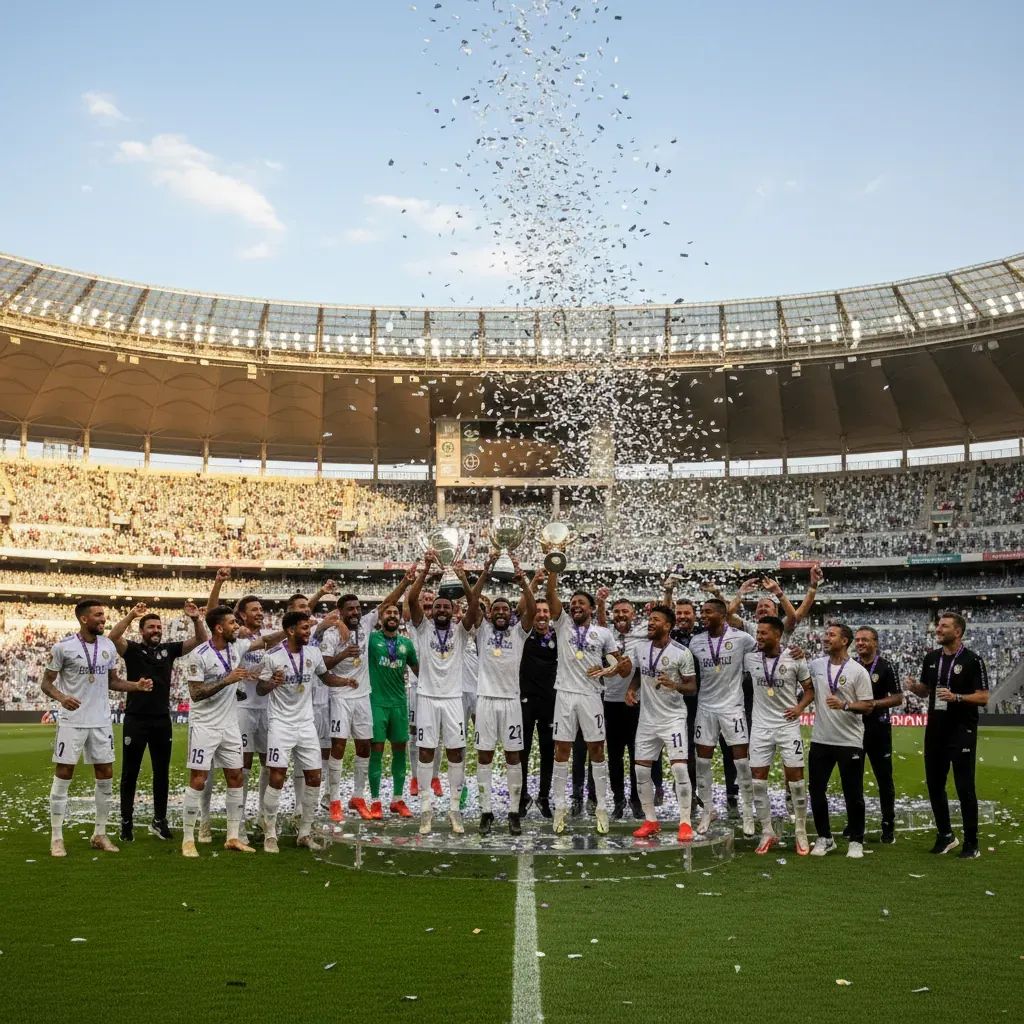
Al Ain Football Club wrapped up the 2025-2026 season emphatically, dismantling Al Jazira with a commanding 4-1 victory in the President's Cup final at Mohamed bin Zayed Stadium on Friday. The emphatic scoreline represents far more than a single night's sporting drama—it confirms a complete organizational overhaul that has positioned the United Arab Emirates' club system's dominant force for years to come.
The result marks Al Ain's eighth President's Cup triumph, extending an already formidable trophy cabinet that now includes their 15th league crown. For residents tracking the capital's football ecosystem, this double achievement signals the widening gap between elite institutions and the mid-table clubs scrambling beneath them. The continental qualification earned through both domestic honors—specifically, the AFC Champions League Elite group stage berth—carries profound financial implications for Abu Dhabi's sporting infrastructure.
The Match Narrative: Setback, Acceleration, Collapse
Al Jazira surprised Mohamed bin Zayed with an early breakthrough in the 11th minute. Nabil Fekir, the French midfielder operating in a creative role, executed an expertly placed free kick from distance that curled beyond reach and landed in the corner. The goal appeared to shift momentum decisively toward the underdogs, suggesting the favorites might stumble under pressure.
Al Ain's response unfolded with striking efficiency. Soufiane Rahimi, the 29-year-old Moroccan striker who accumulated 9 goals across 15 Pro League appearances this season, leveled matters in the 15th minute through positioning that revealed tactical awareness. His movement into space, combined with clinical finishing technique refined across thousands of training repetitions, restored equilibrium. Rather than settle for parity, Al Ain accelerated their tempo considerably.
Five minutes later—in the 20th minute—Rahimi struck again, this time with a ferocious effort that demonstrated the ruthlessness expected of elite center forwards. The two goals transformed a potential crisis into commanding advantage. Al Jazira's defense, tested repeatedly through the opening 20 minutes, began showing signs of disarray as Al Ain's midfield seized territorial control.
The psychological momentum shifted irrevocably before halftime when Abdul Karim Traore converted smoothly in the 44th minute, extending the advantage to three. Al Jazira, now trailing by two goals with just moments remaining before the interval, faced a daunting second 45 minutes with morale fractured.
Al Jazira probed for openings after the restart, testing Al Ain's defensive organization that had survived an entire Pro League season without defeat. The resistance held firm. In stoppage time, substitute Erik Jorgens delivered the final blow in the 94th minute, sealing the scoreline at 4-1 and igniting celebrations among the traveling support.
Digesting an Unprecedented League Accomplishment
What distinguishes this season from previous Al Ain triumphs is the extraordinary consistency displayed. Their unbeaten Pro League campaign—a "Golden Season" in Gulf football terminology—produced 68 points, equaling the competition record. More significantly, Al Ain became the inaugural team in ADNOC Pro League history to remain unbeaten across 24 consecutive opening matches, a benchmark that speaks to defensive solidity, attacking productivity, and mental resilience across competitors spanning multiple tactical philosophies.
This historical achievement emerged alongside simultaneous competition in the President's Cup knockout format, where opposing teams faced elimination pressure that Al Ain managed without disruption. The organizational capacity to sustain excellence across multiple fronts simultaneously reflects institutional maturity—coaching depth, squad rotation management, medical infrastructure, and player development frameworks that competitors lack.
The 15 league titles now held by Al Ain dwarf rivals' collections. Shabab Al Ahli maintains five championships, while Al Wasl secured one in the previous campaign. The gap represents not temporary fluctuation but structural separation rooted in financial investment, youth academy sophistication, and management continuity. Over recent seasons, top-flight champions have increasingly captured domestic doubles, suggesting that financial resources and organizational quality concentrate sufficiently to allow elite teams winning both league and cup competitions simultaneously.
Abu Dhabi Derby: A Rivalry's Historical Context
The contest between Al Jazira and Al Ain operates as the Abu Dhabi Derby, Gulf football's most geographically proximate rivalry. Across 56 competitive meetings spanning multiple competitions, the record tells a story of fierce equilibrium interrupted by periods of individual dominance. Al Jazira has accumulated 21 victories while Al Ain counters with 12 wins, with remaining encounters distributed among draws and split results.
Within the ADNOC Pro League specifically—the competition's most prestigious format—Al Jazira edges ahead with 13 wins from 32 encounters compared to Al Ain's 12, while 7 matches finished level. This razor-thin margin reflects the intensity and unpredictability that characterizes these meetings.
Statistically, the rivalry produces consistent offensive fireworks. Across their previous 30 meetings, both clubs combined for 100 goals—an average exceeding 3.3 per match. High-scoring outcomes represent the norm rather than exception: over 1.5 goals occurred in 90% of these fixtures, while 70% exceeded 2.5 total. Both teams registering goals happened in 77% of encounters, eliminating defensive security and creating narrative unpredictability that keeps supporters engaged.
Ali Mabkhout stands as the rivalry's all-time leading scorer with 25 goals across Abu Dhabi derbies, a remarkable benchmark demonstrating individual brilliance within these fixtures. More recently, Kodjo Laba contributed 13 of Al Ain's final 20 derby goals, suggesting that elite strikers thrive within this competition's attacking structure. The rivalry's intensity stems from geographic proximity—both clubs operate within Abu Dhabi emirate—combined with distinct supporter demographics and organizational philosophies that generate genuine animosity beyond purely sporting competition.
Rahimi's Seasonal Impact: Consistency When Matches Demand It
Soufiane Rahimi's performance trajectory throughout 2025-2026 warrants specific examination. Across 19 appearances in all competitions, the forward registered 9 goals while averaging 86 minutes per match. Within the Pro League specifically, his 9 goals from 15 appearances—achieved through 54 total shots with 42.59% accuracy—demonstrates both volume and efficiency in finishing.
His statistical profile maintains consistency with seasons past. A FotMob rating averaging above 8.0 suggests performances that exceeded defensive opposition regularly. The timing of his contributions—two crucial conversions in the President's Cup final—exemplifies the clutch finishing demanded of center forwards competing at elite levels. His positioning in the 15th and 20th minutes, combined with clinical execution, transformed the narrative from potential Al Ain crisis to domination.
Rahimi embodies the modern elite forward: statistically productive, tactically disciplined, and psychologically equipped to perform when stakes elevate. His consistency represents a core reason Al Ain sustained excellence across both domestic competitions despite fatigue factors that typically diminish form across extended campaigns.
Continental Qualification and Forward Trajectory
Al Ain's domestic achievements generate consequences extending far beyond annual celebration cycles. The club's AFC Champions League Elite group stage qualification—earned through Pro League dominance and President's Cup victory—positions them among West Asia's elite continental competitors entering the 2026-2027 cycle. The group stage format guarantees multiple fixtures against Asia's strongest clubs while unlocking broadcasting revenue and commercial sponsorship opportunities.
Previous AFC Champions League success, captured during earlier seasons, established institutional knowledge and competitive credibility. The current squad composition combines this continental experience with domestic momentum, creating conditions for sustained international competition beyond traditional Middle Eastern boundaries.
For United Arab Emirates football development broadly, Al Ain's consistent dominance raises questions about competitive balance within professional structures. The concentration of resources and organizational capacity at elite clubs creates growing separation from mid-table competitors, a pattern observed across developed football leagues globally. Whether this represents inevitable market stratification or an impediment to overall sporting competitiveness remains subject to debate among observers prioritizing different strategic objectives.
The Technology Experiment: Forward-Thinking Innovation
Mohamed bin Zayed Stadium featured technological implementations typically reserved for international tournament contexts. Officials deployed specialized cameras attached to the fourth official, enabling enhanced decision-making precision through camera angles traditionally unavailable during match administration. Additionally, electronic substitution systems aimed to reduce time-wasting protocols and streamline administrative functions.
These technologies functioned without significant incident during the final, suggesting successful integration into competitive protocol. For residents following the competition, this technical infrastructure represents the UAE Football Association's ambition to position domestic championships at the forefront of Asian football innovation. The deployment at elite fixtures allows real-world testing before potential FIFA adoption, positioning Abu Dhabi's stadium venues as laboratories for sports technology advancement.
Such infrastructure investments signal strategic intent: establish the Emirates as a center for football modernization while attracting international attention and potential sponsorship relationships. Whether implemented innovations eventually influence tournament protocols remains speculative, but the willingness to experiment distinguishes progressive sporting administrations from traditional competitors.
Season's Closure and Organizational Reflection
The final whistle marked completion of domestic competition for 2025-2026, yet simultaneously activated preparation for continental ambition. For residents across the United Arab Emirates invested in local football development, this season will endure as memorable for its completeness. Few clubs achieve unbeaten Pro League campaigns while simultaneously winning knockout competitions, and fewer still maintain that consistency across multiple fronts simultaneously.
Al Ain's achievement established benchmarks that rivals must laboriously attempt to replicate. The manner of domestic dominance—combined with historic statistical achievements—suggests that organizational excellence has reached plateaus where technological advancement and individual brilliance alone cannot provide competitive advantage. Instead, systematic superiority across institutional infrastructure determines sustained success in modern football.


