
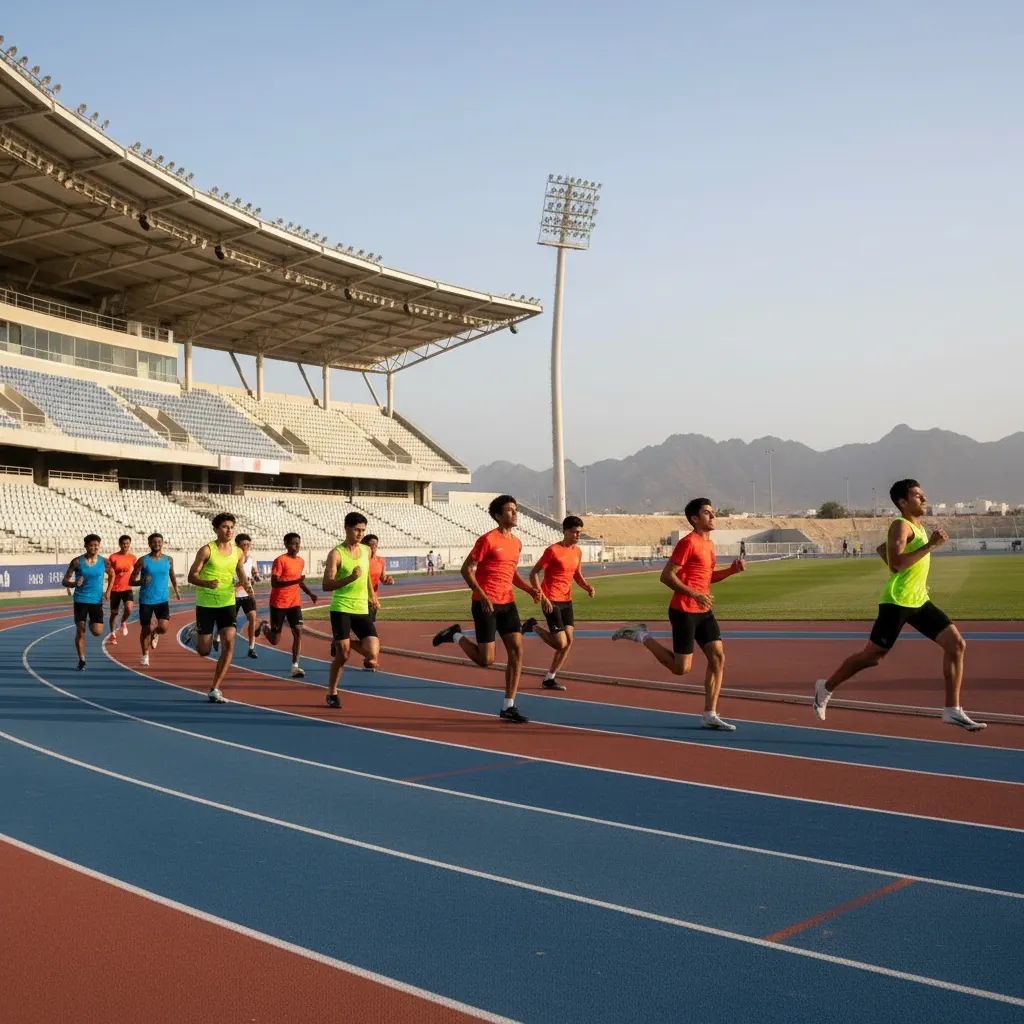
The Vice President's Cup Arrives in Dubai: What 341 Young Athletes Mean for UAE Sports
The United Arab Emirates Athletics Federation is hosting one of the largest national youth competitions this season this weekend at the Dubai Police Officers Club, drawing 341 junior and young adult track-and-field athletes from clubs across all seven emirates. The event—running Saturday, April 4, and Sunday, April 5—serves as a crucial checkpoint before the Arab Regional Championship convenes in Tunisia later this month, making performances here effectively binding for national-team selection.
Why This Matters
• Tunisia Qualifying Window: Athletes who post competitive times this weekend have a realistic path to the Arab Championship (April 26–30), where strong results can unlock invitations to higher-tier continental and international competitions throughout 2026 and 2027.
• Data-Driven Selection: All performances feed into the Athlete Pathway Program launched by the United Arab Emirates Ministry of Sports, which uses analytics and wearable technology to build digital scouting profiles across eight sports disciplines.
• Geographic Diversity: Competitors are traveling from Fujairah to Abu Dhabi, signaling the federation's deliberate push to ensure elite competition remains accessible to young athletes across all emirates.
The Dubai Police Officers Club as Host Venue
The Dubai Police Officers Club provides the technical infrastructure necessary for youth talent evaluation—an all-weather synthetic track, electronic timing systems, and adequate sightlines for coaches to observe technique, composure under pressure, and how athletes recover between heats.
The timing amplifies the stakes. Coaches must submit national-team rosters to the Arab Athletics Union by April 15, leaving only ten days after Sunday's final events conclude. Athletes who stumble this weekend face an anxious calculation: does a single poor performance erase previous training records and rankings, or do selectors weigh the broader season arc? For teenagers accustomed to single-school competitions, the pressure becomes tangible in a way that ordinary club races rarely demand.
The Youth Athletics Boom—And Its Gaps
The United Arab Emirates has engineered measurable growth in organized youth sports over the past two years. Community sports participation has surged, with significant increases in both school-level competitions and university-level engagement across the emirates. Yet underneath these developments lies a persistent constraint: only a minority of school-aged children across the United Arab Emirates meet international physical activity guidelines.
The expansion of structured competition attracts ambitious families and well-resourced clubs. However, routine daily physical activity—the foundation that prevents childhood obesity, builds cardiovascular capacity, and sustains lifelong fitness—remains challenging to scale across broader populations, even as elite pathways expand.
What Happens When You Cross the Finish Line
For the 341 competitors racing at the Dubai Police Officers Club, Sunday evening's results are not merely records in a database. Performance metrics—split times, acceleration profiles, reaction times—feed immediately into the Athlete Pathway Program, which pairs coaching observations with wearable sensor data and biomechanical assessments. The current system aims to triangulate multiple data streams to identify athletes showing promise across multiple dimensions.
Podium finishers may receive invitations to national training camps, a prospect that carries both opportunity and hidden costs. While the federation and some corporate sponsors provide travel stipends, athletes and families from smaller emirates like Ras Al Khaimah and Fujairah absorb significant out-of-pocket expenses for accommodation, meals, and transport during extended trials.
Coaches watch for intangibles that times alone cannot capture. An athlete trailing entering the final 100 meters who summons a decisive kick signals mental resilience. A competitor who wobbles mid-race but finishes strong demonstrates problem-solving under fatigue. In Tunisia, where North African middle-distance runners benefit from altitude acclimatization and cooler climates, these qualities often determine medal outcomes when times cluster within fractions of a second.
The Gender Question Still Lingers
Women comprise roughly half the field at the Vice President's Cup, reflecting years of deliberate outreach and equitable event design. Yet retention statistics tell a harder story. While female registration at youth competitions has climbed steadily, coaches report a notable drop-off after age 16, particularly in distance running and field events, suggesting that family pressures mount as athletes mature.
The federation has responded by integrating gender-equity language into all national programs and guaranteeing equal track access and medal recognition at events like this weekend's Vice President's Cup. Progress is visible. Progress remains incomplete.
The Specialization Trap
Sports medicine practitioners in the United Arab Emirates increasingly worry about ambitious parents pushing children into single-sport training regimens as young as age 10. The reasoning seems logical—earlier specialization increases elite performance odds and scholarship prospects. However, evidence suggests early specialization in single sports can increase overuse injury risk.
The federation now recommends multi-sport participation through middle school, but enforcement is patchy. Club incentive structures—prize money, sponsor visibility, coaching contracts—still reward narrow focus, and parents eager to secure national-team pathways often override medical guidance. The Vice President's Cup, while ostensibly a single-sport competition, implicitly reinforces the message that track specialization is a rational career pathway.
Infrastructure and Geographic Access Challenges
Athletes competing in the Vice President's Cup travel from across the United Arab Emirates, yet the geography of elite training remains concentrated in major population centers. Coaching depth, competition scheduling, facility quality, and sponsorship visibility all concentrate where larger populations support sports programs. Fujairah-based competitors and athletes from smaller emirates report longer commutes to serious training centers and fewer local resources.
This creates practical disadvantages for athletes outside major hubs—not because they train harder, but because infrastructure and opportunity density differs. A young distance runner in a major urban center accesses elite coaches, weekly high-level competition, and injury prevention specialists routinely. A similarly talented peer in a smaller emirate receives fewer of those opportunities routinely. The federation subsidizes some travel and coaching costs, but gaps remain substantial, and family circumstances often determine whether an athlete can bridge them.
What Comes After the Vice President's Cup
Results will post Sunday evening, with full race videos and timing data available on the federation's portal by Monday morning. National-team selections for Tunisia are expected no later than April 15, allowing athletes and families ten days to arrange travel, finalize conditioning, and mentally prepare for the regional stage.
For tournament organizers, Monday begins a different calculus. Video footage and performance databases feed into retrospective analysis: Which clubs fielded the strongest cohorts? Where did coaching investments yield measurable returns? Which geographic regions face underrepresentation among medalists, and what infrastructure gaps explain that? These questions shape the federation's budget allocation and recruitment strategies for the coming season.
For the 341 athletes competing at the Dubai Police Officers Club this weekend, the stakes distill into something simpler and more urgent: demonstrate readiness now, or accept another season's wait. In an increasingly data-driven, metrics-obsessed sports ecosystem, opportunities to impress selectors are finite. This weekend represents one of the year's most visible stages.


