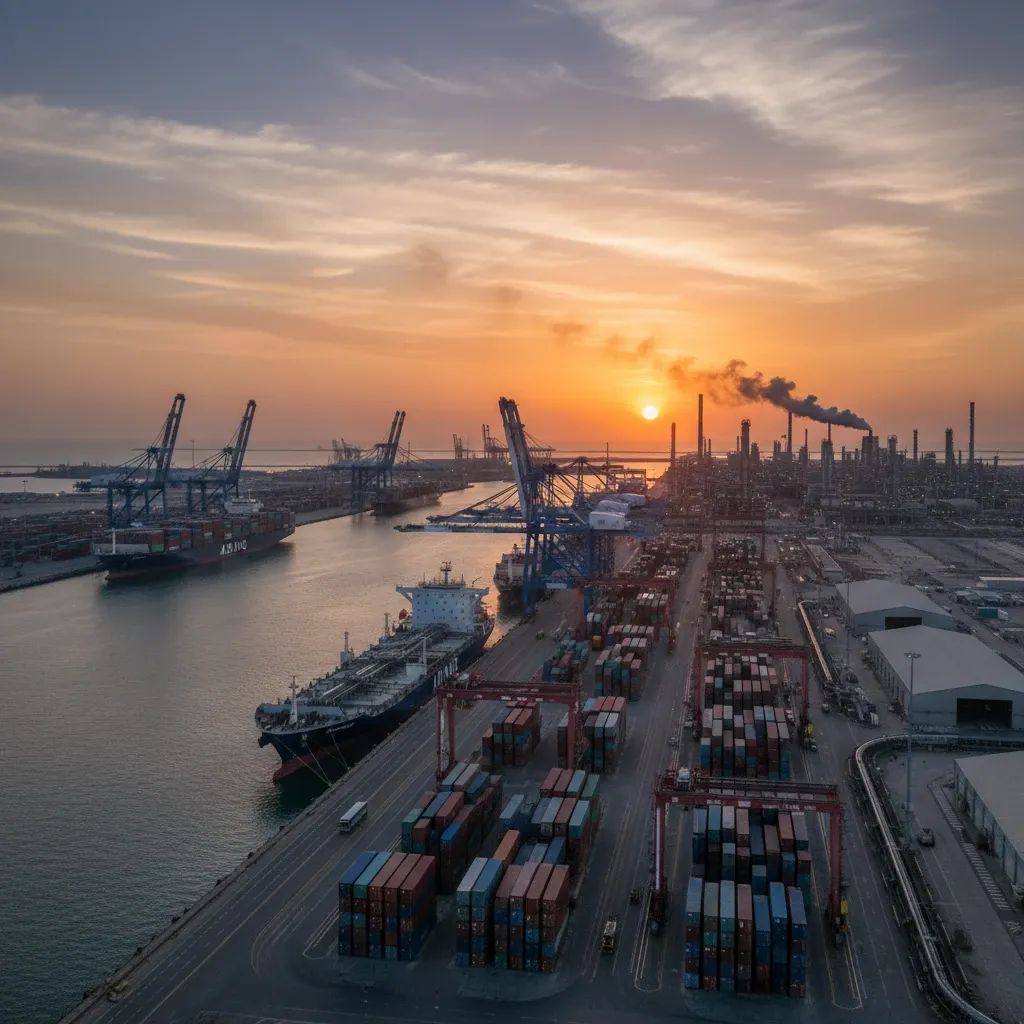
The United Arab Emirates faces renewed upward pressure on energy costs as global oil benchmarks surged over 3% in early trading, with Brent crude climbing to $90.85 per barrel and West Texas Intermediate (WTI) reaching $85.05, driven by escalating geopolitical tensions and military actions between the United States and Iran, along with concerns over crude oil supplies and potential disruptions to shipping through the Strait of Hormuz.
Why This Matters:
• Transport and living costs: Higher crude prices will likely translate to increased fuel costs at pumps across the Emirates within weeks, affecting household budgets and logistics expenses.
• Energy market volatility: The Strait of Hormuz, which handles roughly one-fifth of global oil trade and sits just off the UAE's coastline, represents a critical shipping lane whose stability directly impacts regional energy security and global oil supplies.
• Strategic buffer depleted: Global oil inventories are far lower than in previous crises, leaving less cushion to absorb sudden supply shocks and making price spikes more severe.
• Investment implications: Analysts now forecast Brent could average $102 by August, with some predictions reaching as high as $115 per barrel if geopolitical tensions persist.
Geopolitical Context and Price Drivers
The 3.1% jump in Brent futures—a gain of $2.75 per barrel—stems primarily from heightened geopolitical tensions and military actions between the United States and Iran affecting the Gulf region. These escalating tensions have raised concerns among global traders about potential disruptions to crude oil supplies and shipping routes through the Strait of Hormuz, a critical waterway essential to international energy markets and directly relevant to the UAE's position as a major regional energy hub.
For residents and businesses in the UAE, which relies on stable passage through regional waters for both imports and its own hydrocarbon exports, any escalation in regional tensions represents a potential economic threat to supply chain stability and energy security.
How This Compares to Recent History
The current $90.85 Brent price marks a 16% climb over the past month and sits 30.6% higher than the same period last year. To put this in perspective, Brent crude averaged just $69 per barrel across 2025, making the current level a sharp departure from the relative calm of recent quarters.
Over the past five years, Brent has seen wild swings: from a pandemic low of $18.38 in April 2020 to a peak of $122.71 in June 2022 during the early months of the Ukraine war. The benchmark averaged around $80 in 2024 and just over $82 in 2023. The 12-month rolling average leading into July 2026 stood at $77.17, meaning today's price is running well above trend.
Notably, prices had briefly spiked above $103 in March 2026 before a short-lived diplomatic framework in June brought the market back below $85. That period of relative calm has now given way to renewed market uncertainty.
What Analysts Are Saying
Forecasting firms have scrambled to revise their outlooks. LongForecast now anticipates Brent could open August around $103 and potentially spike as high as $114.82 during the month, with an average close near $109. Goldman Sachs has lifted its 2026 average forecast for Brent to $85 per barrel, up from $77, and expects the benchmark to hit $110 in peak disruption months.
A Reuters poll of 33 economists and analysts conducted in July found consensus estimates rising to $90.44 per barrel for the 2026 annual average, a roughly 40% increase from February projections. WTI is expected to average $84.63 over the same period.
However, not all voices are uniformly bullish. J.P. Morgan Global Research maintains a more cautious view, citing soft supply-demand fundamentals and projecting Brent could average closer to $60 if geopolitical tensions ease and global production continues to outpace consumption. The US Energy Information Administration (EIA), in a forecast completed before the recent escalation, had projected Brent to average $74 in the third quarter, assuming a return to market oversupply. That scenario now appears outdated.
The Supply Crunch No One Saw Coming
Beyond the immediate geopolitical concerns, two additional factors are tightening the global crude balance. First, Ukraine's ongoing strikes on Russian energy infrastructure—including refineries and oil tankers—have reportedly slashed Russia's diesel production capacity by roughly one-third, constraining refined product availability and adding indirect pressure to crude markets.
Second, the world's strategic and commercial oil stockpiles are severely depleted. Governments across OECD nations drew heavily on emergency reserves during earlier crises, and those buffers have not been rebuilt. This depletion means the market has less elasticity to absorb sudden supply shocks, amplifying price volatility when disruptions occur.
Analysts estimate the global oil market is now running a supply deficit of 500,000 to 750,000 barrels per day, with some forecasts suggesting the gap could widen further if regional instability persists. This deficit stands in stark contrast to the supply glut conditions many had anticipated for mid-2026.
What This Means for Residents and Investors
For households and businesses in the United Arab Emirates, the immediate concern is fuel cost inflation. While the Emirates benefits from domestic hydrocarbon production, retail fuel prices are closely tied to international benchmarks. A sustained rise in Brent to the $90–$110 range will likely translate to higher costs at the pump, increased logistics expenses for goods, and upward pressure on utility bills tied to diesel-fired generation.
For investors, the energy sector is experiencing a volatility spike that presents both risk and opportunity. UAE-based energy firms and logistics companies exposed to regional markets face operational uncertainty, while those with hedged fuel contracts or diversified supply chains may navigate the environment more effectively. Equity markets sensitive to oil price swings—including construction, aviation, and consumer discretionary sectors—are likely to see increased volatility in the coming weeks.
Currency markets are also watching closely. Higher oil revenues typically support the Emirati Dirham's peg to the US Dollar, but prolonged regional instability could complicate fiscal planning and investment inflows.
The Road Ahead
Market participants are now pricing in a period of elevated uncertainty tied to geopolitical developments. The question is no longer whether prices will stay elevated in the near term, but how high they can climb if regional tensions intensify further or if additional supply disruptions emerge elsewhere.
For now, the United Arab Emirates finds itself at the geographic and economic center of global energy market attention. The stability of shipping lanes in the region, the resilience of its own export infrastructure, and the trajectory of international diplomatic efforts will all play critical roles in determining whether crude prices stabilize near current levels or break decisively above $100 per barrel in the weeks ahead.
Residents should monitor fuel price adjustments closely, consider adjusting household and business budgets for energy cost increases, and stay informed on regional developments that could affect supply chains. Investors with exposure to energy-sensitive sectors may want to review portfolio positioning and consult with advisers on hedging strategies appropriate for a high-volatility environment.