
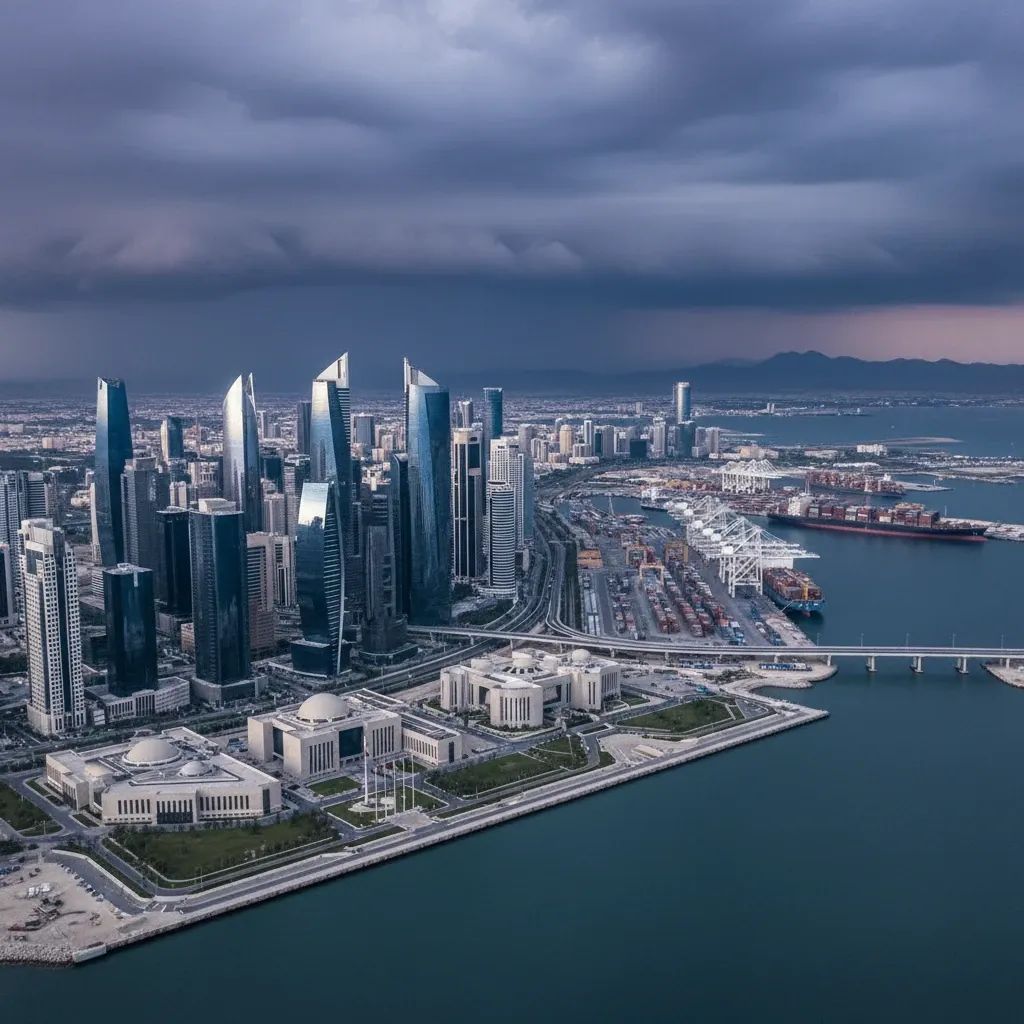
The Gulf Cooperation Council and European Union held an emergency virtual summit today with foreign ministers scrambling to address what the GCC describes as "brutal Iranian aggression" that has sent the Middle East into its most dangerous spiral in years. The meeting, led by GCC Secretary-General Jasem Albudaiwi and EU High Representative Kaja Kallas, comes after Iranian missile and drone strikes targeted multiple Gulf states—including the United Arab Emirates—triggering a regional security crisis that threatens global energy supplies and trade routes.
Why This Matters:
• Iranian strikes hit UAE territory, causing casualties and injuries, and prompting diplomatic responses.
• Economic concerns: Oil market sensitivity and potential supply chain disruptions could affect the UAE's trade-dependent economy.
• Legal framework activated: GCC states have invoked Article 51 of the UN Charter, asserting the right to collective self-defense.
• Your safety: Diplomatic sites and residential areas were targeted, raising security concerns for the region's large expat population.
What Sparked the Crisis
The current escalation followed Iranian aggression against multiple GCC states. Iran launched coordinated missiles and drones aimed at Israel, UAE, Qatar, Kuwait, Bahrain, Jordan, and Saudi Arabia. The attacks targeted military installations, diplomatic compounds, and strategic infrastructure across the Gulf region.
For the United Arab Emirates, the assault prompted significant defensive responses. Emirati air defenses worked to counter the incoming threats, and the strikes impacted service facilities and residential neighborhoods, prompting official responses from Abu Dhabi.
Qatar and Kuwait also reported attacks on their territories. Doha summoned Iran's ambassador and rejected Tehran's claim that its strikes were aimed solely at American targets, noting that Qatari sovereign territory bore the brunt of the assault. Kuwait described the bombardment as a "heinous attack" and a "flagrant violation" of its sovereignty, successfully repelling the incursion but reinforcing its alignment with Western security frameworks.
The GCC Response: Unified but Cautious
At an extraordinary GCC Ministerial Council meeting, member states issued a joint condemnation of the Iranian attacks and declared that "the security of GCC states is indivisible—any attack on one is a direct attack on all." The statement explicitly invoked Article 51, signaling the Council's legal right to respond with force if necessary.
Yet the six member states have adopted divergent tactical postures. Saudi Arabia vowed to "take all necessary measures to defend itself," while the UAE affirmed its "full and inherent right" to self-defense under international law. Bahrain, home to the US Navy Fifth Fleet headquarters, condemned Iran's strikes as a "treacherous attack" after mounting a defensive response against incoming threats.
Oman, however, has taken a markedly different approach. The Sultanate condemned the strikes as illegal aggression but immediately called for a UN Security Council meeting and urged Washington "not to get sucked in further" into the conflict. Muscat's foreign ministry emphasized that "off-ramps are still available" for de-escalation, reflecting Oman's traditional role as a regional mediator and its reluctance to join a military coalition.
Europe's Dilemma: Strategic Partner, Limited Leverage
The European Union finds itself in an awkward position. Brussels has cultivated the Gulf as a vital strategic partner since launching its EU-GCC Strategic Partnership in 2022, with the next summit scheduled for Riyadh later this year. The bloc depends on Gulf energy exports, maritime security in the Strait of Hormuz, and the region's role as a hub for the India-Middle East-Europe Economic Corridor (IMEC), a flagship EU connectivity project.
Yet the EU's response to the current crisis has exposed internal divisions. Kaja Kallas described the situation as "perilous" and has been engaging Israeli and Arab officials to pursue a negotiated settlement. Several European capitals have echoed calls for "maximum restraint" and adherence to international law, but national positions diverge sharply on whether to support military campaigns against Iran.
The conflict poses potential economic concerns for the EU, including oil market volatility and possible disruptions to supply chains that pass through the Gulf. Analysts note the EU's influence may be limited as it lacks the military muscle to shape outcomes on the ground.
Impact on UAE Residents and Expats
For the millions of expatriates and residents living in the Emirates, the immediate concern is physical safety. The Iranian strikes targeted residential areas and critical infrastructure, a stark reminder that even states with advanced air defense systems face security challenges. The UAE's Civil Defence Authority has urged residents to remain vigilant and follow official guidance, particularly near sensitive sites.
Diplomatic relations have also shifted following the Iranian aggression. While direct travel between the UAE and Iran has been minimal for years, any diplomatic impacts could complicate business operations and consular services for communities with connections to Iran—a significant part of Dubai's trading community.
Economic resilience will be important in the coming period. The UAE's economy is deeply integrated into global supply chains, and any prolonged tensions could potentially affect the Jebel Ali Port, the region's largest container hub, and aviation routes that connect Europe, Asia, and Africa. Energy markets have shown sensitivity to regional tensions, reflecting the Gulf's importance to global oil supplies.
What the GCC Wants from Europe
The GCC's agenda for the emergency meeting is clear: it seeks international condemnation of Iranian aggression, UN Security Council action, and European support for de-escalation efforts that do not reward Tehran's use of force. The Council wants the EU to use its diplomatic weight to press for an immediate cessation of hostilities and to hold Iran accountable for what the GCC characterizes as violations of international law.
Yet the GCC also recognizes Europe's limits. Unlike the United States, the EU cannot offer the Gulf states a military security umbrella. Instead, the partnership is rooted in trade, investment, and soft power. The GCC is pushing for enhanced intelligence-sharing, sanctions enforcement, and coordinated messaging that frames Iran as the aggressor and justifies the Gulf states' defensive posture.
The Road Ahead: Diplomacy or Escalation?
The meeting concluded without immediate public announcements of joint measures, reflecting the complexity of aligning 27 EU member states and 6 Gulf monarchies around a unified strategy. The GCC has made clear it retains the right to respond, while the EU continues to emphasize dialogue and restraint.
For residents of the United Arab Emirates, the coming weeks will test the region's resilience. The Emirates has invested billions in air defense systems, diplomatic soft power, and economic diversification precisely to weather crises like this. Yet the involvement of global powers means the stakes are high.
The international community's response will shape not only the immediate security environment but also the long-term balance of power in a region where energy, trade, and geopolitics intersect. For now, the message from both the GCC and EU is one of unity in principle, even as the practical path forward remains uncertain.


