The United Arab Emirates and Mozambique have moved beyond ceremonial diplomacy. A June 13 phone call between President Sheikh Mohamed bin Zayed Al Nahyan and Mozambican counterpart Daniel Chapo signals the acceleration of tangible commercial frameworks that will reshape investment flows into Southern Africa and reposition the UAE's capital as a lynchpin in continental energy transition and logistics.
Why This Matters
• A Comprehensive Economic Partnership Agreement nears completion, expected to eliminate tariffs and harmonize customs procedures between nations already exchanging over $1 billion annually in goods.
• Renewable energy projects worth billions are transitioning from negotiation to construction, with UAE developers preparing to deploy solar capacity that will electrify millions of Mozambican households while generating long-term returns.
• Port infrastructure managed by UAE-based operators now anchors the supply chains for landlocked Southern African economies, creating immediate advantages for Emirati businesses targeting the 350-million-person SADC market.
The Strategic Architecture Behind the Call
For policymakers monitoring United Arab Emirates foreign engagement, this phone call represents continuity in a deliberate continental strategy. Since 2019, Emirati institutions have allocated over $110 billion to African projects, a commitment that exceeds any other single-nation contributor during the period. Within that universe, Mozambique occupies a peculiar position: it combines three critical dimensions of UAE economic interest that are otherwise dispersed across the continent.
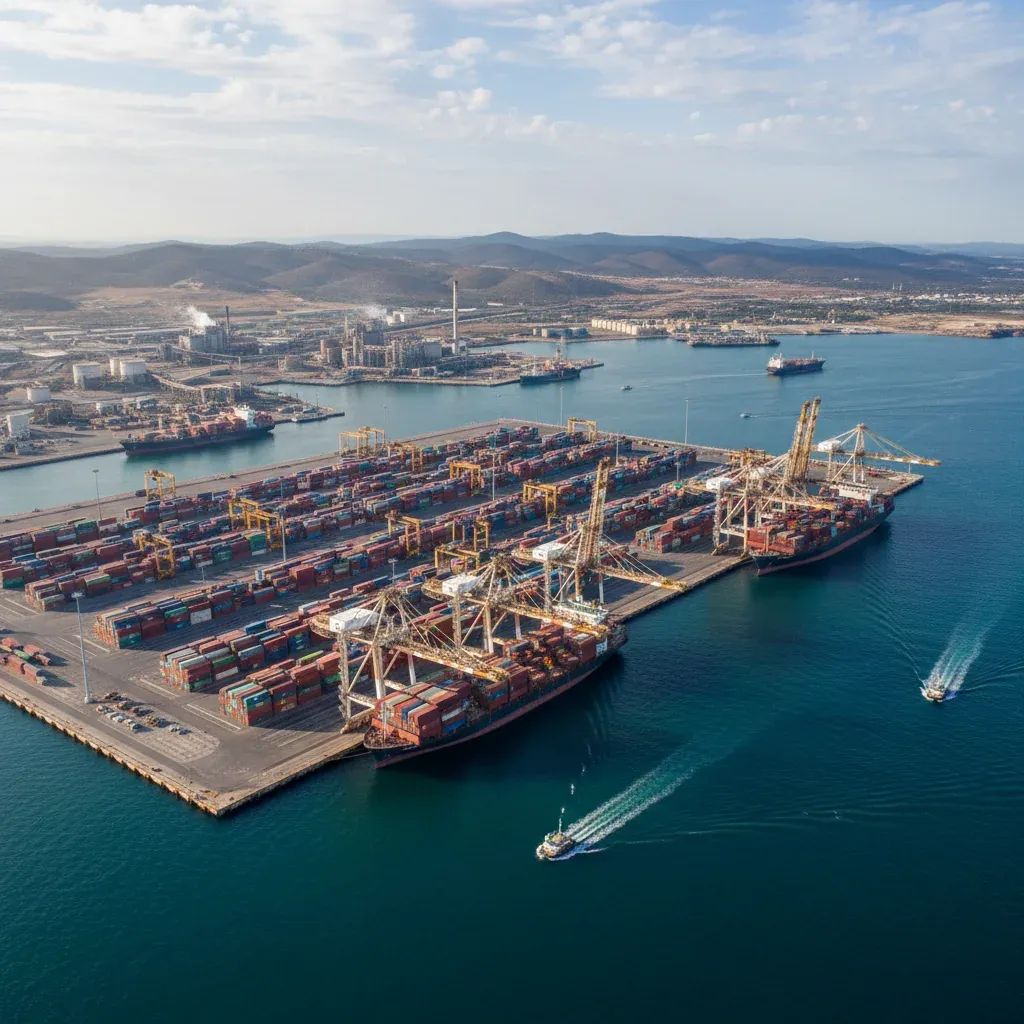
The first is geographic advantage. Mozambique's Indian Ocean coastline stretches 2,500 kilometers, punctuated by three deep-water ports—Maputo, Beira, and Nacala—that function as trade arteries for Zimbabwe, Zambia, Malawi, and the Democratic Republic of Congo. These landlocked neighbors depend on Mozambique's maritime corridors for connectivity. DP World, the Dubai-headquartered port operator, recognized this before most competitors. Through its subsidiary Maputo Port Development Company, the firm invested $165 million in 2025 alone to expand cargo-handling capacity, generating approximately 5,000 jobs since 2010 and cementing the United Arab Emirates as the region's dominant infrastructure manager.
The practical consequence matters for specific industries. A UAE-based pharmaceutical manufacturer exporting to Zambia now moves shipments through a port operated by Emirati executives versed in Emirati timelines and standards. Clearance accelerates. Predictability increases. Competitive advantage materializes. Similarly, agribusiness firms and petrochemical traders benefit from reduced friction and higher velocity through a port ecosystem they effectively control.
The second dimension is energy access. Mozambique's Rovuma Basin contains one of the world's largest concentration of natural gas reserves, with combined liquefied natural gas capacity exceeding 25 million metric tons annually once fully operational. This volume rivals several established African LNG exporters combined. Abu Dhabi's energy investment arm, XRG, secured a 10% stake in the Area 4 concession—a move that diversifies the United Arab Emirates energy portfolio toward lower-carbon LNG exports while simultaneously providing leverage in energy diplomacy across Africa.
The third dimension is the most politically consequential: security stabilization. Mozambique has endured an Islamist insurgency in Cabo Delgado province since 2017, a conflict that threatens the very LNG infrastructure in which Emirati capital is embedded. The United Arab Emirates pragmatically became a security partner, deploying armored vehicles, military training, surveillance capabilities, and intelligence support since 2017. In 2022, both nations formalized this arrangement through a memorandum of understanding on security coordination and counter-terrorism. From a UAE perspective, this security footprint is capital preservation rather than charity. Instability in Cabo Delgado directly endangers Emirati energy investments. Preventive security cooperation reduces investment risk.
The Renewable Energy Acceleration
Today's phone call emphasized renewable energy expansion, and the financial stakes justify that focus. Masdar, the Abu Dhabi clean energy firm, committed $10 billion for African renewable projects through 2030, targeting 10 gigawatts of installed capacity continent-wide. Mozambique features prominently in that deployment strategy, not through development priorities but because the mathematics incentivize capital allocation.
The country receives abundant solar radiation, possesses minimal competing industrial electricity demand during off-peak hours, and maintains governmental counterparts willing to negotiate long-term power purchase agreements. Two initiatives illustrate the trajectory. AMEA Power, a UAE-based developer, partnered with Mozambican firm Hidropower to construct a 125-megawatt photovoltaic installation in Tete province, with a $150 million investment. That facility will supply electricity to approximately 150,000 households and offset annual carbon emissions equivalent to removing 30,000 vehicles from the road—but the real strategic value lies in the template. Once operational, it establishes a replicable model for subsequent projects across the country.
A second initiative involves Infinity Power, the Masdar joint venture with Africa50, an Abuja-based infrastructure investor. They are piloting floating solar technology—photovoltaic panels mounted on water reservoirs—to circumvent the land-use politics that occasionally obstruct terrestrial installations. The target capacity extends to 1 gigawatt, sufficient to electrify a city the size of Harare.
Mozambique's government is simultaneously accelerating indigenous renewable deployment through its Renewable Energy Auction Promotion Program, abbreviated PROLER. This framework aims to bring 120 megawatts of solar and wind online through competitive bidding that attracts international developers. A 30-megawatt photovoltaic tender in Sofala province's Dondo district relaunched in May 2026, with formal bidding expected in the second half of this year. Winning investors assume full-cycle responsibility: financing, construction, operation, and maintenance—a model that aligns precisely with how UAE firms structure emerging-market engagements: end-to-end control and predictable cash flows over 20-year operational periods.
By 2030, Mozambique intends to deploy at least 1,000 megawatts of solar capacity and 200 to 500 megawatts of onshore wind. The United Arab Emirates—having invested over $70 billion in African energy and green infrastructure between 2019 and 2023—remains the obvious financing partner.
What This Means for Companies and Investors Based in the UAE
The accelerating Comprehensive Economic Partnership Agreement, currently in final-stage negotiations, will materially reshape the operating environment for UAE-headquartered businesses targeting Mozambique expansion. Once concluded, the treaty will harmonize customs procedures, reduce tariff barriers, and—crucially—establish reciprocal legal protections for cross-border capital deployment and asset protection.
For agribusiness operators, this development carries particular weight. The United Arab Emirates imports 85% of its food requirements, making it one of Africa's largest foreign agricultural investors by necessity. Companies operating farms or food-processing facilities in Mozambique—or evaluating entry—will benefit from a formal treaty that protects invested capital against sudden regulatory reversal. Discussions in February 2026 between Mozambique's Economy Minister and the UAE Ambassador to Mozambique centered precisely on these investment safeguards and dispute resolution mechanisms.
The bilateral trade relationship already demonstrates operational scale. In 2022, the two countries exchanged $1.082 billion in goods. Mozambique exported $578 million to the United Arab Emirates, primarily comprising gold, coal, and agricultural commodities, while importing $504 million of refined petroleum, vehicles, and capital equipment. The United Arab Emirates ranks as Mozambique's second-largest import source and fifth-largest export destination—a position that amplifies in commercial significance as port infrastructure improves and logistics costs decline.
For sectors like pharmaceuticals, fertilizer production, and industrial chemicals, Mozambique functions simultaneously as a destination market and as a manufacturing platform serving the 16-nation Southern African Development Community, which represents 350 million people. A UAE-based pharmaceutical firm, for instance, could establish a Mozambique production facility and distribute across the SADC region with minimal tariff friction once the CEPA takes effect. The scale economics shift materially. Raw material costs decline. Regional distribution from Mozambique becomes more competitive than direct shipment from the Gulf.
Agriculture, Food Security, and Climate Alignment
The United Arab Emirates confronts a scarcity profile distinct from most nations: limited arable land and freshwater. This structural constraint drives strategic hunger for African agricultural partnerships. In February 2026, Mozambique's Minister of Agriculture convened with the UAE Minister of Climate Change and Environment in Dubai to establish a joint technical team implementing an existing memorandum of understanding on environment and biodiversity. The arrangement moved beyond symbolic cooperation into operational mechanics.
Separately, Mozambique joined the Agriculture Innovation Mission for Climate, a UAE-led consortium assembling nations, private investors, and research institutions to develop farming techniques resilient to climate volatility. For Mozambique, this translates into access to advanced irrigation systems, proprietary crop genetics, and agro-processing infrastructure. For the United Arab Emirates, it diversifies the agricultural supply chains that feed its population of 9.9 million people—a critical national interest given that food insecurity poses existential economic risk in a region where arable land is scarce.
Tourism cooperation similarly merits attention, though it registers lower financial stakes. Discussions progressed toward a potential memorandum of understanding designed to increase technical collaboration and position Mozambique as a destination for Gulf travelers. The UAE's tourism sector annually accommodates millions of regional and international visitors; expanding destination networks reduces competitive pressure from established markets while creating new investment opportunities for Emirati hospitality operators.
The Broader Continental Context
Today's phone call sits within the larger narrative of how the United Arab Emirates has positioned itself as Africa's preferred infrastructure and capital partner. Emirati companies now manage ports from Somalia to Angola, operate renewable energy installations across the continent, and maintain diplomatic representation in 19 Sub-Saharan nations. Within this continental architecture, Mozambique functions less as a peripheral opportunity and more as a cornerstone market that consolidates multiple strategic interests—energy transition, logistics dominance, food security, and security stabilization.
For UAE businesses and investors, Mozambique represents neither speculation nor charity. It is a territory where Emirati operational expertise, capital access, and political relationships converge to generate measurable returns. As the Comprehensive Economic Partnership Agreement advances through final stages and renewable energy projects transition from tender phase into construction, the bilateral partnership will increasingly define how Emirati capital flows into Southern Africa and how Mozambique leverages Gulf expertise to meet its own development targets. The momentum established today reflects neither diplomatic celebration nor policy gesture. It reflects calculation: two economies discovering that their interests align across infrastructure, energy, agriculture, and security. For residents and businesses in the United Arab Emirates, that alignment translates into accessible markets, predictable returns, and reduced geopolitical friction in a strategically vital region.