
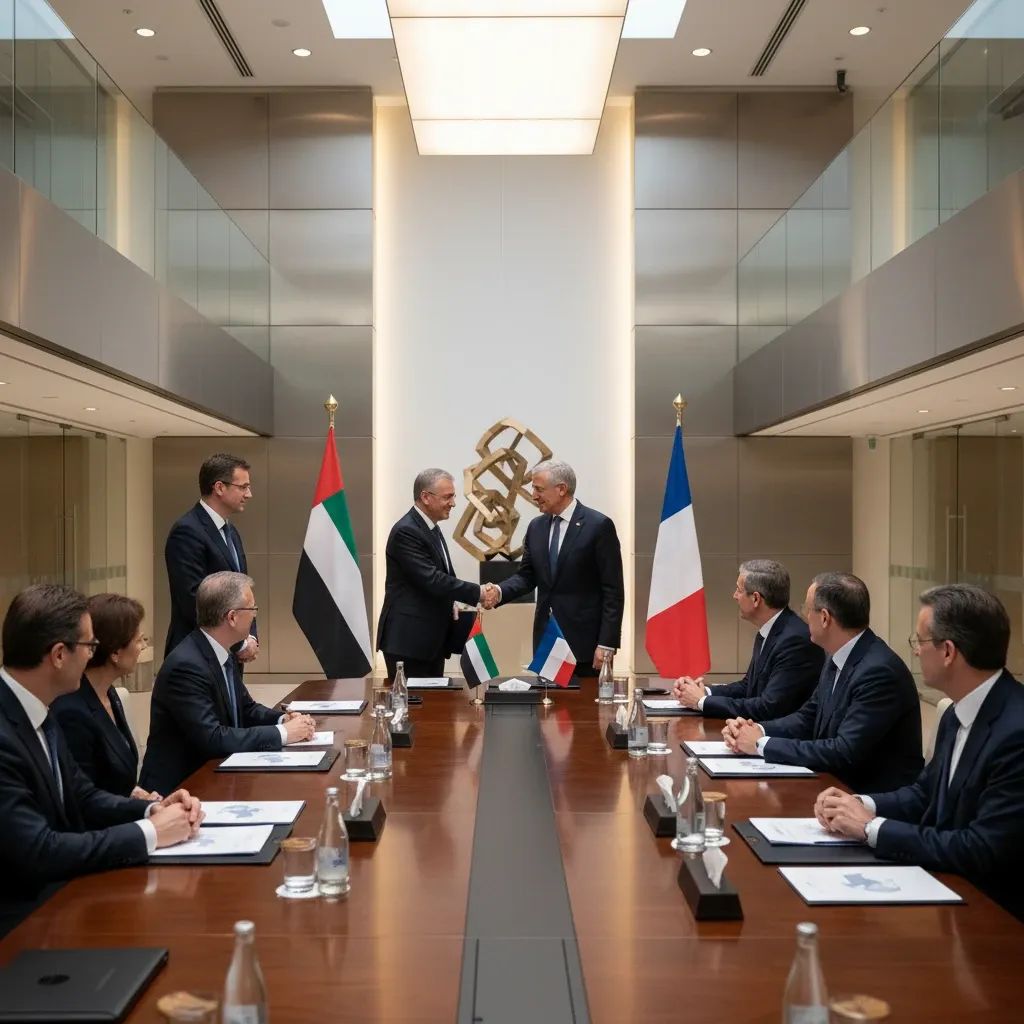
Sheikh Abdullah Discusses UAE-France Strategic Ties and Regional Security in Paris
Deputy Prime Minister Sheikh Abdullah bin Zayed held diplomatic discussions with Jean-Noël Barrot, France's Foreign Minister, in Paris on March 3, 2026. The meeting focused on strengthening bilateral relations between the UAE and France and addressing regional security concerns following the Iranian missile attacks that struck the UAE on February 28.
The discussions centered on strategic partnership coordination and multilateral approaches to containing regional escalation. Both officials reviewed ongoing cooperation between the two nations and explored pathways for de-escalation amid heightened tensions in the Gulf region.
Context: Why This Meeting Matters
The timing of Sheikh Abdullah's Paris visit reflects broader strategic calculations in UAE foreign policy. On February 28, Iran launched a significant missile barrage against the UAE, resulting in casualties and damage to infrastructure, including a French military installation at Bateen airfield in Abu Dhabi. This incident underscored the security vulnerabilities that have prompted intensified diplomatic engagement across European capitals.
The meeting represents part of a coordinated diplomatic offensive by UAE leadership to strengthen multilateral partnerships that enhance regional stability. By engaging European counterparts directly, the UAE seeks to build consensus around measured, proportionate responses to Iranian aggression while maintaining channels for eventual de-escalation.
Broader European Engagement
Sheikh Abdullah's Paris meeting was part of a wider diplomatic initiative. In the preceding days, he conducted phone consultations with multiple European foreign ministers to coordinate messaging on containing escalation and preventing regional contagion. This reflects the UAE's strategy of building a European consensus that the region's security is a collective concern requiring coordinated responses.
These diplomatic efforts complement the UAE's existing security relationships and its broader foreign policy orientation toward multilateral partnerships that don't rely solely on any single external power.
The Established UAE-France Partnership
While this specific meeting focused on immediate security concerns, it builds on an established foundation of bilateral cooperation. The UAE and France maintain one of the Gulf region's most developed partnerships, spanning defense, energy, technology, and trade sectors.
Bilateral trade reached €8.5 billion in 2024, with non-oil trade expanding significantly year-over-year, demonstrating the commercial depth underlying the relationship. France ranks as a significant commercial partner for the UAE, with numerous French companies maintaining permanent operations across the Emirates in sectors including energy, technology, and professional services.
Defense and Industrial Cooperation
The UAE and France have developed defense industrial partnerships that extend beyond traditional buyer-vendor relationships. EDGE Group, the UAE's sovereign defense technology conglomerate, has engaged in detailed discussions with French defense firms regarding advanced technology development and co-production arrangements. These discussions represent the long-term trajectory of the relationship, though specific announcements remain subject to ongoing negotiations.
Joint naval initiatives, including ventures in shipbuilding and maritime security, have been established as part of bilateral cooperation frameworks. These partnerships position the UAE as a co-developer in advanced defense systems rather than merely a purchaser of finished products.
Energy and Clean Technology
The UAE and France collaborate extensively on civilian nuclear energy and renewable infrastructure. France provided technical expertise for the Barakah Nuclear Energy Plant, the Arab world's first commercial nuclear reactor complex. Joint initiatives in hydrogen development, smart grid optimization, and renewable energy projects represent expanding cooperation in clean technology sectors.
A significant AI partnership framework was established in February 2026 during the AI Impact Summit in New Delhi, involving Crown Prince Sheikh Khaled bin Mohamed bin Zayed and French leadership. This partnership reflects Emirati investment in technology ecosystems and represents the economic foundation supporting broader strategic cooperation.
Implications for Residents and Investors
For people living in the UAE, the strengthening of European partnerships carries practical dimensions. Expanded cooperation with France and broader European engagement creates additional economic opportunities across fintech, logistics, AI research, renewable energy, and defense industrial sectors.
Enhanced security cooperation through multilateral partnerships can contribute to regional stability, which typically supports investor confidence and economic activity. The diversification of security relationships across multiple European partners, rather than reliance on any single external power, reflects a sophisticated approach to geopolitical positioning.
Professional opportunities in expanding sectors—particularly renewable energy, technology development, and joint venture operations—continue to grow as cooperation deepens. The institutional mechanisms facilitating UAE-France cooperation, including business councils and regular diplomatic engagement, provide frameworks for ongoing commercial partnership development.
Looking Forward
Sheikh Abdullah's March 3 meeting with Foreign Minister Barrot exemplified the UAE's diplomatic approach to regional challenges: building multilateral consensus, deepening established partnerships, and maintaining channels for strategic communication with key global powers. While the immediate backdrop involves security concerns, the broader context reflects the UAE's long-term strategic positioning as a hub for international cooperation in a complex geopolitical environment.
The months ahead will test whether coordinated European and Gulf partnerships can effectively address regional tensions while maintaining openness to de-escalation opportunities through established diplomatic channels.


