
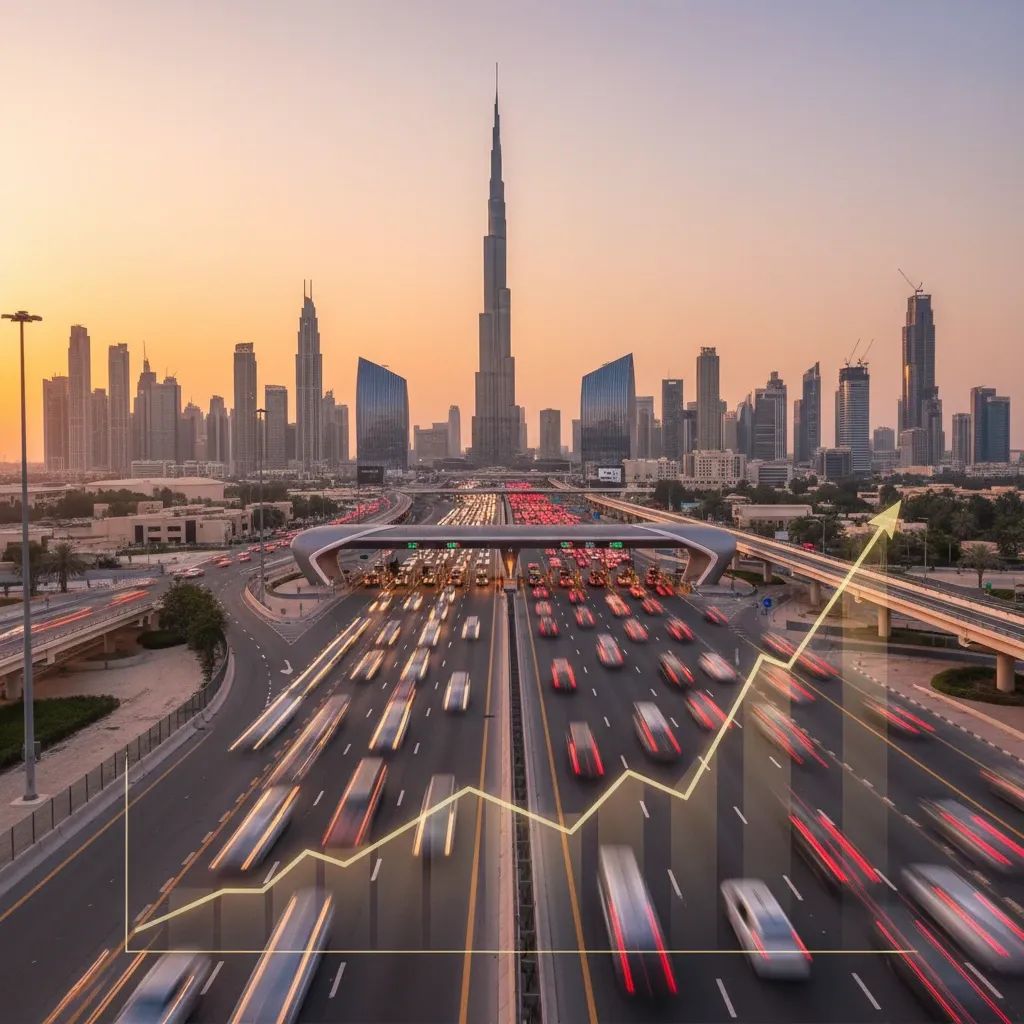
What Dubai Drivers Pay Now
Salik Company PJSC, Dubai's toll gate operator, has restructured its pricing model effective January 31, 2025. Drivers now face variable tolls: AED 6 during peak hours (6 AM–10 AM and 4 PM–8 PM on weekdays), AED 4 during off-peak windows, and zero fees between 1 AM and 6 AM. For residents planning commutes, these rates replace the previous flat AED 4 charge and are now permanently embedded in Dubai's road infrastructure. Off-peak and overnight drivers benefit from lower or zero fees, though peak-hour drivers shoulder higher costs.
During Ramadan 2026, Salik has announced adjustments to peak hours to match shifted daily routines during the holy month—a localized pricing tweak that residents should monitor in communications from the company.
Revenue Surge and Investor Returns
The revised pricing structure has delivered substantial results for the company and its shareholders. Revenue climbed 35.1% year-on-year to AED 3.1 billion in 2025, translating into AED 1.66 billion in total dividends—a 42.6% increase from 2024.
Salik operates under a 100% payout policy, distributing all net profit available for distribution to shareholders. The company has pledged AED 890.3 million in dividends for H1 2026 (comprising AED 782.5 million in cash for H2 2025 net profit plus a special AED 107.8 million tranche), bringing 2025's cumulative dividend to AED 1.66 billion versus AED 1.16 billion in 2024. Shareholders receive 11.8712 fils per share for H2 2025, including the special payout.
How the Revenue Growth Happened
Three factors drove Salik's 2025 performance. First, the variable pricing model immediately optimized revenue capture without dampening demand—peak-hour trips contributed disproportionately to the company's 26.3% quarterly revenue growth in Q4 2025. Peak-hour tolls now account for 36% of chargeable trips, validating the pricing overhaul.
Second, the full-year contribution of the Business Bay Crossing and Al Safa South gates, which opened in November 2024, expanded the network from eight to ten gates. These additions pushed total annual trips to 639.1 million—a 22% increase in Q4 2025 compared to the prior year. Toll usage fees surged 37.3% to AED 2.74 billion, while fines added another AED 290.6 million.
Third, a concession fee reduction from 25% to 22.5% (effective April 2024), negotiated with Dubai's Roads and Transport Authority (RTA), widened net margins. Together, these factors delivered EBITDA of AED 2.14 billion, up 35.8%, and net profit after tax of AED 1.55 billion, a 33.4% increase.
Financial Performance and Margins
Salik's profitability stands among the highest globally for toll operators. The company achieved a 69.2% EBITDA margin and a 50.2% net profit margin, reflecting near-zero competition and minimal capital requirements once toll gates are operational.
For investors, this profitability supports the aggressive 100% payout ratio. The trade-off is straightforward: minimal retained earnings for organic growth or financial buffers. Salik's Board retains discretion to adjust payouts based on cash management requirements and future opportunities, but the policy framework prioritizes income distribution.
Understanding the Shareholder Structure
For international residents unfamiliar with UAE corporate terminology: PJSC (Public Joint Stock Company) is a publicly traded corporation in the UAE. The RTA (Roads and Transport Authority) is Dubai's government agency responsible for roads and transport. Salik operates under an exclusive concession agreement with the RTA until June 2071, granting it the right to operate all existing and future toll gates.
2026 Outlook: Moderating Growth
Salik's 2026 guidance marks a deliberate transition. The company forecasts 4–6% revenue growth, reflecting the reality that variable pricing and the two new gates have already been fully absorbed into operations. Organic traffic expansion will drive growth alongside emerging revenue streams.
EBITDA margins are expected to hold steady in the 68–69% band, with net profit margins mirroring 2025 levels. Management projects parking payment solutions—already generating AED 24 million in 2025 via partnerships with Emaar Malls and Parkonic—will scale to AED 35–50 million in 2026. Data monetization is expected to contribute another AED 5–10 million.
Beyond Tolls: Smart Mobility Expansion
Salik is diversifying its operations. A 10-year agreement with Dubai Airports, signed in early 2025, integrates Salik into the emirate's aviation and ground transport coordination, though revenue specifics remain undisclosed. Partnerships with Schneider Electric, Vcharge, and ENOC will enable Salik's digital wallet to process payments for electric vehicle charging and fuel transactions, expanding beyond toll gates.
No new toll gate locations for 2026 have been confirmed, but the exclusive concession leaves room for future network expansion if the RTA's traffic studies warrant additional installations.
Global Context: How Salik Compares
Among publicly traded toll operators, Salik's 93.6% trailing twelve-month payout ratio is at the extreme end globally. Transurban Group (Australia) guides for 69 cents per security in FY26 distributions, balancing payouts against financial reserves. Atlas Arteria maintains a 40 cents per security payout for 2025–2026. Brookfield Infrastructure Partners operates at a 63% payout ratio, which analysts consider elevated for infrastructure assets. Salik's pure-cash, 100% distribution policy is structurally distinctive.
The underlying assumption is uninterrupted profitability and stable cash generation. Any unexpected deterioration—economic slowdown, traffic volume declines, or regulatory fee changes—would immediately pressure dividend sustainability, as the company retains virtually no financial cushion. For now, Dubai's macroeconomic indicators support the model: population growth, rising tourist arrivals, and record passenger traffic at Dubai International Airport underpin demand.
Risks and Monitoring Points
Three factors could affect the 2026 outlook. First, traffic saturation: if Dubai's road usage plateaus or shifts toward public transit expansion (the RTA is developing metro and autonomous bus networks), trip volumes could stagnate. Second, regulatory changes: variable pricing has faced public discussion, and any RTA mandate to adjust peak fees would impact revenue. Third, cost pressures: if the RTA reverses concession fee reductions or imposes new operational mandates, margins could compress.
For residents and investors, Salik's performance reflects Dubai's economic vitality. The 639.1 million annual trips captured in 2025 indicate sustained city activity—construction projects, tourism, and commuter movement. Whether that momentum continues through 2026 will determine if dividend distributions hold steady or adjust to market conditions.


