
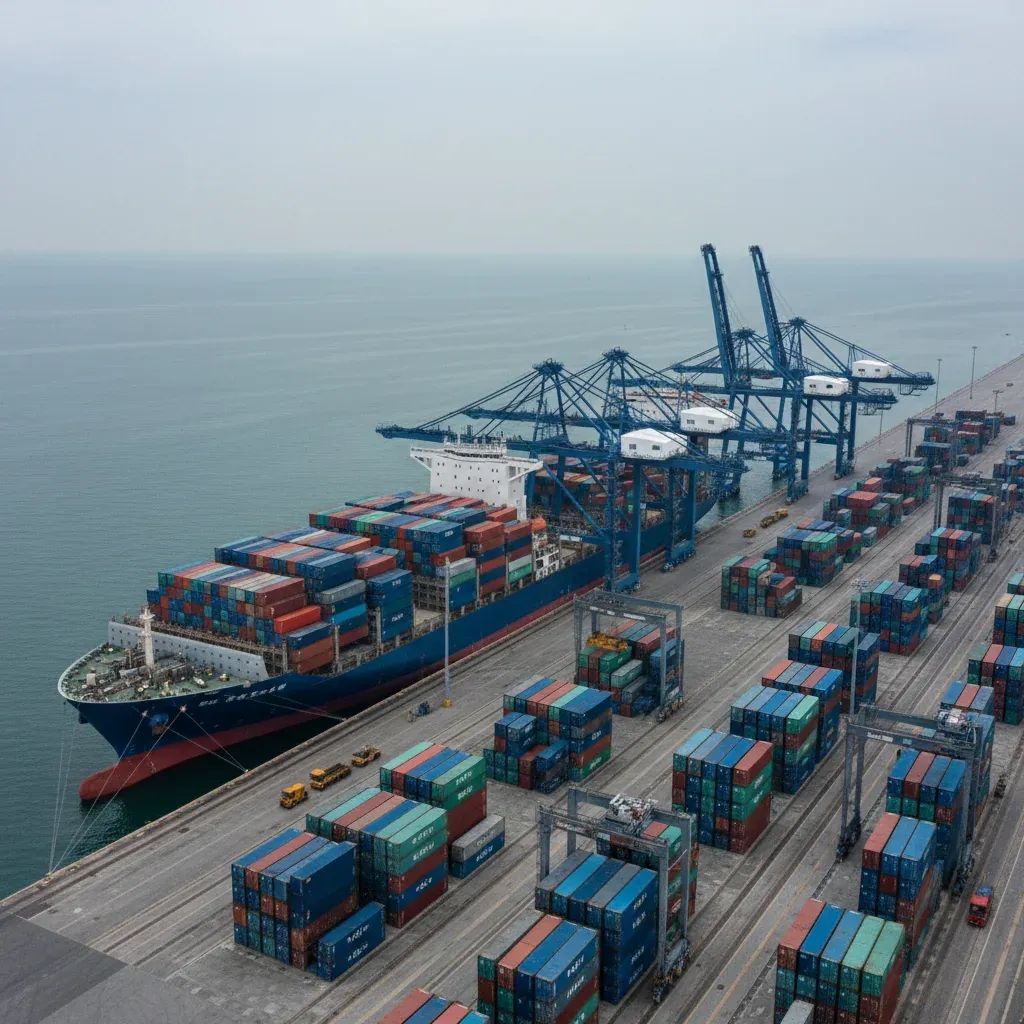
A Safer Route, A Changing Trade Map
The United Arab Emirates' port operators are quietly redrawing Middle Eastern logistics by moving cargo away from traditional choke points. Sharjah's multi-billion-dirham push to scale Khorfakkan Port—paired with inland logistics complexes and new trade corridors—represents less a promotional campaign and more a pragmatic response to how global supply chains now function. For residents, businesses, and anyone dependent on imported goods, this infrastructure shift carries immediate consequences: port delays contract, shipping costs stabilize, and employment expands across sectors most people never see but everyone depends on.
Why This Matters
• Immediate impact on your wallet: New logistics routes and bonded storage zones mean lower import costs and faster clearing for retailers, restaurants, and manufacturers relying on imported goods.
• A geographically safer alternative: With Khorfakkan positioned outside the Strait of Hormuz, shipping lines gain a crisis-resistant path that avoids years of regional tension.
• Employment wave incoming: 8,400+ new logistics, transport, and warehouse jobs are already being hired for across Sharjah and neighboring emirates as infrastructure scales.
How Geography Became Destiny
Until 2025, Khorfakkan Port existed in the commercial shadows of Jebel Ali—a competent secondary terminal without urgent reason to expand. That changed dramatically when regional disruptions made the Strait of Hormuz feel less like a reliable passage and more like a calculated risk. Shipping companies that had routed cargo through Dubai's massive hub for decades suddenly reconsidered. By mid-2026, Khorfakkan had experienced significant growth in container traffic—a shift that happened not because the port invested heavily overnight, but because geography, timing, and fear converged at precisely the right moment.
The operational data tells the story clearly. During the same period when Khorfakkan surged, Jebel Ali's parent company DP World saw overall group container throughput slide 5.7% in the first half of 2026. Abu Dhabi's Khalifa Port experienced sharper pressure as the same regional instability that benefited Khorfakkan diverted traffic away from traditional hubs. This wasn't random. Shipping lines were actively choosing alternatives. Khorfakkan sits on the Arabian Sea side of Oman, enjoying direct access to international shipping routes without funneling through contested waters. For operators managing risk, that distinction changed everything.
The port's infrastructure—deep-water berths, high-capacity cranes, and strategic location—finally mattered in the way planners had always intended. But geography alone doesn't create a lasting competitive advantage. It creates an opening. What Sharjah is building now is the apparatus to turn that opening into structural advantage.
Building Beyond the Waterfront
Modern port competition is fundamentally won or lost inland. A terminal can move containers efficiently, but if cargo piles up in clogged warehouses or sits in traffic heading inland, efficiency becomes theater. Sharjah understands this. The real expansion happening isn't just Khorfakkan Port expanding its container capacity from 3.5 million to 5 million units annually—it's the construction of an invisible network that turns a port into an ecosystem.
Al Dhaid Logistics Complex, positioned approximately 50 kilometers inland from Khorfakkan, functions as a sorting hub designed to absorb throughput before it enters congested city streets. The facility will process containers across digitalized, bonded warehouse space. What "bonded" means in practice: cargo can enter, be processed, stored, or repackaged without triggering immediate customs duties. For traders managing multi-market distribution—importing goods, deciding whether to sell locally, or re-exporting regionally—this creates significant cash-flow advantages. Pay the tax when goods actually leave the facility, not when the container door opens.
The facility's true power emerges once Etihad Rail integration completes. Containers will be able to move directly from Khorfakkan's docks onto freight trains heading south toward Saudi Arabia, west toward Abu Dhabi, or deeper into the emirates. That eliminates truck congestion and reduces transit times substantially. The infrastructure is under construction, and timelines remain aggressive, but the vision is concrete.
Sajaa Logistics Complex fills a different role. Launched in 2026 as the UAE's largest bonded dry port, Sajaa spans over 3 million square feet and can handle significant container volumes. Its location near Emirates Road (the main highway), Sharjah International Airport, and Al Hamriyah Port makes it a natural consolidation point for cargo arriving at multiple Sharjah ports. A container might land at Khorfakkan but be stored and processed at Sajaa, then dispatched to a final destination at Khalid Port or elsewhere without redundant customs procedures. This flexibility matters more than it sounds. For companies managing clients across multiple markets simultaneously, operational flexibility directly reduces risk and cost.
Together, Al Dhaid and Sajaa significantly expand the logistics infrastructure behind Khorfakkan's waterfront expansion, effectively enhancing capacity to handle increased throughput. These aren't glamorous facilities—photographs of warehouses don't excite boardrooms—but they represent the actual mechanics of how modern supply chains function.
The Corridors That Connect
Infrastructure gains real power only when it connects to somewhere meaningful. Sharjah's investment in trade corridors demonstrates this principle directly.
A Sharjah-Dammam corridor went live in March 2026, creating integrated land and sea transport between the United Arab Emirates and Saudi Arabia. Previously, traders routing goods to Saudi customers faced choices none of them preferred: ship via Jeddah on the Red Sea (adding days), wait for traditional Gulf shipping slots (capacity constraints), or drive overland via conventional highway routes (congestion, complexity). The new corridor shortens that path. Goods move from Khorfakkan's inland facilities directly overland to Saudi industrial zones via dedicated routes. For manufacturers and distributors managing cross-border supply chains—a massive portion of UAE commerce—this eliminates friction and saves time measurably.
The Sharjah-Oman corridor launched in May 2026 serves a different strategic purpose. It leverages Omani ports at Sohar, Duqm, and Salalah alongside land crossings at Khatmat Malaha and Al Madam. For traders with clients across Oman or East Africa, having multiple routing options eliminates dependency on any single gateway. Instead of committing to one path, companies optimize based on current market conditions: vessel schedules, capacity availability, or geopolitical stability. This is the opposite of old hub-and-spoke models where everything funneled through one mega-terminal, forcing customers to accept whatever constraints that terminal imposed.
These corridors aren't theoretical. Companies are already using them. The fact that they exist at all signals that Sharjah has moved from infrastructure pitch to functional network.
Immediate Practical Consequences
If the logistics sector employs you, Khorfakkan's expansion directly affects your career trajectory. The port's infrastructure development is expected to generate approximately 8,400 new professional positions across driving, logistics operations, warehousing, and related roles—according to expansion announcements. Al Dhaid and Sajaa require warehouse operators, customs brokers, freight forwarders, operations coordinators, and supervisory staff. The expansion isn't aspirational; hiring is already happening. Companies positioning themselves inside the ecosystem are recruiting actively.
If you run a business dependent on imports or exports, the timing could reshape your operations substantially. Dwell time—the duration cargo sits in port or warehouse waiting—directly affects working capital. Faster processing means cash flows circulate faster. For high-volume traders, that difference accumulates into serious money. A trader importing 500 containers monthly who cuts average dwell time from 10 days to 6 days effectively gains 2,000 container-days of storage capacity freed annually. That translates into either reduced warehouse costs or increased throughput from the same facilities.
Bonded storage at Sajaa or Al Dhaid reshapes the unit economics for traders managing re-export businesses. Rather than paying import duties on goods arriving at the port, storing them in a commercial facility, and paying again on export, traders now store pre-import-duty and process tax liability only when goods actually leave the system. For companies moving high volumes of containers annually, this can equal substantial savings in interest costs alone.
If you invest in industrial property, logistics zones near Al Dhaid and Sajaa are becoming focal points for commercial activity. Land availability, warehouse space, and small trading offices within reach of these complexes are experiencing renewed interest as companies position supply-chain functions close to the ecosystem's core. Property development companies are noting this shift.
The Competitive Landscape Hasn't Simplified
Khorfakkan's surge shouldn't be misread as other ports collapsing. Jebel Ali remains the Middle East's largest container terminal, still processing millions of containers annually. DP World reported $24.4 billion in group revenue for 2025, with Jebel Ali alone contributing growth of approximately 9% year-on-year in origin-and-destination volumes during 2025. It's massive, efficient, and connected to every major shipping line globally. Its vulnerability isn't operational; it's geographic. The Strait location provided no shelter when regional tensions spiked.
Khalifa Port in Abu Dhabi has invested heavily in automation and efficiency. AD Ports Group recorded AED 20.8 billion in revenue for 2025 with 23% growth in container throughput (7.7 million TEUs across the entire group). The port's semi-automated terminal operated by CMA CGM handled 1.3 million containers in its inaugural year. Yet mid-2026 exposed a shared vulnerability with Jebel Ali: the same geopolitical disruptions that benefited Khorfakkan diverted traffic away from traditional hubs. Once regional tensions ease, traditional hubs may reclaim displaced volume.
Port of Salalah in Oman follows Khorfakkan's geographic playbook. With 4.3 million containers handled in 2025 (a 31% increase), Salalah ranked third globally in operational efficiency that year. Like Khorfakkan, it sits outside the Strait—a shared geographic advantage that positioned both ports as alternatives during disruptions. Salalah's performance suggests that multiple ports positioned outside traditional chokepoints can sustain growth simultaneously.
Saudi Arabia's King Abdullah Port is expanding aggressively under the banner of Mawani. Saudi ports collectively handled 8.32 million containers in 2025, up 10.6% year-on-year. King Abdullah Port is targeting 6 million TEU annual capacity, with long-term ambitions reaching 20 million TEU. Saudi Arabia is investing substantially in port infrastructure, signaling intent to capture regional trade flows rather than ceding them to UAE or Omani terminals.
Khorfakkan's advantage isn't that it's the biggest—it won't dethrone Jebel Ali soon. Its advantage is resilience, accessibility, and integration into modern logistics networks. When supply chain predictability becomes more valuable than pure volume, that distinction carries real weight.
The Strategic Calculation Beneath the Marketing
The promotional film titled 'From Khorfakkan, Opportunities Begin' presents an optimistic vision: connectivity automatically creates competitiveness, infrastructure investment automatically yields throughput growth, and integrated logistics networks automatically function seamlessly. Reality is messier.
Khorfakkan's surge in container traffic between 2025 and mid-2026 is real and measurable. But that growth occurred during acute regional disruptions when alternatives to traditional hubs became urgently attractive. The critical unknown is sustainability: Will shipping lines lock in long-term contracts with Khorfakkan once regional tensions ease? Will Etihad Rail integration complete on schedule? Will the operation maintain efficiency as container throughput scales further? Will customs procedures and port operations remain frictionless at higher volumes?
The $2 billion expansion roadmap is ambitious. Scaling from 3.5 million to 5 million TEU capacity within months was aggressive. Reaching 7 million and 10 million over 24-36 months assumes flawless execution and sustained demand. History suggests real-world timelines slip and unexpected costs emerge. For businesses considering major investments tied to this ecosystem—relocating warehousing to Sajaa, signing logistics contracts dependent on Al Dhaid capacity, or committing supply chains to new trade corridors—realistic due diligence matters. The infrastructure is being built, the ambition is genuine, and early results are promising. But the ecosystem remains relatively new, untested under ordinary conditions, and dependent on coordination across multiple government agencies and countries.
What Comes Next
By late 2026, Khorfakkan will handle 5 million containers annually—a baseline already competitive with mid-tier global ports. Over the following 24 months, expansion toward 7 million and 10 million TEU capacity will either cement Khorfakkan's status as a genuine regional alternative or expose execution gaps in either infrastructure delivery or demand generation.
Etihad Rail integration represents the critical inflection point. Once freight trains can move containers directly from Khorfakkan's hinterland into Saudi Arabia or deeper into the United Arab Emirates, the competitive equation fundamentally shifts. Truck-dependent logistics faces margin pressure; rail-connected hubs gain structural advantage. The technology exists. The track is being built. Timeline reliability will determine whether this inflection point arrives in 2027 as planned or drifts into 2028.
For residents of the United Arab Emirates, the practical implications are straightforward: employment is coming to logistics and transport sectors with meaningful intensity; shipping costs should stabilize or decline as route diversity removes monopoly pricing power; and supply chain resilience improves when multiple gateways function simultaneously. For investors, opportunities exist in industrial property positioned near Al Dhaid and Sajaa, in logistics service companies ready to scale operations, and in transport operators expanding capacity to meet demand. For businesses dependent on imports or exports, new routing options and bonded storage capacity directly reduce operational friction and working capital requirements.
Khorfakkan's expansion isn't headline-grabbing infrastructure. It won't dominate news cycles the way major political announcements do. For practical purposes—how goods physically move, how quickly they arrive, what options traders have, where jobs emerge—it represents foundational infrastructure that incrementally, measurably, and durably changes how the region's logistics operate. The opening exists. What Sharjah builds from it over the next 24 months will determine whether that opening becomes lasting competitive advantage or a temporary response to geopolitical crisis.


