
A Conditional Truce With Serious Caveats
Iran's military leadership has promised to halt strikes against neighboring states on one condition: those nations must not allow their territory to become a staging ground for attacks on Iranian soil. President Masoud Pezeshkian delivered this message during a televised address on March 7, framing it as both a policy recalibration and, remarkably, an apology for recent operations that rattled the region. The announcement reflects Tehran's attempt to compartmentalize its conflict—ceasing hostilities with Iraq, Syria, and other neighbors while explicitly preserving the right to target American and Israeli assets. For people in the United Arab Emirates, this distinction matters enormously.
Why This Matters
• Regional security corridors: Iraq and Syria may become safer for business travel if Iran honors the pledge, potentially restoring shipping lanes and air routes that have been congested since late February.
• Oil price stabilization: Fewer strikes on Arab infrastructure reduce blockade fears around the Strait of Hormuz, where 30% of global oil shipments pass monthly, directly affecting United Arab Emirates fuel and export costs.
• Aviation delays and costs: United Arab Emirates carriers have rerouted around Iranian airspace; restored northern routes could save up to 90 minutes per flight and cut fuel expenses by roughly 5–8%.
The Context: Why Tehran Shifted Course
The assassination of Supreme Leader Ali Khamenei on March 1 created a power vacuum that reshaped Iran's decision-making machinery. Pezeshkian, who became president in July 2024, now chairs an interim leadership council—a temporary governing body lacking the institutional authority of Khamenei's office. This structural weakness may have driven the pivot. Pezeshkian publicly attributed the recent strikes to "miscommunication within the military ranks," an admission that Iran's military leadership was in disarray during the succession crisis.
What preceded this apology was a cycle of tit-for-tat escalation. In late February, a joint United States-Israeli campaign codenamed "Operation Epic Fury" commenced on February 28, targeting Iranian leadership, nuclear sites, and missile facilities. Iran retaliated with hundreds of drone and missile strikes aimed at American military bases, Israeli locations, and military facilities in Arab states hosting U.S. forces. Those Arab states—particularly Iraq—absorbed collateral damage, which apparently prompted the subsequent reversal.
The timing also reflects pragmatism. Pezeshkian, who has repeatedly signaled interest in "constructive engagement" with the international community, now faces a choice: maintain the regional attack posture and risk further isolation, or compartmentalize the conflict to preserve relationships with immediate neighbors. He chose the latter, but with a critical asterisk: hostilities against American and Israeli targets continue.
What This Means for Residents and Business
For expat workers employed by UAE companies in Iraq's oil sector—particularly in Baghdad, Basra, and the Kurdish region—this development reduces immediate exposure to Iranian strikes on Iraqi infrastructure. The conditional ceasefire theoretically makes daily operations safer, though attribution remains murky: Israeli drone strikes and American special operations can easily be misattributed or deliberately mislabeled as Iranian actions, potentially reigniting tensions.
UAE-based companies with supply chains running through Syria face similar but more complex calculations. Syrian airspace has been partially restricted since late February. If Pezeshkian's pledge holds, Damascus-based operations may see faster customs clearances and reduced flight diversions. However, Syria remains a battlefield for Israeli air campaigns, so the net gain is partial.
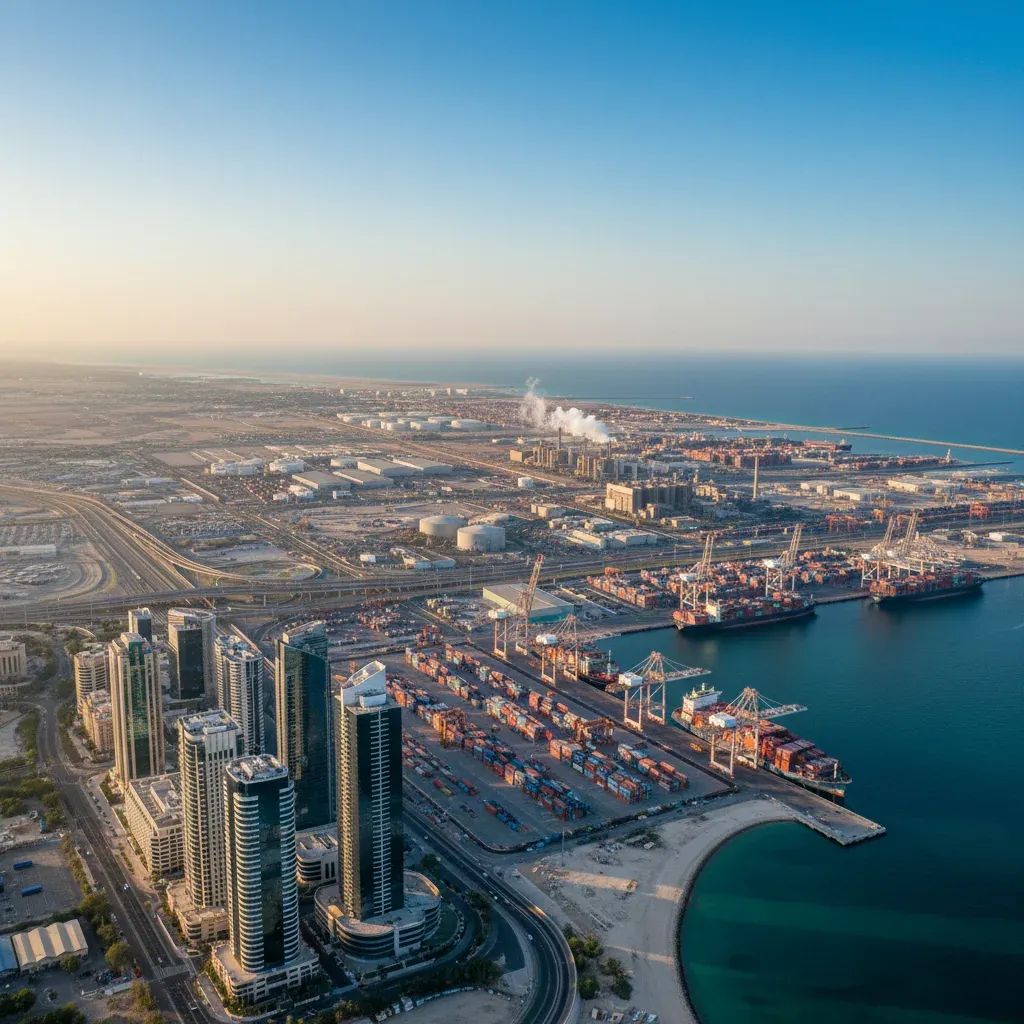
The logistics sector—specifically ports and warehousing—stands to benefit most. According to port authority figures, Jebel Ali Port, the region's largest container terminal, recorded a 12% throughput decline in late February as shipping lines rerouted away from the Gulf. Gradual normalization could restore that volume within weeks, lifting revenues for UAE port operators and freight forwarders.
Aviation is the clearest winner. Emirates and Etihad Airways have maintained northern detours around Iranian airspace at considerable fuel penalty. Restored routes through Iraq and Syria would reduce flight times to Europe by up to 90 minutes on single routes, compounding savings across daily operations. At current fuel prices, this could save each carrier approximately $50,000 to $80,000 USD (approximately 180,000 to 290,000 AED) per day in combined operational costs. The UAE Civil Aviation Authority has not yet confirmed route restoration timelines, but industry sources expect preliminary discussions within days if the ceasefire holds.
For consumers, the impact is indirect but meaningful. Fuel surcharges on imports, which have inflated roughly 4–6% since the conflict escalated, should decline if aviation costs fall and shipping normalizes. Grocery prices, which track imported goods heavily in the United Arab Emirates, may see modest relief in coming weeks if de-escalation continues.
How Neighbors Are Calibrating Their Response
Iraq has cautiously endorsed the ceasefire. Prime Minister Mohammad Shia al-Sudani immediately reaffirmed that Iraqi territory will not serve as a launch pad for attacks on Iran, essentially underwriting Pezeshkian's condition. Baghdad walks a perpetual tightrope between Iranian-backed militias and American military advisers, so this stance is unsurprising—Iraq gains if conflict subsides but risks Iranian displeasure if it cooperates too openly with Washington.
Syria, where Iranian military forces have maintained a presence since 2015, has been quieter. President Bashar al-Assad issued perfunctory gratitude for Iran's support but hasn't publicly commented on enforcement mechanisms. Assad's restraint likely reflects awareness that Syrian territory has become contested ground—Israeli aircraft operate regularly, and American special forces occupy the southeast. Detailed commitment to the ceasefire could expose Syria to U.S. scrutiny.
Turkey is diplomatically more assertive. President Recep Tayyip Erdoğan condemned both the American-Israeli strikes and Iran's retaliation, offering to mediate between Washington and Tehran. This positioning serves Ankara's interests: Turkey is a NATO member but maintains roughly $5 billion in annual trade with Iran, making neutrality profitable. Erdoğan's offer to mediate serves both diplomatic and economic interests.
Azerbaijan presents complications. On March 5-6, Baku accused Iran of drone attacks on its Nakhchivan exclave, a statelet geographically separated from the country. Tehran denied the claim and blamed Israel. Azerbaijani President Ilham Aliyev called the incidents "terrorist acts" but simultaneously assured Iran that Azerbaijani territory would not host operations against it. This rhetorical contortion—condemning Iranian aggression while pledging non-cooperation with Iran's enemies—shows how conditional ceasefires can produce awkward diplomatic theater.
The American Position: Maximalism Unshaken
The United States government rejected Pezeshkian's overture within hours. President Donald Trump restated demands for Iran's "unconditional surrender," language Pezeshkian publicly mocked as "a dream they should take to their grave." Treasury Secretary Scott Bessent warned of an "even more intense bombing campaign" forthcoming, signaling Washington's intent to press its military advantage rather than negotiate.
This divergence is fundamental. The U.S.-Israeli campaign aims to dismantle Iran's nuclear program and induce regime change—objectives Tehran categorizes as existential threats. A conditional ceasefire with neighbors doesn't address those demands, so American and Israeli planners see little reason to modulate pressure. Pezeshkian's peace offer, in effect, was directed at regional players, not Washington.
Economic Ripples for the UAE and Beyond
The United Arab Emirates has substantial economic exposure to regional stability. Beyond the immediate supply-chain and aviation benefits, deeper financial implications matter. The UAE Central Bank has quietly advised commercial lenders to prepare for potential additional U.S. sanctions if Iran's behavior deteriorates. Banks with correspondent relationships in New York—essential for dollar transactions—have tightened compliance procedures on Iran-linked transfers, adding friction to legitimate trade.
Oil markets remain volatile. According to market data, Brent crude has oscillated between $78 and $92 per barrel since the conflict escalated. Much of that swing reflects blockade concerns: if Iran were to close the Strait of Hormuz, through which roughly 30% of global seaborne oil moves, prices would spike dramatically. Pezeshkian's pledge to spare neighboring states theoretically reduces blockade risk, though the exclusion of U.S. and Israeli targets leaves room for escalation if those actors attack Iranian territory again.
For UAE exporters—particularly those shipping non-oil goods through regional ports—route normalization directly improves margins. A 5-8% reduction in logistics costs per shipment, compounded across thousands of daily transactions, adds up to tens of millions of AED annually.
Enforcement: The Weak Link
Pezeshkian's ceasefire is contingent on neighboring states preventing attacks from their territory—a condition fraught with attribution problems. Non-state militias operate across porous borders. Israeli intelligence services conduct covert operations with regular impunity. American special forces maintain undisclosed bases in the region. Determining whether a drone strike originates in Iraq or Israel, or whether a particular cell acts independently or under foreign direction, is often impossible.
The interim leadership council in Tehran, which includes Pezeshkian alongside senior clerics, lacks institutional authority equivalent to Khamenei's office. Internal factions—particularly the Islamic Revolutionary Guard Corps, which historically operates with considerable autonomy—may challenge the ceasefire if it conflicts with their strategic calculus. A mid-level commander's decision to launch a retaliatory strike could unravel the entire arrangement.
What UAE Residents Should Do Now
For business travelers to Iraq and Syria:
• Maintain comprehensive travel insurance and security protocols despite the ceasefire
• Monitor daily GCAA updates on airspace status; don't assume permanent route restoration
• Brief home offices on realistic timelines—normalization may take weeks, not days
For logistics companies and freight forwarders:
• Begin preliminary discussions with port authorities about route restoration schedules
• Update supply-chain models with contingency plans if the ceasefire deteriorates
• Track Jebel Ali Port throughput weekly; volume recovery will signal sustained de-escalation
For UAE consumers:
• Expect modest price relief on imported goods within 4-6 weeks if aviation costs decline
• Monitor grocery prices for surcharge reductions on key imports
• Don't anticipate dramatic price drops; relief will be gradual and incremental
For investors and business stakeholders:
• Oil price volatility will likely persist; regional de-escalation alone won't stabilize markets
• Prepare contingency financing if renewed escalation forces additional supply-chain rerouting
• Dollar liquidity may remain tight due to compliance tightening on regional transactions
The Outlook: Cautious and Conditional
For United Arab Emirates residents and businesses, the pragmatic takeaway is guarded optimism tempered by vigilance. Regional travel should be reassessed continuously rather than assumed permanently safer. Companies with Iraq-based operations should monitor enforcement daily—one misattributed strike or deliberate violation could reverse gains overnight. Firms with Syrian assets face similar uncertainty amplified by Syria's status as an ongoing conflict zone.
The core reality is that Pezeshkian bought breathing room for his interim government, signaling restraint to the region while preserving Iranian strikes against American and Israeli targets. This compartmentalization may hold for weeks or months, particularly if Trump's threatened intensification doesn't materialize immediately. But the underlying conflict—rooted in American regime-change ambitions and Iranian assertions of regional influence—remains unresolved. The ceasefire is tactical, not strategic. For those living and working in the United Arab Emirates, that distinction determines everything from supply-chain planning to insurance costs.


