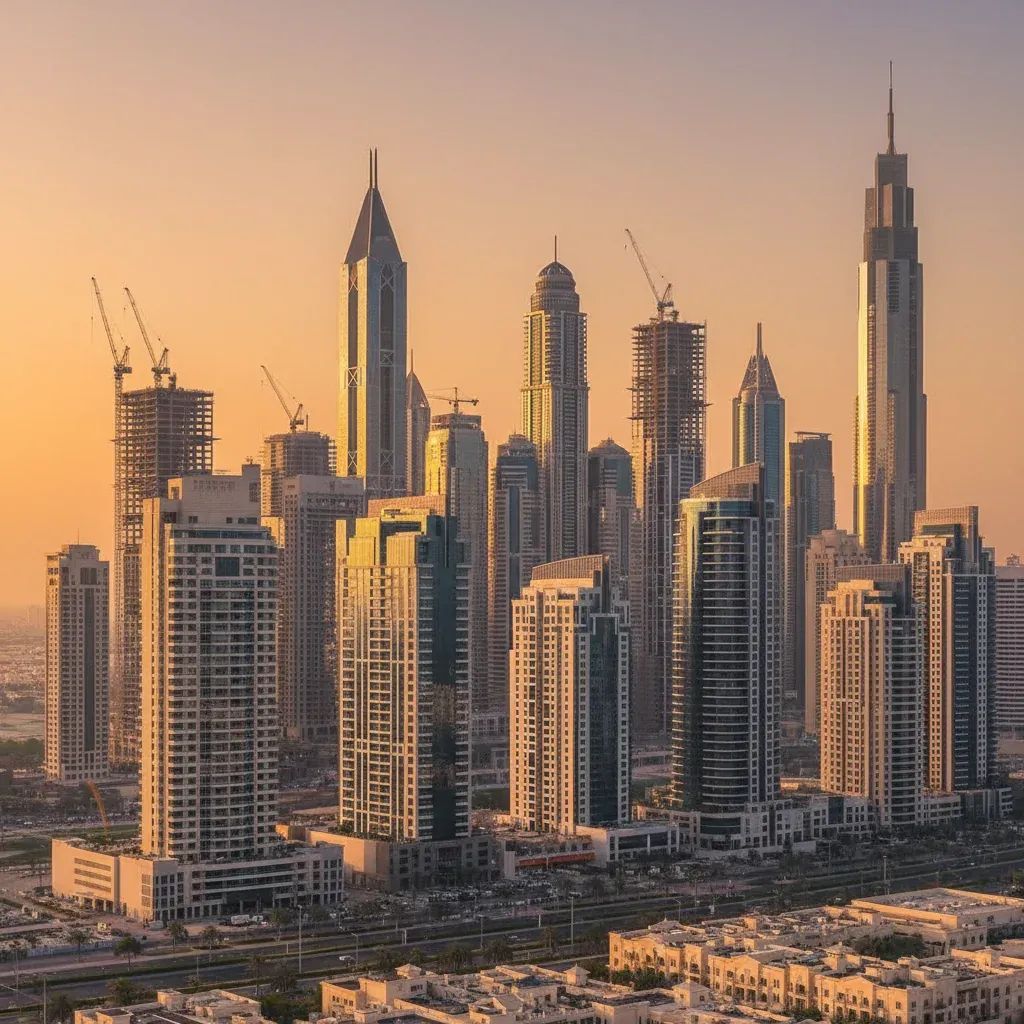
A Week in Dubai's Real Estate Machine: What AED 11.3 Billion Tells You About the Market
One week of property transactions in Dubai totaled AED 11.3 billion across 4,086 deals—a figure that captures neither melodrama nor market panic, but rather the steady hum of a real estate ecosystem that has learned to function without constant excitability. For residents and investors evaluating where to position themselves, this snapshot matters less for its headline number than for what lies beneath: the velocity, the types of deals moving, and the geographic pressure points.
Why This Matters
• Off-plan activity remains strong: In this week's reporting, off-plan properties accounted for AED 4 billion across 2,313 deals, reflecting sustained investor appetite for construction-stage assets despite moderation from 2024's peak activity.
• Buyer diversity sustains volume: Sales, mortgages, and gift transfers each played distinct roles, signaling participation from multiple cohorts: owner-occupants, leverage-seeking investors, and families restructuring wealth.
• Geographic winners emerging: Five neighborhoods captured nearly AED 2.1 billion of the week's sales, indicating that infrastructure proximity and masterplan maturity now matter more than mere project launches.
The Composition: Who Bought What
The week divided into three transaction categories. Straight sales—the cleanest metric of genuine buyer appetite—generated AED 7.4 billion from 3,111 deals. Residential units dominated this category with 2,797 sales, though land purchases (167 deals) and building sales (146 deals) provided evidence of investor interest beyond standard apartment acquisition.
Mortgage registrations added AED 2.5 billion through 738 filings, with residential units again leading (444 loans), followed by land mortgages (189) and building financings (105). This distribution matters: if buyers were predominantly cash-driven speculators, mortgage volumes would languish. Instead, financing activity remained robust, suggesting a meaningful proportion of purchasers were long-term residents or international investors seeking leverage within the UAE Central Bank's current 3.65% base rate environment.
For UAE residents pursuing mortgages, key mechanics to understand include: LTV (Loan-to-Value) limits typically cap at 80% for UAE nationals and 75% for expatriates; most banks require salary transfers to their institution; minimum income thresholds generally start at AED 5,000 monthly; and pre-approval processes typically take 3-5 business days. Current mortgage products range from 3.99% to 4.44% fixed rates for up to five years, offering predictability in your monthly payments. Ensure your employer's salary documentation is current and that you've verified your credit status before approaching lenders.
Gift transfers—often overlooked in casual reporting—moved AED 1.2 billion through 237 transactions. For expat families and high-net-worth individuals, these represent deliberate estate planning mechanics: consolidating assets under beneficiaries' names, repositioning portfolios ahead of residency transitions, or establishing generational wealth within UAE legal frameworks that exempt inherited residential real estate from taxation. The volume signals active wealth management activity rather than distressed circumstances.
Off-Plan vs. Ready Properties: This Week's Split
During this reporting week, off-plan properties generated AED 4 billion from 2,313 transactions, while ready and near-ready projects delivered AED 3.3 billion from 798 deals. This week's split reflects developer payment structures that allow capital deployment across construction phases rather than lump-sum settlement, but it also reveals something subtler: buyers are increasingly filtering by developer credibility and delivery history rather than chasing every launch announcement.
Developers like Azizi Developments and Emaar have benefited from this selectivity. The market has absorbed enough new launches that investors now compare competing projects on fundamentals—connection to Metro expansions, school proximity, rental absorption rates—rather than purchasing on momentum alone. The result: stronger projects capture disproportionate attention, while secondary-location launches struggle to attract their initial targets.
Geographic Concentration: Infrastructure as Currency
The week's highest-value neighborhoods tell a coherent story about what's driving demand. Airport City led with AED 611 million in transactions, benefiting from proximity to the expanded Al Maktoum International Airport and its logistics-driven development corridor. Business Bay followed with AED 426 million, sustained by established office-to-residential connectivity and accessibility to downtown employment clusters. Seih Shuaib 3, Um Suqeim First, and Palm Deira filled the remaining top five, collectively representing AED 981 million.
What unites these neighborhoods is predictable access. Business Bay residents commute reliably to DIFC and financial services hubs (typically 10-15 minutes by car during off-peak hours). Airport City benefits from both logistics employment and the forthcoming Dubai South megaproject. Seih Shuaib's industrial-adjacent positioning attracts both investors seeking stable rental demand and owner-occupants in skilled trades. Price per square foot in these established zones typically ranges from AED 1,200-1,800 for apartments, compared to AED 800-1,200 in emerging areas further south. In contrast, peripheral zones with speculative launches but limited infrastructure anchors have seen transaction velocity decline relative to 2024 levels.
A villa under construction on Palm Jumeirah sold for AED 69 million during the week—a reminder that luxury waterfront properties maintain distinct pricing mechanics from mainstream residential. Similarly, an off-plan apartment in the same area transacted at AED 41 million, reflecting the Palm's premium positioning despite it being a saturated masterplan. These high-value deals depend less on volume and more on buyer-seller alignment on unique assets, not broader market direction. For context, Palm Jumeirah luxury units command AED 8,000-12,000 per square foot, placing them in an entirely different buyer category.
What Foreign Capital Is Actually Doing
International investors contributed materially to the week's activity, though tracking their precise share remains opaque. Public data from the Dubai Land Department doesn't segregate transactions by buyer nationality, but several patterns indicate sustained foreign participation. First, the resilience of freehold zones—Downtown Dubai, Dubai Marina, Jumeirah Village Circle, Palm Jebel Ali—where non-citizens can hold indefinite ownership, suggests that foreign capital continues to flow into properties where title clarity is unambiguous.
Second, the prevalence of off-plan sales aligns with international buyer preferences. Flexible payment schedules appeal to investors who want to deploy capital gradually and who may be coordinating purchases across multiple markets. Foreign buyers also dominate the luxury segment (properties above AED 5 million), where the week's individual deals suggest sustained demand despite global wealth concentration anxieties.
Third, mortgage financing volumes signal that international buyers aren't exclusively cash-driven. UAE banks now offer fixed-rate products between 3.99% and 4.44% for up to five years, creating predictability for foreign investors unfamiliar with local lending mechanics. This accessibility removes a friction point that previously deterred international leverage-based purchases. For expat residents, this competitive mortgage environment means you should shop across multiple lenders—annual percentage rates and processing fees vary significantly, and pre-approval from one bank provides leverage to negotiate better terms with others.
The Golden Visa program—granting 10-year residency for property investments of AED 2 million or more—continues to act as a powerful pull factor. For high-net-worth individuals from developed markets, acquiring a UAE property coupled with long-term residency transforms real estate from a pure investment into a lifestyle and succession planning asset. Families can position children in international schools, establish business presence within UAE regulatory frameworks, and access regional investment opportunities without annual visa renewals.
Market Velocity and Transaction Patterns
The AED 11.3 billion weekly figure represents robust ongoing activity in the Dubai market. Current transaction volumes demonstrate sustained demand from both end-users seeking housing and investors evaluating entry points.
The proliferation of deals across various price segments suggests that end-users now comprise a meaningful share of buyers, with purchasing driven by functional housing needs rather than speculative positioning. A residential market serving millions of expat and Emirati residents requires consistent transaction volume for normal population turnover, employment-driven relocation, and life-stage housing transitions.
For expatriates and resident investors, this environment carries important tactical implications. Rental yields continue to range between 5% and 12%—multiples above London or New York—but the spread between high-performing and average projects has widened. A property in an established community with strong school access and Metro connectivity might yield 8-10%, while a similar-priced unit in a newly completed masterplan with uncertain rental absorption could yield 4-5%. Selectivity has transitioned from optional to essential.
Supply, Delivery, and Practical Considerations
The Dubai real estate market experiences ongoing new project launches, with developers managing construction timelines across multiple developments. Historical data suggests that announced completion windows sometimes extend beyond initial projections due to construction sequencing, permitting processes, and unforeseen site-specific factors. Neighborhoods experiencing multiple concurrent megaprojects may see different absorption patterns than single-project communities.
Buyers evaluating entry points should prioritize developer track record over launch-phase enthusiasm. Emaar, DAMAC Properties, and Binghatti maintain superior completion discipline. Projects with adjacent Metro stations or planned school developments command better long-term value, not for speculative reasons but because occupancy and rental stability improve with amenity proximity. The affordable-luxury segment (AED 1 million to AED 3 million) remains the most liquid tier, driven by end-users seeking quality housing at achievable price points.
Interest Rate Environment and Capital Cost Dynamics
The UAE Central Bank's 3.65% base rate creates financial conditions distinct from Western markets. With federal funds rates in the US potentially declining through 2026, mortgage products available at 3.99-4.44% offer predictable long-term financing costs for UAE residents. For international investors comparing Dubai property investment against alternatives—U.S. commercial real estate, European residential, Asian emerging markets—the combination of stable local rates, favorable tax treatment, and residency optionality tips the risk-return calculation toward Dubai acquisition.
However, any resurgence in global inflation or unexpected monetary tightening would reverse this dynamic. Investors should model scenarios in which mortgage rates rise to 5-5.5%, testing whether projected rental yields still justify acquisition at current price points. For properties in oversupplied submarkets, deteriorating financing conditions could materially compress valuations. As a UAE resident, monitor both local Central Bank announcements and global monetary policy trends, as they directly affect your borrowing costs and property valuations.
The Investor Takeaway
The AED 11.3 billion weekly transaction volume reflects a market in which infrastructure-driven decisions increasingly override speculation-driven impulses. International capital continues flowing toward Dubai, drawn by regulatory clarity, superior rental yields, tax advantages, and residency incentives. The consistent transaction activity demonstrates that Dubai's real estate market serves genuine housing demand from a growing, diverse population alongside investor capital seeking favorable risk-return profiles.
For residents navigating purchase decisions this quarter, the fundamentals favor infrastructure-adjacent developments with proven developer delivery records. Off-plan properties remain viable if they offer realistic payment structures and credible project timelines, but the days of reliably capturing 20-30% appreciation through launch-phase discounting have passed. The market now rewards diligence, patience, and familiarity with specific developer and neighborhood mechanics over headline-chasing.
When evaluating a purchase, verify these practical factors: commute time to your workplace, proximity to your children's school (if applicable), current rental data for comparable units in the community, the developer's historical delivery track record, and whether the property's price per square foot aligns with comparable recent sales in that neighborhood. Global property investors should monitor mortgage rate trajectories and supply completion timing in their target neighborhoods, but the underlying drivers—consistent population influx, economic diversification, regulatory stability—remain intact. Dubai's real estate market has matured into one where capital flows are sustainable precisely because they're rooted in demographic and economic fundamentals rather than perpetual price escalation.