
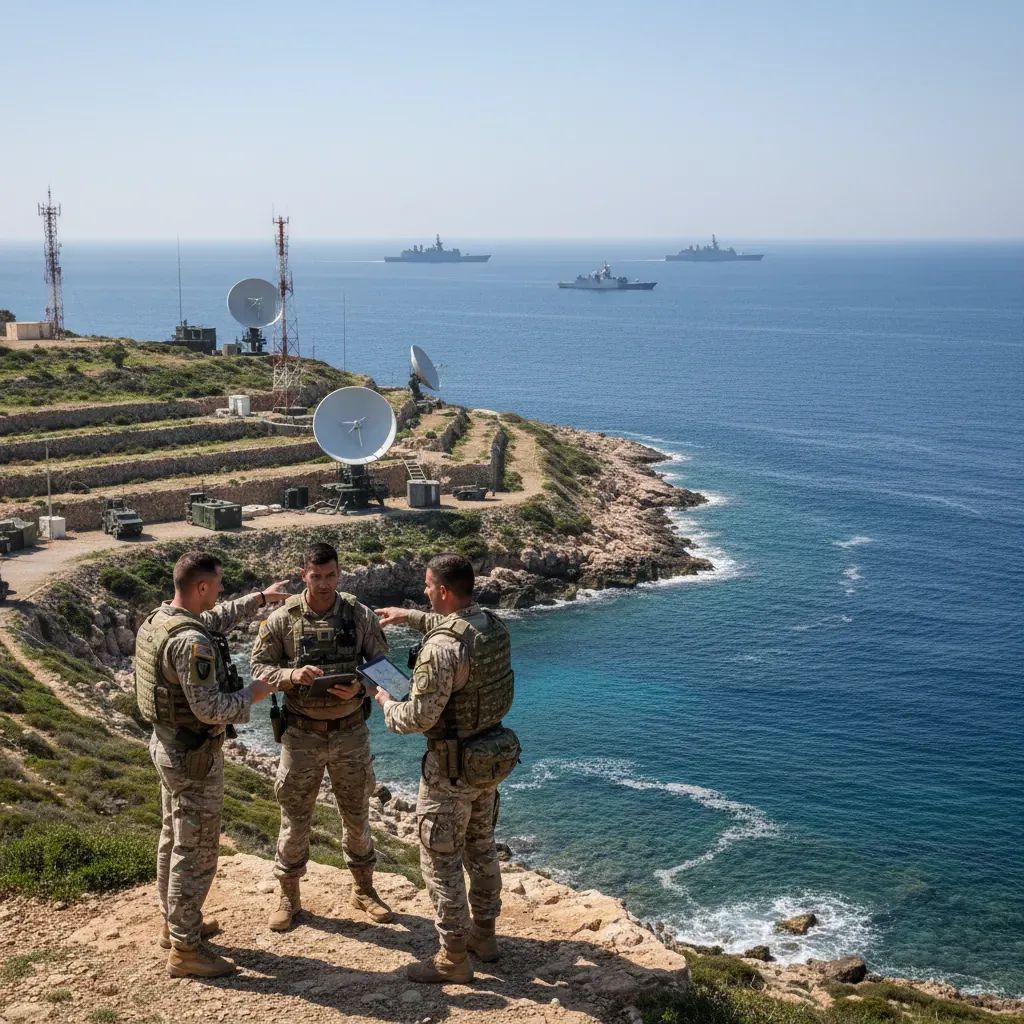
The French government has committed to deploying advanced anti-missile and counter-drone defense systems to Cyprus, following a series of drone strikes on the British RAF Akrotiri military installation that marked the first direct attack on the facility in four decades. The deployment, confirmed by President Emmanuel Macron in direct talks with Cypriot President Nikos Christodoulides, underscores the escalating security challenges facing the Eastern Mediterranean as regional tensions spill into European sovereign zones.
Why This Matters
• Regional spillover: The recent drone attacks—involving what are believed to be Iranian-made Shahed drones, with attribution to Hezbollah or Iran still under investigation—demonstrate that Middle Eastern conflict zones now directly threaten European military assets and civilians in Cyprus.
• For UAE residents: The attacks highlight Iran's expanding drone capabilities and demonstrated willingness to strike Western military targets outside immediate conflict zones. This raises important questions about similar vulnerabilities across the Gulf region, where U.S. and allied forces maintain significant military presence and where drone proliferation poses growing regional security concerns.
• French commitment: Paris will send at least one frigate and possibly a second, along with layered air defense systems capable of intercepting missiles, aircraft, and low-cost UAVs.
• Broader coalition response: Greece has already dispatched four F-16 fighter jets and two frigates, while the UK reinforced counter-drone capabilities at Akrotiri and evacuated military families from the base.
• Expat implications: The heightened military posture and security alerts affect the tens of thousands of British citizens and international workers living near the Sovereign Base Areas in southern Cyprus.
The Incident That Triggered the Deployment
Shortly after midnight on March 1, a drone believed to be Iranian-made Shahed-type struck the RAF Akrotiri airfield, causing minor material damage but no casualties. The impact prompted a partial evacuation and shelter-in-place orders for base residents. Cypriot authorities intercepted two additional UAVs the following morning as they approached the British installations, though initial reports suggested these drones may have crashed into the Mediterranean Sea before reaching their targets.
The strike represents the first hostile attack on RAF Akrotiri since 1986, a symbolic threshold that has galvanized European defense ministries. British officials believe the first drone was launched before London announced it would allow U.S. forces to use UK airbases for strikes on Iranian missile sites, though the timing remains contested. The Royal Air Force later confirmed that F-35B Lightning stealth fighters based at Akrotiri engaged and destroyed drones over Jordan in a separate incident, marking the first live combat deployment of these jets from the Cypriot facility.
What France Is Sending
France is deploying its SAMP/T air defense system, a European-developed platform comparable in capability to the American Patriot system. The system is designed to intercept cruise missiles, tactical ballistic missiles, manned aircraft, and both traditional and unmanned aerial threats. The system provides 360-degree coverage with an intercept range exceeding 150 kilometers and enhanced defenses against hypersonic threats.
France's anti-drone strategy emphasizes layered, cost-effective responses rather than relying solely on expensive interceptor missiles. The deployment will include both traditional interceptor missiles and electronic jamming technology designed to disrupt drone control signals and navigation systems. Additional elements include detection suites designed to identify low-altitude, slow-moving UAVs that evade traditional radar systems.
The naval component—at least one French frigate, with a second potentially en route—will provide both offshore air defense and command-and-control capabilities for the integrated defense network. The vessels will carry long-range surveillance radars and vertical-launch interceptor cells, creating a mobile defense capability that extends beyond Cyprus's coastal perimeter.
Impact on Residents and Regional Stability
For the British military families stationed at Akrotiri and Dhekelia, the recent attacks have already altered daily life. Personnel dependents were evacuated from the base and relocated to other areas of Cyprus as a precautionary measure. The UK Ministry of Defence has also deployed the Royal Navy destroyer HMS Duncan to the eastern Mediterranean, reinforcing the naval cordon around the island.
The Cypriot government finds itself in a delicate position. President Christodoulides has repeatedly emphasized that Cyprus is not a party to military operations and intends to maintain neutrality, yet the island's geography places it squarely within the operational theater of the wider Iran-Israel-U.S. conflict. The presence of British Sovereign Base Areas—legally UK territory but physically embedded within Cyprus—complicates this neutrality, as attacks on those zones can trigger broader security responses that affect the entire island.
Greek support has been immediate and unequivocal. Athens dispatched two frigates, including the advanced FDI HN frigate Kimon, equipped with cutting-edge radar and ASTER missile systems. Greek officials have publicly stated that any threat against Cyprus is unacceptable, reinforcing historic defense ties between the two nations. The four Greek F-16s now operating from Cypriot airspace provide an additional layer of rapid-response capability against both manned and unmanned aerial threats.
Broader Security Concerns
Beyond the immediate military response, Cypriot authorities are grappling with internal security risks. Intelligence agencies have raised concerns about potential security threats linked to Iranian nationals residing in the Turkish-occupied northern Cyprus (a breakaway territory recognized only by Turkey since 1974), a zone beyond the control of the Republic of Cyprus. Security measures along the UN-surveilled Green Line are being strengthened to prevent cross-border infiltration or coordinated attacks.
The presence of thousands of Israeli citizens in Cyprus—either as tourists or temporary residents—adds another layer of complexity. Cypriot security services are monitoring for potential actions by Hamas-affiliated cells or other groups opposed to Israel's regional operations. The European Commission has decided to maintain heightened vigilance and is coordinating with Europol on internal security risks related to the escalating Middle Eastern tensions.
Previous warnings about Cyprus vulnerability proved prescient. In June 2024, the late Hezbollah Secretary-General Hassan Nasrallah publicly threatened to strike Cyprus if Israel used the island's military infrastructure for attacks against the group. That warning, initially dismissed by some analysts as rhetorical posturing, now appears to have reflected serious strategic intent.
NATO's Evolving Drone Defense Posture
France's deployment is part of a broader NATO adaptation to the proliferation of low-cost, high-impact drone technology. Across the alliance's eastern flank, member states are fielding systems like the Merops counter-drone platform, a compact, AI-driven solution that integrates radar, optical sensors, and autonomous interceptor drones. Poland, Romania, and Denmark have already deployed Merops units, which are designed to function even under heavy electronic warfare conditions.
The United States maintains Aegis Ballistic Missile Defense ships in the Mediterranean, equipped with SM-3 interceptors capable of engaging ballistic missiles at high altitudes. The UK's Type 45 destroyers, armed with the Sea Viper system, can launch multiple missiles simultaneously and guide them to separate targets, providing a robust shield against coordinated drone swarms.
Germany is also expected to approve the dispatch of a frigate to the region following a formal request from Nicosia, further thickening the defensive cordon around Cyprus. The collective NATO response reflects a recognition that Eastern Mediterranean security is now a shared concern, with direct implications for European airspace, maritime trade routes, and the safety of military and civilian populations across the region.
What Comes Next
The French anti-drone and missile systems are expected to arrive in Cyprus within the coming weeks, though official deployment timelines remain classified for operational security reasons. The systems will likely be integrated with existing Greek and British air defense networks, creating a unified command structure capable of sharing real-time threat data and coordinating intercepts across multiple layers.
For residents, the enhanced military presence may bring reassurance but also serves as a visible reminder of Cyprus's proximity to conflict zones. The island's role as a logistics hub, energy transit point, and host to Western military installations ensures it will remain a focal point in regional security calculations. Whether the increased defensive posture deters further attacks or simply shifts aggressor tactics toward other targets remains an open question, one that European defense ministries are watching closely as regional tensions evolve.


