
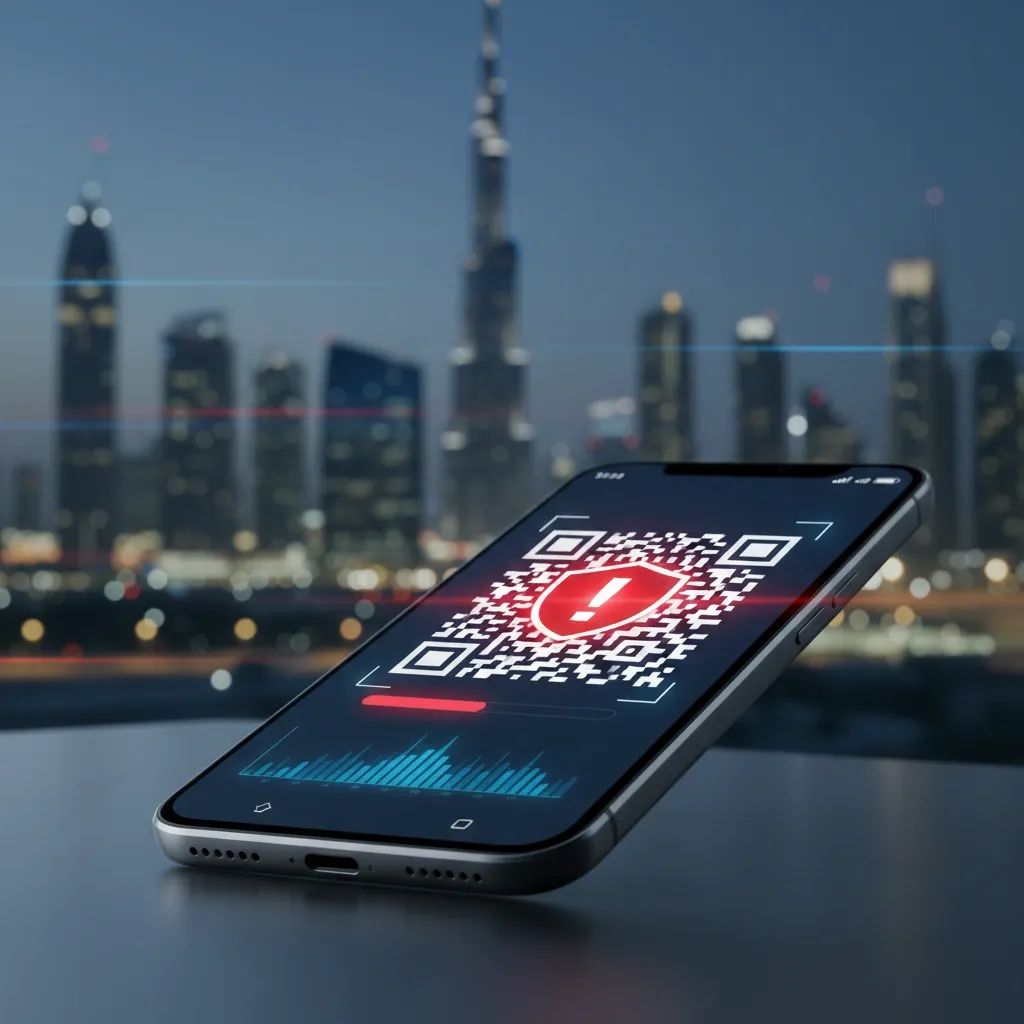
Residents of Dubai are scanning QR codes without realizing the risks. The Dubai Police have issued warnings about malicious QR codes that have become an entry point for financial theft and credential hijacking. The threat is real—it's embedded in parking meters, restaurant tables, delivery packages, and unsolicited emails flooding inboxes.
Why This Matters
• One scan can compromise accounts: Fraudulent QR codes redirect users to fake payment pages or login portals designed to harvest banking credentials and one-time passwords.
• Physical stickers are everywhere: Criminals are overlaying fake codes on parking systems and restaurant payment points—locations where residents let their guard down.
• Users often don't verify: Many people scan codes without checking where they're actually going or verifying the source.
• Personal data at risk: Some codes may trigger downloads or redirect to phishing sites that compromise banking and personal information.
The Anatomy of a Modern Scam
QR code fraud works through social engineering combined with technical attacks. Cybercriminals craft QR codes accompanied by urgent-sounding messages—promising rewards, claiming security alerts, or mimicking government notices. The bait is distributed through three primary channels: unsolicited emails, physical stickers overlaid on legitimate codes, and packages containing codes labeled with tracking language.
When scanned, these codes often redirect to near-perfect replicas of banking portals or official login screens. The visual difference might be subtle—slight discoloration, air bubbles, uneven edges—but residents scanning quickly rarely notice.
Physical tampering is a common tactic. A scammer places a sticker over the legitimate QR code at a parking meter. When a resident scans it to pay, their payment details flow directly to a criminal account rather than the municipal system.
What This Means for Residents
Falling victim to a malicious QR code can have serious consequences. Once compromised, criminals can access bank accounts, email accounts, and stored financial data. A single misjudgment has the potential to compromise multiple accounts and personal information simultaneously.
Yet the Dubai Police emphasize a critical truth: no legitimate organization in the United Arab Emirates will ever request PINs, passwords, or verification codes through phone calls, SMS messages, or unverified digital links. When such requests arrive—whether framed as security alerts or urgent notices—they are invariably fraudulent.
The immediate protection lies in behavioral change. Before scanning any QR code, ask three questions: Is the code from a trusted source? Does the context make sense? Are there visible signs of tampering? If you're uncertain, don't scan.
Safe Scanning Practices
When scanning is necessary—such as ordering from a restaurant's digital menu—visually inspect the code for inconsistencies. Look for stickers with uneven edges, color mismatches, or air bubbles. Ask staff whether the code is official. Preview the resulting URL before opening it. Legitimate URLs begin with "https://" and display recognizable domain names. Shortened URLs, unusual character combinations, or obvious misspellings are warning signs.
Practical Action Steps from Dubai Police
The Anti-Fraud Centre at the General Department of Criminal Investigation has issued specific guidance:
Before you scan: Verify the source. If the code is a physical sticker, ask the establishment whether it's official. Avoid codes from unknown sources, particularly those in unrequested emails or SMS messages. Check for visual signs of tampering.
After scanning: Pause before entering information. Preview the URL. Ensure it begins with "https://" and the domain matches what you expect. Never proceed from shortened URLs or sites with obvious spelling errors in the domain.
Never provide: Personal identification numbers, banking credentials, or passwords on any site accessed through an unverified QR code. If a website requests immediate payment information or sensitive data upon loading, exit immediately. Contact the organization directly using a phone number from their official website to verify whether the request was legitimate.
Report suspicious activity immediately: Contact your bank immediately if you believe you've been compromised, then escalate to authorities using the eCrime platform or by calling 901 for non-emergency reporting.
The Broader Threat Landscape
QR code fraud doesn't exist in isolation. The Dubai Police have simultaneously intensified warnings about impersonation scams, where fraudsters pose as government representatives or banking staff to extract sensitive information through phone calls and SMS messages. Phishing campaigns exploiting various tactics have become more common, using urgency to override caution.
For residents, the message from authorities is clear: treat every QR code as potentially malicious until you've verified its legitimacy. That single moment of verification—inspecting the code, confirming the source, previewing the URL—is the barrier between convenience and compromise. Individual awareness remains the most effective defense against QR code fraud.


