
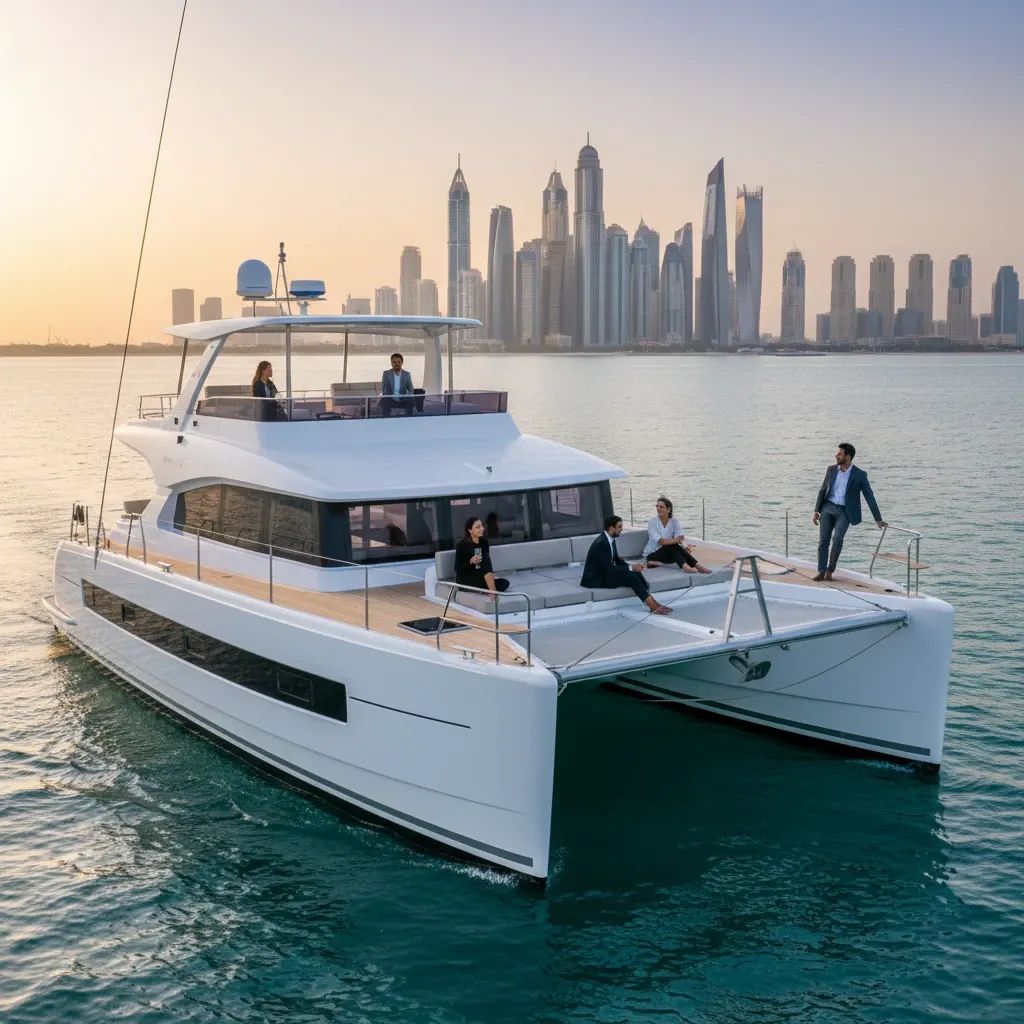
The founder of Chinese e-commerce giant JD.com has entered the yacht business with a provocative promise: vessels priced at roughly $14,500, a figure that positions recreational boating somewhere between a used Honda Civic and a new Jet Ski. Sea Expandary, the venture backed by billionaire Richard Liu, is targeting what the company calls "ordinary salaried workers" in a bid to strip the exclusivity from an industry long associated with oligarchs and hedge fund managers.
Why This Matters:
• Price disruption: At $14,500, these yachts cost less than half the annual salary of many middle-income professionals in the United Arab Emirates, potentially democratizing an activity previously reserved for the ultra-wealthy.
• Regional implications: While U.S. tariffs on Chinese boats now exceed 50%, markets in Asia and the Middle East could see these vessels arrive with fewer trade barriers, reshaping local recreational marine industries.
• Strategic shift: China's government is leveraging its dominance in commercial shipbuilding—over 50% of global merchant fleet production—to pivot toward recreational maritime tourism, a sector historically controlled by European and American brands.
The Business Model Behind the $14,500 Yacht
Sea Expandary has inked strategic framework agreements with Shenzhen and Zhuhai, two coastal cities in Guangdong province, to establish an integrated manufacturing base. The venture, which carries an investment envelope of approximately $723 million (5 billion yuan), will consolidate research, production, sales, and after-sales support under one industrial ecosystem.
Liu himself has pledged long-term capital but will remain focused on JD.com's core operations, leaving day-to-day yacht management to a dedicated team. The company's strategy hinges on automation, modular construction, and AI-assisted design—methods borrowed from automotive mass production—to compress costs that have traditionally kept yachts in the luxury stratosphere. Environmental features, including solar panels, wind power integration, and fully electric engines, are marketed as standard, not premium, equipment.
Interestingly, Sea Expandary has already secured orders for five 72-meter catamarans from unnamed international clients, suggesting the company is not limiting itself to the budget segment. This dual approach—entry-level affordability paired with high-end custom builds—mirrors the strategy of electric vehicle manufacturers who use flagship models to subsidize mass-market offerings.
What This Means for Residents and Investors
For expatriates and locals in the United Arab Emirates, the arrival of ultra-affordable yachts could fundamentally alter access to marine recreation. The country's coastline, marina infrastructure, and maritime culture have long catered to high-net-worth vessel owners, but a $14,500 entry point would put yacht ownership within reach of mid-level professionals, potentially spurring demand for slip rentals, maintenance services, and coastal tourism packages.
However, regulatory and logistical questions remain. Will these vessels meet the maritime safety standards enforced by the UAE's Federal Transport Authority? How will resale value compare to established brands? And critically, will tariffs or import restrictions dampen availability in Gulf markets?
The United States has already imposed tariffs exceeding 50% on Chinese-built yachts—a combination of baseline customs duties (around 3%) and elevated trade measures introduced in April 2025 that brought total rates to approximately 54%. Europe, meanwhile, is tightening its own import regime: the Carbon Border Adjustment Mechanism (CBAM), effective January 1, 2026, adds costs to steel and aluminum imports, materials integral to yacht construction. By July 2026, the EU will also eliminate the €150 duty-free threshold on parcels, imposing a flat €3 levy per item category for low-value shipments.
For the UAE, which maintains relatively open trade channels with China, these global tariff walls could create a price arbitrage opportunity. If Sea Expandary vessels enter the Emirates without the punitive levies applied in Western markets, local buyers and charter operators could access a product unavailable—or prohibitively expensive—elsewhere.
China's Domestic Yacht Boom and Quality Concerns
China's recreational boating sector has experienced explosive growth, with registered yachts surging from 4,500 to nearly 10,000 in just three years. The broader yacht market, valued at $445 million in 2025, is forecast to reach $648 million by 2030, reflecting a compound annual growth rate of 7.8%. Private ownership dominates, accounting for over 82% of the market in 2024, while commercial charter operations are expanding at 15.2% annually, driven by tourism initiatives in Hainan Free Trade Port.
Yet the question of quality and safety looms over mass-produced Chinese yachts. Historical issues with electrical systems, plumbing, and structural integrity have dogged some manufacturers, and resale values for Chinese-built vessels have depreciated faster than American or European counterparts. However, industry observers note a marked improvement since 2019, when major Chinese builders began hiring engineers from Western firms and overhauling quality control processes. Brands like Aquila, for example, have earned favorable reviews for their power catamarans, praised for ergonomic design and competitive pricing.
For buyers in the United Arab Emirates, due diligence will be essential. Warranties, dealer reputation, and independent marine surveys should be non-negotiable, particularly for vessels priced at a fraction of the market norm. The lack of a long-term track record in Gulf conditions—where extreme heat, high salinity, and intense UV exposure test materials—adds another layer of uncertainty.
How Traditional Builders Are Responding
Luxury yacht manufacturers are not attempting to compete on price. Instead, they are doubling down on bespoke customization, sustainability, and advanced technology. Zero-emission propulsion systems, hydrogen and methanol fuel cells, and AI-powered navigation are now standard offerings in the high-end segment. Builders emphasize the use of recycled aluminum, bamboo flooring, and bio-based composites, positioning sustainability as a resale necessity rather than a marketing gimmick.
Experiential luxury is also gaining traction: expanded beach clubs, wellness spas, and vessels designed for polar exploration or scientific research cater to ultra-high-net-worth individuals seeking more than simple status symbols. Traditional builders are betting that their clientele will continue to value exclusivity, craftsmanship, and personalized service over cost efficiency.
This strategic divergence creates a bifurcated market: Sea Expandary and its imitators target the emerging middle class in Asia and potentially the Middle East, while European and American yards continue to serve clients who view yachts as floating estates rather than recreational vehicles.
The Long-Term Global Ripple
If Sea Expandary delivers on its price promise and maintains acceptable quality, the ripple effects will extend beyond consumer choice. Marina operators may need to rethink slip pricing and capacity. Insurance underwriters will adjust premiums based on new risk profiles. Coastal governments could see increased demand for maritime infrastructure, from fueling stations to repair facilities.
For the United Arab Emirates, a country with significant maritime ambitions and a growing recreational boating culture, the arrival of affordable yachts could accelerate participation in water sports, boost domestic tourism, and create new service industries. The risk, however, is that a flood of low-cost vessels could overwhelm existing regulatory frameworks or strain environmental protections in sensitive coastal zones.
Whether this venture succeeds in "mass-marketing luxury" or simply floods the market with disposable boats remains to be seen. What is certain is that the $14,500 yacht is no longer a hypothetical thought experiment—it is a signed contract, a funded factory, and a potential disruptor to an industry that has operated on the same economic principles for decades.


