
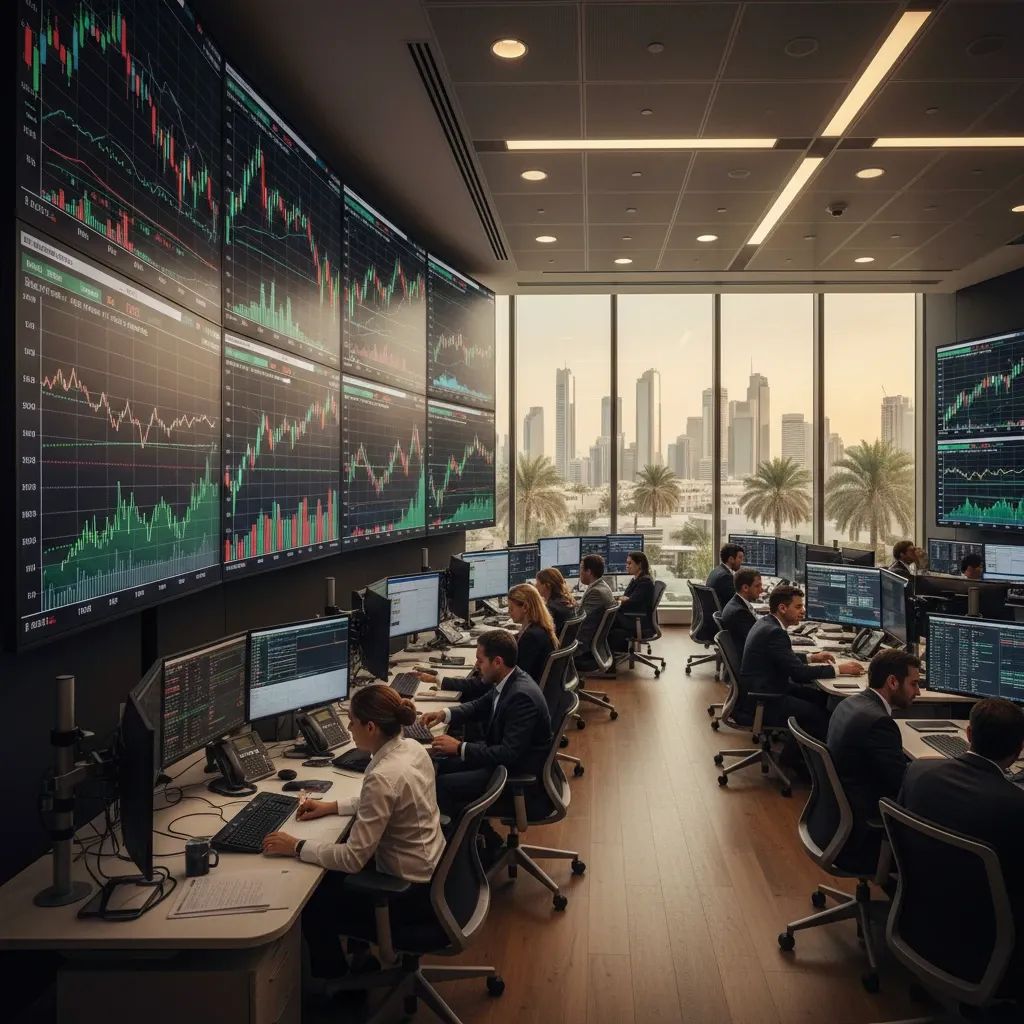
What's Actually Changing
The Abu Dhabi Securities Exchange (ADX) is dismantling a mechanical constraint that has governed every futures and ETF trade on its platform since inception. Effective August 3, 2026, price limits—the daily ceilings and floors that automatically halt trading when an instrument moves beyond a preset percentage—will vanish for Exchange Traded Funds and all derivatives contracts. Equities will retain their existing safeguards for now, but the derivatives market operates under a fundamentally new architecture.
The practical outcome: if crude oil futures spike on geopolitical tension or a tech-focused ETF drops on earnings surprises, prices adjust instantly. No trading pause. No artificial freeze. This is particularly significant for residents and institutions across the United Arab Emirates managing exposure to commodity volatility, currency swings, or cross-border investment flows.
Why This Matters
• Instant hedging: Companies can protect against energy and currency risk in real time rather than waiting for market pauses to lift.
• Competitive execution: Traders no longer need to route orders to London or New York for instruments that behave identically to their Western counterparts.
• Pricing accuracy: ETF and futures prices converge instantly with global benchmarks, eliminating "price band lag"—the costly delay where regional instruments lag global markets.
The Shift From Mechanical Safety to Market Discipline
Until now, ADX operated much like emerging exchanges in Asia and the Middle East: price movements triggering automatic trading halts created a rhythm of disruption and resumption. A sharp drop hits the floor limit, trading stops for 10 minutes, then resumes. A spike hits the ceiling, pause, resume. The original logic was reasonable—protect retail investors from panic spirals and speculative excess. In execution, these bands became friction points at precisely the moments when traders needed speed.
The new structure mirrors mature Western exchanges. The New York Stock Exchange permits ETFs to trade without daily price limits, relying instead on designated market makers to provide continuous liquidity and exchange-wide circuit breakers that activate only during systemic crashes. Deutsche Börse's Xetra platform in Frankfurt uses the same principle: designated sponsors maintain two-way pricing throughout the session, eliminating artificial stops. London Stock Exchange requires registered market makers to honor maximum spreads on ETPs, ensuring price continuity.
ADX is formally adopting this model, signaling that Abu Dhabi considers itself aligned with developed-market standards rather than precautionary emerging-market practice. The exchange retains discretionary authority to impose trading pauses during extreme dislocations—a supervised brake replacing mechanical ones—but such interventions will be deliberate decisions, not automated triggers.
Infrastructure and Liquidity Provider Obligations
This transition places new demands on market makers and liquidity providers. When price bands exist, they naturally compress volatility and narrow the range market makers must defend. Remove the bands, and order book depth and bid-ask spreads become the primary disciplinary mechanism. Tighter spreads mean market makers absorb more risk per transaction; deeper order books signal confidence that demand exists at multiple price levels.
The ADX has invested in platform upgrades to handle this shift. Message throughput has increased. Order book latency has been reduced. Algorithmic traders and proprietary firms gain access to enhanced co-location services—physical proximity to exchange servers, measured in microseconds, that eliminates mechanical execution delays. These investments are not cosmetic; they directly affect whether a trader's limit order executes or sits unfilled during volatile sessions.
For wealth managers and family offices based in the UAE, the practical implication is straightforward: you can now enter and exit positions without hitting an artificial trading halt. A diversified portfolio holding emerging-market ETFs, commodity hedges, or sector-focused funds can be rebalanced during volatile sessions without the friction of waiting for price bands to reset. Execution quality—the actual price you receive versus the price you intended—should improve, particularly during the volatile moments when liquidity is most needed.
Corporate Treasurers and Real-Time Hedging
Energy companies, export-oriented manufacturers, and financial institutions holding foreign currency reserves operate in an inherently risky environment. Crude oil prices swing on geopolitical news. Shipping routes face disruption. Currency pressures affect cross-border commerce. For these firms, hedging is not optional activity; it is operational necessity.
ADX's futures market now permits real-time protection. An energy exporter facing sudden crude price weakness can hedge positions immediately rather than waiting for the next trading session. A manufacturer with foreign currency payables can adjust exposure during the precise window when currency movements demand action. A financial institution managing reserves can implement shifts without watching an instrument freeze while global markets adjust.
Previously, the price band structure created a peculiar penalty: traders on the ADX sometimes experienced worse execution than traders using global venues because they could not execute during the exact moment when hedging was most valuable. That arbitrage disadvantage disappears. A company treasurer managing regional risk can now execute through Abu Dhabi without accepting execution friction as the cost of local trading.
The Derivatives Market Acceleration
This change exists within ADX's broader strategy to establish Abu Dhabi as the derivatives hub for the Middle East and North Africa. In May 2026, the exchange deepened its partnership with Bloomberg, embedding real-time derivatives data and order book visibility into the Bloomberg Terminal. That integration reached over 350,000 financial professionals worldwide, making ADX futures and options accessible to institutional portfolios that previously considered regional derivatives exotic or illiquid.
Institutional demand for derivatives in the MENA region has been climbing steadily throughout 2026, and the appetite reflects genuine risk-transfer needs rather than speculative enthusiasm. Geopolitical volatility persists. Oil prices remain volatile. Currency movements affect cross-border commerce. Shipping disruptions damage profitability. These are not theoretical concerns; they shape daily decisions for any enterprise with material exposure to the Middle East.
Energy and commodity derivatives dominate flows, reflecting the region's economic structure. But the expansion extends to equity index futures, foreign exchange contracts, and fixed-income instruments. With price limits removed, traders respond instantly to global financial announcements, central bank policy shifts, or earnings surprises without watching an ADX instrument freeze while the rest of the world's markets adjust.
Lessons From Saudi Arabia's Market Evolution
Saudi Arabia's experience offers a template for what occurs when structural market barriers fall. In 2021, the Tadawul extended short-selling access to all eligible investors—a technical regulatory change with enormous practical consequences. Pricing efficiency in the Saudi ETF market improved sharply. Premiums and discounts that had reached 38 percentage points collapsed to within 1% to 3%. Arbitrage mechanisms accelerated. Assets under management expanded tenfold over the following years.
That Saudi reform addressed a different bottleneck—retail investors lacked the ability to short-sell, preventing them from correcting mispricings. The underlying principle, however, was identical to ADX's current move: remove the barrier, and prices find their true level faster. Capital allocates more efficiently. Institutional confidence increases.
The Saudi precedent also revealed an underappreciated secondary effect. Once market infrastructure improved, institutional capital that had previously avoided Tadawul migrated in. Hedge funds, regional asset managers, and global proprietary trading firms viewed the reforms as a signal that the exchange was serious about matching international standards. ADX is betting on a similar dynamic. Remove the price limits, modernize the infrastructure, announce the Bloomberg partnership, and institutions previously skeptical of Abu Dhabi Securities Exchange begin to view it as a legitimate venue rather than a regional alternative.
Competitive Positioning Within MENA and Beyond
Abu Dhabi's capital market reforms serve a larger strategic purpose. The emirate has committed to building a diversified, knowledge-intensive economy beyond oil. Sovereign wealth vehicles—the Abu Dhabi Investment Authority and Mubadala—function as patient capital providers for long-term infrastructure and innovation investments. The capital markets are being positioned as the connective tissue linking domestic and international investment flows.
Demand for regional derivatives tied to equity indices, commodities, and fixed-income instruments is rising as Gulf Cooperation Council nations integrate more deeply with North African economies and South Asian financial centers. Firms operating across this expanded footprint require venues where they can hedge and execute strategies efficiently. ADX is positioning itself as that venue by removing execution barriers.
Looking further ahead, ADX is exploring tokenized derivatives through regulatory sandboxes and innovation initiatives. Artificial intelligence and algorithmic trading systems are being incorporated into the platform's architecture. These initiatives remain contingent on ongoing rule-making through the remainder of 2026, but the direction is unmistakable: Abu Dhabi intends to compete as a technology-forward derivatives exchange for a region increasingly requiring sophisticated risk management infrastructure.
The Execution Test Begins
Removing price limits is a structural reform, not a guaranteed efficiency boost. Success depends on whether liquidity providers deliver on the implicit promise: tighter spreads, faster fills, and more reliable price formation. The ADX has committed to maintaining surveillance and discretionary intervention authority during exceptional volatility, providing a safety net while also requiring judgment about when to activate manual trading pauses.
For anyone managing capital, conducting hedges, or executing investment strategies in the Middle East, August 3 marks a transition point. The local market becomes more responsive to information. Execution quality should improve. The trade-off is that the exchange no longer artificially stabilizes price movements; that burden shifts entirely to market participants. For sophisticated traders and institutions, that is an acceptable bargain. For retail investors and less experienced traders, it may require adjustment in risk management discipline and order-placement strategy.


