
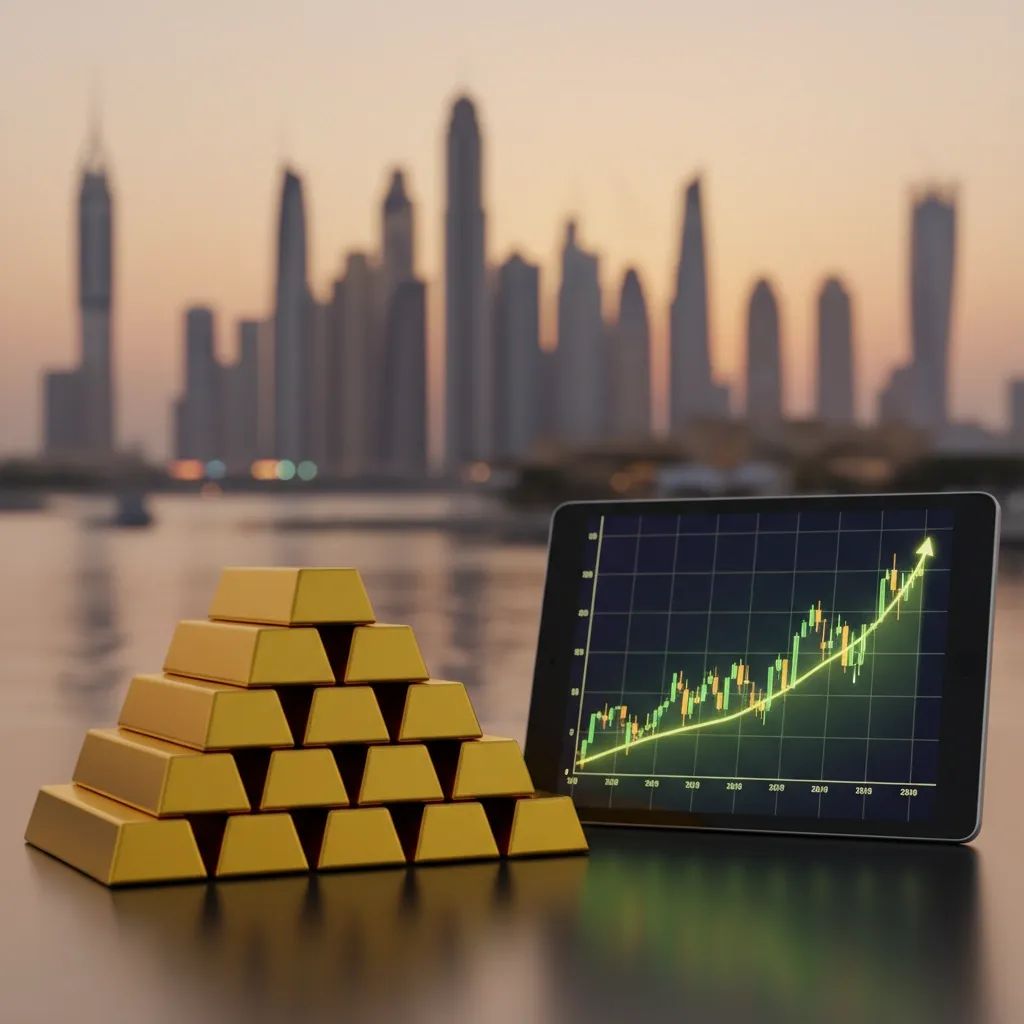
The precious metals complex moved sharply higher on currency flows this morning, with spot gold advancing to $5,112.34 per ounce as the strengthening hands of international investors seized on a softer greenback. For residents and investors managing wealth across the United Arab Emirates, the implications extend well beyond today's price action—this represents a structural shift in how global capital is repositioning amid mounting economic uncertainty.
Why This Matters
• Portfolio hedging becomes urgent: As real interest rates compress and geopolitical flashpoints intensify, gold transitions from a speculative bet to a defensive necessity for UAE-based investors.
• Currency advantage for dirham holders: A retreating dollar reduces the friction for UAE investors buying dollar-denominated commodities, improving effective purchasing power.
• Precious metals entering new cycle: Silver, platinum, and palladium all posted gains between 0.8% and 1.5%, signaling rotation toward tangible assets across the entire suite of industrial and safe-haven metals.
Understanding Today's Market Move
The dollar's retreat this morning—visible in a measurable dip on the Bloomberg Dollar Spot Index—triggered a cascade of buying across the metals complex. Spot silver climbed 1.5% to $85.03, platinum gained 1.3% to $2,159.01, and palladium moved up 0.8% to $1,630.71. April gold futures told a slightly different story, declining 0.2% to $5,115.80, a divergence that suggests some traders are locking in short-term gains while longer-dated positioning remains constructive.
This pattern reflects fundamental market mechanics. When the dollar weakens, assets denominated in dollars become cheaper for buyers holding euros, sterling, yen, or—critically for this audience—United Arab Emirates dirhams. That advantage combined with declining US Treasury yields supported bullion today. With 10-year yields retreating, the opportunity cost of holding gold—an asset that pays no interest—shrinks meaningfully. For portfolio managers in the Emirates, this equation shifts the calculus toward accumulation.
The Geopolitical Foundation
Beyond currency mechanics, there exists a persistent undercurrent that continues to influence precious metals markets. Middle Eastern tensions involving the United States and Iran, with direct implications for the Strait of Hormuz—through which approximately 20% of global oil transits—remain a key factor. Any extended supply disruption would cascade through regional economies with immediate force, affecting everything from UAE energy stocks to inflation expectations for import-dependent segments.
For investors here, gold functions as geopolitical insurance. During periods of maritime risk or broader conflict escalation, central banks and institutional accounts historically accumulate bullion as a reserve asset uncorrelated to traditional markets. This demand layer has proven surprisingly durable across different market cycles.
Central Banks and Reserve Diversification
A notable trend shaping precious metals markets is official sector demand for bullion. Central banks—particularly those in emerging markets and resource-exporting nations—have been increasing their gold reserves as part of broader dollar diversification strategies. This institutional repositioning removes volatility and provides clarity for longer-term investors—individuals can construct gold allocations with reasonable confidence that systematic demand from reserve managers will persist.
For residents of the United Arab Emirates, this carries strategic weight. When major central banks accumulate gold, they establish a price floor that protects against deflationary shocks.
What Declining Yields Signal
US Treasury yields have moved lower in recent sessions, a shift driven by weaker economic data and recalibration of expectations around Federal Reserve policy. The Federal Reserve remains on pause regarding rate cuts, yet market participants are increasingly focused on potential policy adjustments.
For UAE investors, this matters profoundly. Lower real yields (nominal yields minus inflation) compress the returns available from fixed income, making gold's hedging properties more valuable relative to bonds. In an environment where holding cash erodes purchasing power and Treasury yields offer inadequate compensation, bullion becomes not just insurance but a rational allocation.
Precious Metals Beyond Gold
The broader rally across the metals complex today reflects various supply and demand dynamics. Silver's 1.5% advance reflects ongoing industrial demand from sectors including solar manufacturing, electric vehicle production, and technology applications. Platinum's 1.3% gain reflects persistent industrial demand from automotive catalytic converters and emerging technologies. Palladium's 0.8% advance reflects current market conditions, though long-term demand dynamics remain subject to shifts in automotive technology.
The Path Forward for UAE Investors
Current technical positioning reflects support and resistance levels established by recent trading activity. For residents managing money across multiple jurisdictions, gold offers straightforward benefits. The dirham's peg to the US dollar means UAE-based investors experience commodity pricing similarly to Americans, without the currency translation complexities faced by European or Asian counterparts. Physical gold remains accessible through dealers in Dubai's Gold Souk and via allocated accounts at major UAE banking institutions. Exchange-traded funds provide liquidity for those prioritizing tradability.
The current environment—characterized by dollar weakness, geopolitical tensions, compressed real yields, and central bank activity—creates a multi-layered foundation beneath precious metals prices. For astute investors in the United Arab Emirates, the combination presents an opportunity to construct balanced positions in precious metals. Short-term volatility will persist, but the underlying fundamentals remain supportive through the near term.


