
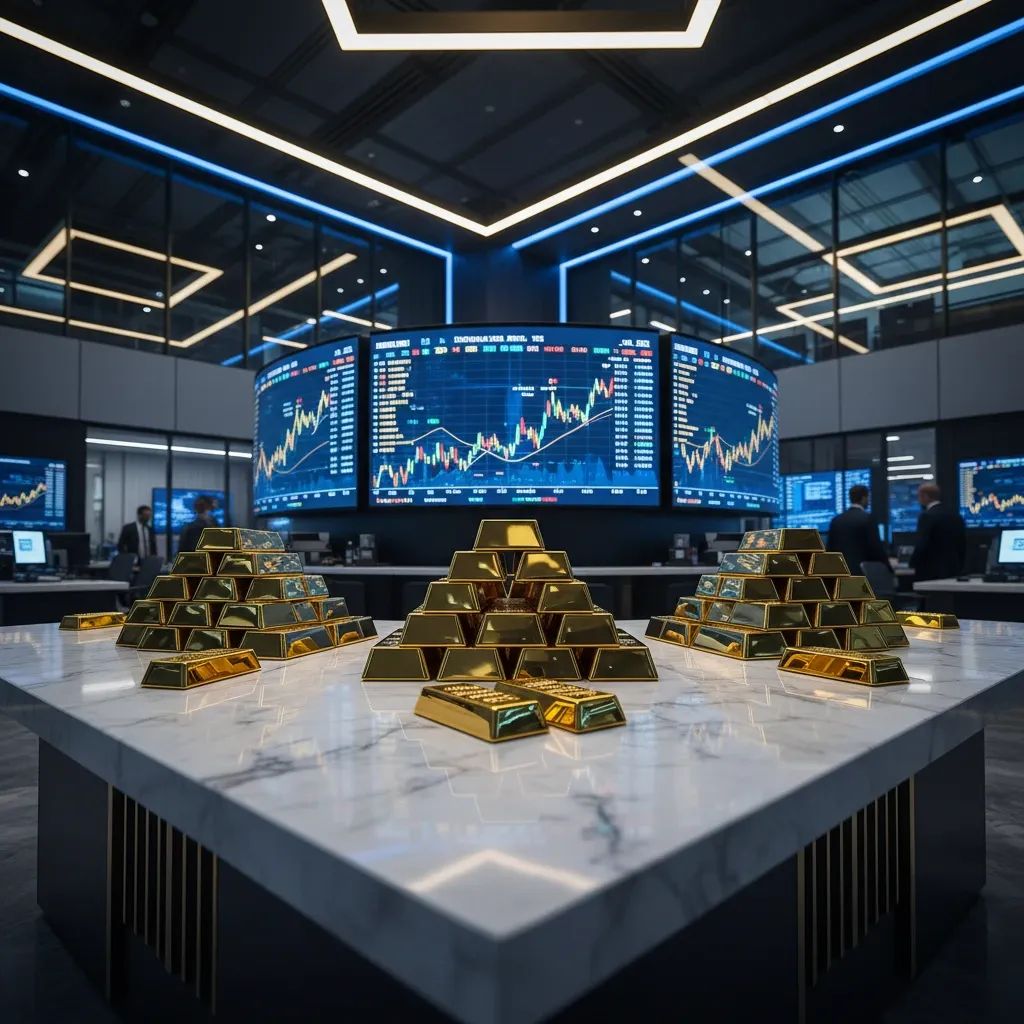
The Gold Momentum That's Reshaping UAE Wealth Strategy
Gold has locked in a seventh consecutive month of gains, and for people managing money across the United Arab Emirates, this sustained climb matters less as a statistical curiosity than as a practical signal about what's happening to global economic confidence—and how that affects their purchasing power, investment choices, and future financial planning. Spot prices hover near $5,180 per ounce, representing a 58% surge over seven months and a 6.5% February advance alone, a rhythm that continues reshaping everything from wedding jewelry budgets to retirement portfolio allocation.
Why This Moment Holds Real Consequence
• Jewelry costs at decade highs: A standard 22-karat necklace once priced at AED 3,000 now costs roughly AED 4,740, forcing many UAE families to postpone purchases or rethink gifting traditions during peak wedding season.
• Trade policy chaos creating the opening: The U.S. Supreme Court struck down Trump's earlier tariff framework, prompting shift to temporary 10% to 15% levies under Section 122, a legal pathway that injects sustained uncertainty into global commerce—precisely the environment where safe-haven gold thrives.
• Central bank demand acting as a structural floor: 800 tonnes of institutional purchases projected for 2026 alone means this isn't speculation-driven volatility but deliberate reserve diversification by governments seeking alternatives to dollar exposure.
• Your portfolio options shifting: With interest rates expected to fall, non-yielding gold becomes relatively more attractive than bonds, altering the calculus for UAE-based wealth managers advising clients on asset balance.
How Trade Policy Turbulence Fuels the Rally
When Washington's tariff approach keeps shifting, international investors reach for certainty. The United Arab Emirates, functioning as a global trade nexus, feels these tremors acutely. Businesses here depend on clear rules governing U.S.-China-European commerce. When those rules destabilize—as happened when the Supreme Court rejected the administration's original emergency tariff authority in late February 2026—traders and portfolio managers respond by rotating toward hard assets that hold value regardless of trade regime.
Gold surged 3.31% in a single session following that court decision, illustrating the metal's sensitivity to policy whiplash. The Trump administration's pivot to Section 122 authority provides legal cover, but the 150-day window and requirement for congressional extension mean markets face rolling uncertainty every few months. This recurring policy friction sustains gold's appeal without requiring a full-blown trade war.
For regional context, the implications extend beyond commodity trading. The Dubai Multi Commodities Centre (DMCC) handles vast gold flows, and elevated prices typically generate increased transaction volumes, supporting employment and tax receipts across refining, logistics, and financial services. Higher valuations, paradoxically, can stimulate activity by attracting hedge funds and institutional traders seeking exposure.
The Deeper Drivers: Central Banks Leading the Charge
The headline reads "tariff uncertainty," but the real structural force propelling prices upward involves governments. China and India—major trading partners with the UAE—continue systematic accumulation of physical bullion, explicitly seeking to reduce dollar dependency. This institutional appetite differs fundamentally from past speculative rallies. Central bankers operate with long time horizons and institutional mandates. They're not chasing momentum; they're rebalancing reserves in response to persistent concerns about U.S. fiscal sustainability and dollar hegemony.
J.P. Morgan's projection of 800 tonnes in central bank purchases during 2026 captures the scale of this structural bid. That volume, concentrated among a relatively small number of sovereign wealth funds and reserve managers, creates a price floor that casual speculation cannot undermine. Geopolitical friction—particularly U.S.-Iran tensions affecting regional stability—adds urgency to reserve managers' desire for portfolio ballast.
Equally significant, the interest rate outlook has shifted. The U.S. Federal Reserve and European Central Bank both signal potential easing cycles as 2026 progresses. Lower real interest rates (nominal rates adjusted for inflation) reduce the opportunity cost of holding gold, which generates no yield. For UAE residents comparing gold holdings to fixed-income investments, this dynamic tips calculations toward bullion. A fixed deposit earning 3% annual return looks less compelling when real rates turn negative and gold appreciates.
A Rally That Defied Historical Precedent
Gold's seven-month winning streak places it in exclusive company. The comparison that resonates most involves the 1979-1980 Iranian Revolution episode, when geopolitical chaos and currency instability propelled gold past $800 per ounce. The intervening decades saw nothing comparable to the current run.
The 2025 calendar year delivered a 67% annual advance—the strongest performance since that 1979-1980 period—and gold logged 53 new all-time highs throughout the year. Those numbers underscore how relentless the upward pressure has been. Yet the rally hit a speed bump: on January 30, 2026, gold suffered its worst single-day drop since 1983, plunging 9.8% and triggering panic selling. The metal traded at levels not seen since late November 2025.
What mattered more than the decline itself was the response. Gold reclaimed the $5,000 threshold within days, demonstrating that underlying demand remained intact. For UAE-based traders and family offices, that episode delivered a textbook lesson: volatility remains a feature of gold markets, even during sustained rallies. Recent purchases suffered temporary drawdowns; current buyers benefited from a brief discount. The larger trend—toward higher prices—reasserted itself quickly.
This contrast between the 2020 pandemic surge and today's advance clarifies what's changed. The COVID-era rally was panic-driven, reactive to lockdown fears and unprecedented monetary stimulus. The current streak reflects deliberate institutional positioning, a reshuffling of global reserves in response to structural economic concerns. That difference suggests staying power. Panics fade; strategic policy shifts persist.
Immediate Impact on UAE Households and Businesses
For someone living in the Emirates, gold's climb triggers several practical considerations:
Wedding season now carries premium pricing. The Gold Souk in Dubai and retailers including Damas and Malabar Gold have repriced inventory upward. Families planning June weddings or major gifting now face costs 50% above 2024 levels. Many have responded by shifting toward lighter weight designs or delaying purchases until potential corrections materialize.
Investment advisers fielding urgent portfolio questions. Wealth managers serving UAE expatriates face a recurring client conversation: "Should I buy gold now, or wait?" The forecasts vary widely. Goldman Sachs targets $5,400 by year-end 2026. J.P. Morgan projects $6,300, with bull-case scenarios reaching $8,000 to $8,500 if household allocations surge. UBS pegs three-quarter-2026 targets at $6,200 with potential upside to $7,200. These ranges span roughly $1,300 per ounce, making timing genuinely uncertain.
Advisers emphasize the distinction between core holdings and tactical additions. Maintaining existing gold positions—perhaps 5% to 10% of a diversified portfolio—aligns with conservative wealth management practice. Leveraged bets or concentration in bullion introduce unnecessary risk precisely when prices sit at historical peaks. A 10% to 15% correction would be consistent with gold's historical volatility and should not trigger panic among disciplined investors.
Currency hedging considerations for expatriates. The dirham remains pegged at 3.67 to the dollar, and many UAE residents maintain dollar exposure through employment contracts and savings. If the dollar weakens—as gold's continued strength hints might occur—expatriates remitting funds home face currency headwinds. Gold's inverse correlation to the greenback offers partial protection, though direct currency contracts or multi-currency savings accounts provide more efficient hedging for pure FX exposure.
Regional economic stimulus through trading activity. The DMCC processes vast volumes of physical gold, and elevated prices correlate with increased transaction turnover. Brokers, logistics providers, and refining operations benefit from heightened activity, supporting employment and regional tax revenue.
Counterarguments Worth Considering
No rally proceeds without skeptics, and several factors warrant caution before assuming gold reaches the most bullish projections:
Tariff workarounds could limit disruption. Deutsche Bank notes that while Trump administration tariffs generate headline uncertainty, the shift from IEEPA authority to Section 122 may prove functionally equivalent. If the economic impact proves marginal, one key driver supporting gold demand diminishes. Markets may eventually recognize that U.S. trade policy, while volatile, isn't fundamentally restructuring global commerce.
Inflation dynamics remain ambiguous. If tariffs feed into consumer prices, gold benefits as an inflation hedge. But if tariffs instead trigger economic slowdown and demand destruction, deflationary pressures could emerge. Gold becomes less appealing in deflationary environments; investors then prefer cash or short-term government securities. The tariff impact on inflation remains genuinely uncertain.
Geopolitical tensions could de-escalate. U.S.-Iran friction currently supports gold as a regional safe haven. But Middle East tensions are subject to diplomatic surprises. Any breakthrough—Israeli-Palestinian progress, Iranian nuclear negotiations, Saudi-Iran détente—would remove a key pillar of safe-haven demand. The region's residents know these dynamics viscerally; predicting their resolution remains speculative.
Central bank buying cannot accelerate indefinitely. Nine straight months of elevated institutional purchases (confirming February's provisional data) cannot persist at current intensity forever. Reserve managers face budget constraints and internal diversification limits. If central bank appetite plateaus or reverses—perhaps after achieving target reserve ratios—gold loses a critical structural support. Timing such a transition remains impossible, but the shift remains likely eventually.
Profit-taking at psychological thresholds. Gold has repeatedly approached round numbers ($5,000, then $5,200) where retail sellers emerge and technical traders book gains. Consolidation near current levels would not negate the rally but could delay fresh upside for months.
Navigating the Technical Landscape
Spot gold traded at approximately $5,181–$5,192 per ounce during the morning session, showing minimal movement and reflecting market consolidation after weeks of rapid appreciation. April gold futures traded at $5,209.20, up 0.3%, indicating futures command a modest premium over spot (a structure called contango that reflects storage costs and convenience yields).
The February monthly gain of 6.5% marks a deceleration from earlier months in the streak, suggesting the rally's velocity may be moderating. That's neither bullish nor bearish necessarily; it simply suggests the market is catching breath before the next leg upward. Analysts monitoring price charts note that the $5,000 level has functioned as a support floor since January's correction. Multiple bounces from that zone suggest it represents genuine buying interest, not coincidence.
Resistance forms around $5,300 based on recent trading patterns. A sustained breakout above that level on meaningful volume would likely trigger fresh buying as technical traders confirm uptrend continuation. Conversely, failure to hold $5,000 would suggest deeper retracement toward $4,700, though consensus views such a decline as temporary rather than a trend reversal.
The Broader Regional Context
The UAE's role as a physical bullion trading hub becomes increasingly relevant as gold prices climb. Infrastructure investments—vaults, refining capacity, regulatory clarity—position Dubai as a critical node in global gold flows, particularly as Asian demand intensifies and Western markets grapple with policy uncertainty.
Islamic finance structures offer another angle. Gold-backed sukuk and Sharia-compliant gold investment vehicles have gained traction across the region, attracting conservative investors who seek both religious compliance and participation in a historically robust asset class. As prices climb, these instruments grow more valuable for GCC investors.
For policymakers, gold's performance validates decades of emphasis on developing the Emirates' financial infrastructure. The DMCC framework and regulatory ecosystem attract global market participants precisely because they offer clarity amid chaos elsewhere. That institutional advantage, combined with regional geopolitical friction, ensures continued inflows.
Year-End Scenarios and What They Mean
Major financial institutions project a range of outcomes for 2026:
The bullish consensus: J.P. Morgan's $6,300 year-end forecast assumes continued central bank buying, Fed rate cuts, and persistent geopolitical friction. This represents roughly a 20% gain from current levels—substantial but not unprecedented for a full year. Goldman Sachs' $5,400 target reflects a more conservative demand sustainability view and potential profit-taking as prices approach psychological thresholds.
The aggressive upside: UBS's $7,200 scenario and J.P. Morgan's $8,000 to $8,500 bull case require a significant increase in household gold allocations, mirroring late-1970s behavior when individual investors poured capital into bullion amid stagflation fears. Such outcomes remain speculative but carry non-trivial probability if inflation proves more stubborn than anticipated or a major currency crisis unfolds.
The downside cushion: A $4,400 floor projected by conservative analysts would represent a 15% decline from current levels—painful for recent buyers but still leaving gold up dramatically year-over-year. This scenario assumes tariff uncertainty fades, central banks pause purchases, and equity markets rally on stabilizing economic data.
For UAE residents navigating these projections, the key insight involves recognizing gold's dual character as both crisis hedge and long-term diversifier. Short-term volatility is inevitable. The metal will experience drawdowns; consolidation phases are normal. But the seven-month winning streak reflects structural shifts in global monetary policy and reserve management that remain unlikely to reverse quickly. Whether gold ultimately reaches $6,300 or consolidates near $5,000, its portfolio role—particularly for those with dollar exposure or geopolitical sensitivity—remains intact and arguably strengthened by recent performance.
The decision for most UAE investors isn't whether to own gold, but how much and through what vehicles. Physical ownership offers tangible security and liquidity in local markets. Gold ETFs provide tax-efficient exposure and storage simplicity. Sukuk and Islamic products serve investors with specific compliance requirements. The rally validates all these approaches; execution and timing matter far more than the directional conviction itself.


