
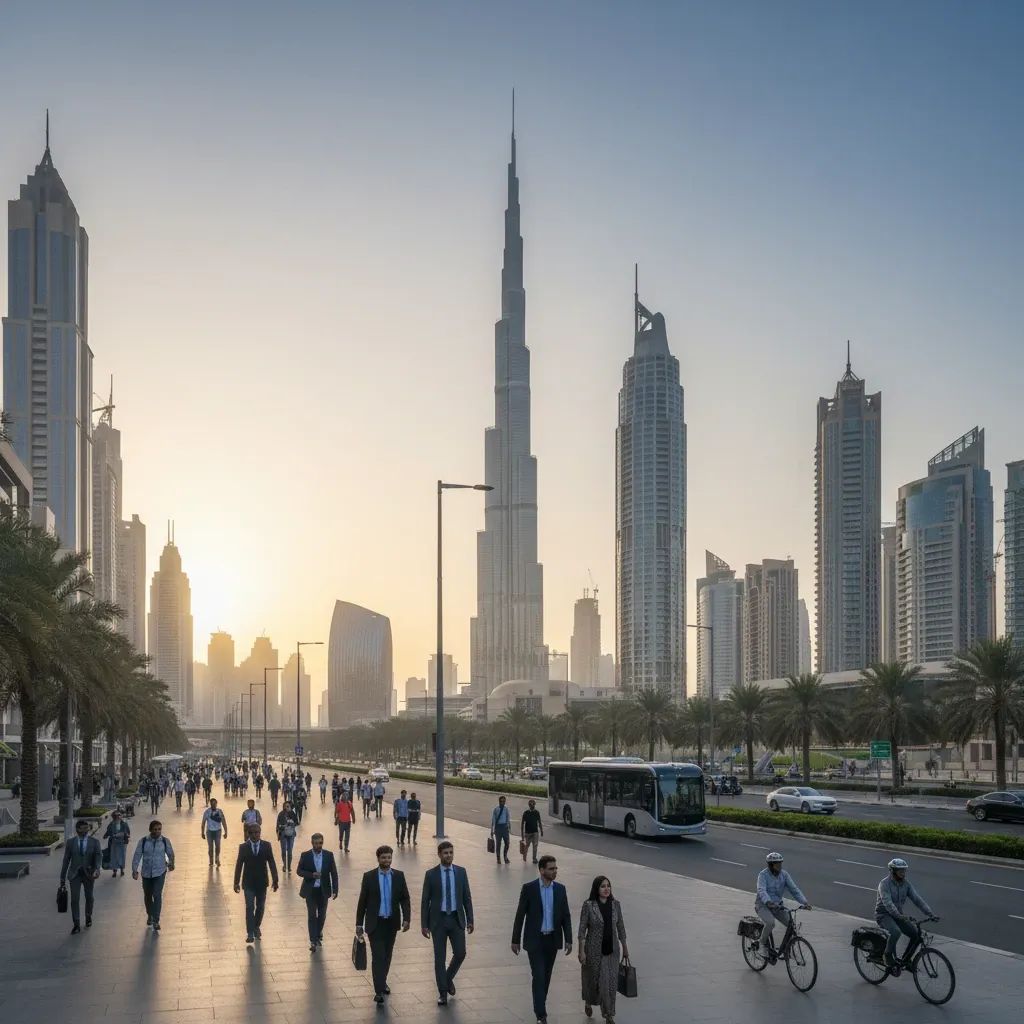
Expatriates living across the United Arab Emirates have transformed a period of genuine regional military tension into validation of a decision many made years ago: choosing this nation as a home. What distinguishes their response isn't blind faith or tribal allegiance, but observable competence—measurable defense systems performing as advertised, government officials maintaining composure during crisis, and daily life continuing uninterrupted despite acknowledged external threats.
Why This Matters
• Defense infrastructure tested and proven: Over 92% of detected ballistic missiles and 93% of drones were neutralized between late February and early March 2026, with no significant civilian casualties reported
• Transparent crisis communication: Rather than silence or panic-inducing rhetoric, the UAE Ministry of Defence released factual interception statistics, creating credibility that persists into normal operations
• Expat behavioral voting: Schools remained open, workplaces functioned normally, and neither mass evacuations nor rental cancellations occurred—the strongest indicator of genuine confidence
• Cybersecurity containment: State-sponsored cyberattacks reaching 90,000–200,000 daily attempts were neutralized without disrupting banking, power, or government systems
The Confidence Calculation
When expatriates describe feeling "protected," they're not referencing abstract reassurances or optimistic political rhetoric. They're describing a tangible combination of infrastructure, institutional competence, and leadership visibility that they can observe directly. For foreign residents—people who chose displacement voluntarily and retain the option to leave—this distinction matters profoundly.
A UAE Quality of Life Security Survey conducted in 2025 found that 98.7% of residents reported feeling safe walking alone after dark, with 98.1% of women giving the same answer. These figures preceded the February-March military escalation by months, indicating baseline confidence uninfluenced by crisis management performance. When tested against actual regional conflict, that confidence didn't evaporate. Instead, it proved durable.
The 2026 Edelman Trust Barometer ranked the United Arab Emirates first globally for public trust in government—a statistical abstraction until you observe what residents actually do. They showed up to work. They maintained normal routines. They made long-term commitments. The behavioral evidence of confidence often exceeds survey data in reliability.
The Defense Architecture Behind Every Announcement
The UAE Armed Forces operates a deliberately diversified air defense network designed to prevent any single technological vulnerability from creating a catastrophic gap. This isn't speculation; it's purchasing history backed by decades of defense procurement records.
The Terminal High Altitude Area Defense (THAAD) system—American-made and traditionally restricted to U.S. military use—has been deployed here since the early 2020s. The UAE became the first foreign nation to acquire this long-range capability, a status that carries significant strategic weight. Complementing the THAAD batteries are Patriot PAC-3 systems for mid-range threats and South Korean M-SAM (Cheongung II) batteries, with two operational since August 2025 under a $3.5 billion procurement agreement finalized in 2025.
For shorter-range and drone interception, the military integrated Israeli Barak MX systems (deployed post-Abraham Accords), French Crotale and Mistral platforms, Russian Pantsir-S1 units, and specialized Israeli drone countermeasures technology. The force structure also includes Swedish RBS-70 systems and British Rapier platforms, creating an air defense architecture that forces potential adversaries to overcome multiple, distinct technological approaches simultaneously—an exponentially harder task than breaching a monolithic system.
This procurement diversification is deliberate operational strategy. Dependency on a single supplier or technology creates vulnerability to either diplomatic pressure on the supplier or a technological breakthrough that could neutralize that system. By acquiring complementary systems from multiple producers, the UAE reduces long-term supply-chain fragility while forcing adversaries to develop counter-solutions for each distinct platform.
During late February and early March 2026, this diversified architecture performed under live-fire conditions. The Ministry of Defence disclosed that between the February 28 escalation onset and March 2, the following interception statistics were recorded:
• 174 ballistic missiles detected → 161 destroyed, 13 fell harmlessly into the sea
• 8 cruise missiles detected → 8 destroyed
• 689 drones detected → 645 intercepted, 44 landed within UAE territory causing minor collateral damage from debris impacts
The remaining threats—primarily from drone debris—caused material damage but no significant casualties. Critically, officials released failure rates alongside success rates, a transparency choice that made success statistics credible rather than propaganda.
Why This Transparency Builds Confidence
In most regional nations experiencing military crises, governments default to one of two communication strategies: official silence that breeds rumor and anxiety, or constant alarmist broadcasts that exhaust credibility. The United Arab Emirates adopted a third approach—methodical, factual disclosure without embellishment.
When AI-powered cyberattacks began targeting national infrastructure in early 2026, the UAE Cybersecurity Council publicly confirmed the threat rather than concealing it. Officials disclosed that daily breach attempts ranged from 90,000 to 200,000 and that 128 confirmed cyber threat incidents had been recorded since January 2026, originating from state-sponsored actors across 14 countries.
This transparency could have triggered panic. Instead, it communicated competence: the government understood the threat space so comprehensively that it could quantify attacks in real time, meaning residents weren't flying blind. The Council explicitly framed cybersecurity as shared responsibility between state and individual, urging residents to report suspicious activity and maintain basic security hygiene. The implicit message: threats exist and are being actively monitored.
When the U.S. Department of State issued a travel advisory on March 2, 2026—recommending Americans reconsider travel to the UAE and ordering non-emergency personnel to depart—local officials didn't issue defensive counter-statements or contest the advisory's validity. They simply maintained operational continuity. Schools held classes. Banks processed transactions. Government offices functioned. The implicit message was stronger than any rebuttal: "We understand external concerns. Here's our operational response—we're functioning safely."
Visible Leadership During Crisis
The continued public presence of senior officials, particularly Sheikh Mohammed Bin Rashid Al Maktoum, throughout the February-March escalation reinforced confidence rather than triggering panic. This distinction matters. Leadership visibility during military crisis can either communicate control or signal desperation depending on how it's executed.
In the UAE's case, officials maintained their composed public schedules without theatrical reassurance or anxiety-driven broadcasts. This restraint communicated something crucial: genuine confidence that the situation remained managed rather than spiraling. For expatriates accustomed to either authoritarian silence or nervous over-communication, this calibrated composure proved reassuring.
What This Means for Residents
For the 9 million expatriates across the United Arab Emirates, the events of late February and early March 2026 functioned as a live-fire test of government capacity under realistic stress conditions. The results exceeded baseline expectations in most measurable dimensions.
Future regional tensions may bring temporary operational disruptions: airspace closures affecting flight schedules, mobile phone emergency alerts requiring shelter-in-place procedures, or brief school closures as precautionary measures. But the baseline scenario—continued functioning of essential services, maintained safety, and transparent communication—has now been operationally validated.
This matters practically. Residents can commit to long-term employment contracts without panic about sudden evacuation needs. Schools can enroll students with confidence that instruction will continue during regional tensions. Financial institutions can operate normally knowing that cybersecurity infrastructure contains threats before they disrupt banking systems. These aren't small advantages in a region where alternative nations often oscillate between conflict and authoritarian lockdown.
The Numbeo Safety Index 2026 ranked the UAE as the world's safest nation for the second consecutive year, achieving a score of 86.0. Abu Dhabi specifically maintained its position as one of the planet's safest cities for the tenth consecutive year, with a Safety Index of 88.9. These rankings emerge from resident surveys asking practical questions rather than government assertions. The answers residents provide translate into visible behavior: late-night commutes without safety escorts, teenagers using public transportation alone, routine business operations during potential crisis periods.
Regional Strategic Positioning
The UAE's security posture doesn't exist in isolation. The nation has cultivated explicit defense partnerships with the United States, South Korea, Israel, and France, participating in joint training exercises including the annual Red Flag (hosted by the U.S. Air Force), Iron Union, and Native Fury operations. A $130 million U.S. Foreign Military Sale approved in May 2025 ensures ongoing maintenance and logistical support for the F-16 fighter aircraft fleet, preventing the slow degradation that typically undermines military readiness over multi-year periods.
Defense procurement strategy emphasizes deliberate technology transfer rather than perpetual foreign dependency. The UAE is negotiating localized production agreements with Elbit Systems for Hermes 900 unmanned aerial vehicles under the 2025–2028 strategic defense plan. This approach builds domestic expertise while reducing long-term vulnerability to diplomatic pressure or geopolitical supplier realignment.
The Behavioral Indicator
Perhaps the most credible measure of genuine expatriate confidence isn't survey data but observable behavior. During the February-March military escalation, the Numbeo Safety Index 2026 and Expat Insider 2025 rankings showed no significant deterioration. Residents didn't file mass evacuation requests. Commercial real estate leasing continued. School enrollments proceeded normally.
This behavioral continuity reveals something difficult to manufacture through government communication: residents voting with their location choices and staying because the risk-benefit calculation genuinely favors remaining. The 2025 Expat Insider report ranked the UAE first globally for personal safety among expatriates—a ranking that preceded the military crisis and thus reflected baseline reputation rather than crisis performance.
When that reputation was tested, it held. That validation now compounds: new residents arrive having heard the UAE is safe and secure; existing residents confirm it through lived experience; potential migrants receive testimony from trusted networks that the infrastructure delivers on its promises. The multiplier effect becomes self-reinforcing without requiring government intervention beyond competent operational performance and transparent communication.
For anyone living in the UAE or considering relocation, the March 2026 period essentially functioned as an operational audit of government capacity. The audit passed. Whether future regional tensions arrive—and in this geography, they likely will—residents now possess evidence that abstract security claims translate into measurable protection and that leadership composure during crisis doesn't signal helplessness but competence.


