
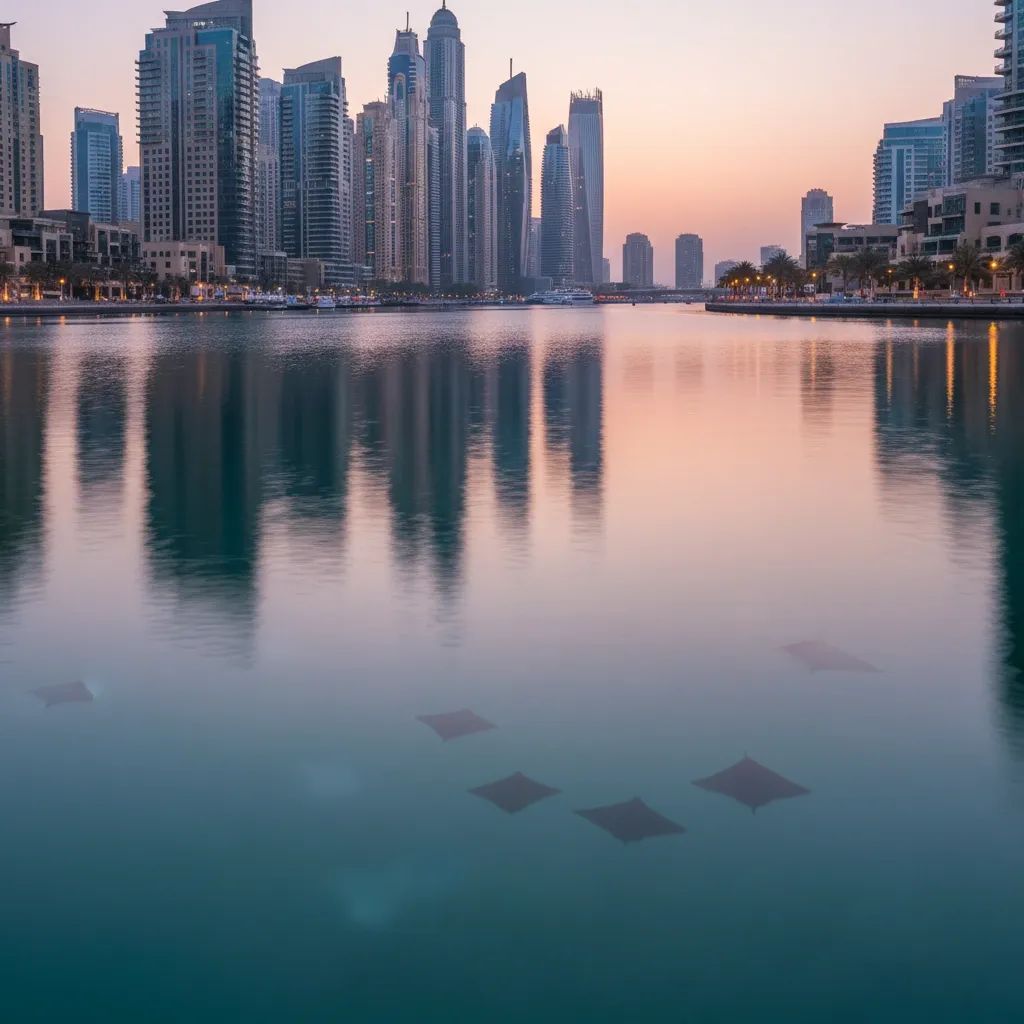
The United Arab Emirates' Dubai Marina has seen cownose rays gliding through its shallow waters in recent weeks, a phenomenon locals recognize from the quieter days of the pandemic lockdown. Only this time, the reduced boat traffic owes less to public health restrictions and more to the ongoing regional conflict that has effectively closed the Strait of Hormuz since late February, cutting vessel movement through the critical waterway to roughly 5% of normal levels.
Why This Matters:
• Calmer waters attract endangered species: Rays classified as "regionally endangered" are returning to the marina in numbers not seen regularly since spring 2020.
• Economic disruption brings ecological reprieve: The Iran War's maritime blockade has inadvertently created conditions for marine life recovery across Dubai's coastal zones.
• Long-term biodiversity gains underway: The Dubai Reef Project has already increased fish biomass by 800% at pilot sites, with 20,000 artificial reef modules planned by 2027.
The Iran War's Unintended Marine Sanctuary
When the United States and Israel launched strikes against Iran's nuclear facilities on February 28, the retaliatory closure of the Strait of Hormuz rippled far beyond global oil markets. For Dubai Marina—a densely developed waterfront that typically hosts hundreds of recreational vessels, water taxis, and tourist boats weekly—the disruption has meant unusually serene conditions. Residents walking along Dubai Marina Walk have captured footage of rays swimming within meters of the promenade, their diamond-shaped silhouettes visible just below the surface.
Marine biologists familiar with the Arabian Gulf note that cownose rays, which migrate seasonally, prefer environments with minimal propeller noise and sediment disturbance. Spring temperatures between 22°C and 26°C align with their breeding patterns, but the critical variable this year has been the near-absence of boat wakes churning the water column. A representative from the conservation group AzraqME, which documented similar sightings during the 2020 pandemic, confirmed that reduced vessel traffic consistently correlates with increased ray presence in shallow coastal waters.
The broader regional maritime slowdown—enforced by a US counter-blockade on Iranian ports and sporadic diplomatic shipping arrangements with China, Iraq, and Pakistan—has dampened commercial and recreational activity across the Gulf. While Dubai Marina itself hasn't released specific traffic data, anecdotal reports from marina operators suggest booking cancellations for yacht charters and water sports have exceeded 60% since March, creating conditions that mirror the height of COVID-19 restrictions four years ago.
A Catalog of Visitors: What Lives Beneath the Skyscrapers
Dubai Marina's location at the intersection of deep Gulf waters and artificial coastal infrastructure has always made it a statistical outlier for marine sightings. The 3.5-kilometer canal, dredged to depths of 8 to 12 meters, functions as an accidental migration corridor for species that would otherwise avoid heavily trafficked shorelines.
Eagle rays, distinguished by their white-spotted dorsal patterns and wingspans approaching 2 meters, were filmed extensively in April 2020 near the Jumeirah Beach Residence end of the marina. These bottom-feeders hunt crustaceans in the sandy substrate that lines the canal floor, and their presence typically signals healthy prey populations. In 2022, researchers from the Environment Agency Abu Dhabi announced the discovery of Aetomylaeus wafickii, a new eagle ray species identified from specimens collected during a 2016 Gulf survey, underscoring how much remains unknown about the region's marine taxonomy.
The most dramatic visitor in recent memory arrived in January 2022, when Sheikh Hamdan bin Mohammed shared footage of what marine experts identified as a Bryde's whale—a baleen species rarely observed this close to urban coastline. The 12-meter cetacean, recognizable by the three parallel ridges on its head and twin blowholes, spent approximately 20 minutes circling the western basin before returning to open water. Bryde's whales migrate through Gulf waters during winter months, feeding on schools of sardines and anchovies that congregate near thermal upwellings. The sighting prompted the Dubai Municipality to issue temporary slow-speed advisories for boats operating within 500 meters of the marina entrance.
Whale sharks, the Gulf's gentle giants, have been documented in Dubai Marina only once in the social media era—a juvenile approximately 4 meters long that spent two days in August 2015 filtering plankton near the Marina Mall docking area. These spotted filter-feeders, which can reach lengths of 24 meters as adults, are drawn to summer plankton blooms but typically remain in deeper offshore waters. Marine biologists at the time noted that juveniles occasionally venture into shallow bays when chasing dense prey aggregations, though such events remain statistically rare for a developed marina.
What This Means for Residents and Investors
For the estimated 120,000 residents living in Dubai Marina's high-rise towers, the increased marine activity offers a tangible reminder of the Gulf's ecological baseline—what the coastline supported before large-scale urbanization. However, experts caution against interpreting temporary sightings as evidence of systemic recovery. Dr. Saif Al-Ghais, a marine ecologist who has studied Arabian Gulf biodiversity for two decades, notes that "episodic wildlife appearances during traffic lulls are encouraging but fragile. Sustained recovery requires habitat restoration, not just reduced disturbance."
That restoration is now underway through the Dubai Reef initiative, announced in 2024 as a AED 183 million project spanning 600 km² of the emirate's territorial waters. The program deploys modular artificial reefs constructed from marine-grade concrete, designed to mimic natural rock formations that provide shelter for juvenile fish and substrate for coral attachment. As of September 2025, 3,600 modules had been installed across pilot sites near Jebel Ali and the Palm Jumeirah, with underwater surveys documenting 15 native species including yellow-spotted groupers, blackspot snappers, and yellowfin barracuda.
The 10% biodiversity increase recorded at these sites within 18 months represents one of the fastest habitat colonization rates observed in the Gulf, according to project monitors. Fish biomass—the total weight of fish per cubic meter—jumped eightfold, suggesting the reefs are functioning not just as shelter but as productive feeding grounds. If deployment continues on schedule through 2027, the cumulative effect could reshape Dubai's coastal food web, potentially drawing larger pelagic species like tuna and dolphinfish closer to shore year-round.
For property owners and tourism operators, the ecological improvements carry financial implications. Waterfront developments with documented marine biodiversity increasingly command premium valuations in regional real estate markets, while dive tourism—a relatively underdeveloped sector in Dubai compared to destinations like Fujairah—could expand if reef ecosystems mature. The Palm Jebel Ali project, which will add new marinas and underwater attractions when deliveries begin later in 2026, has incorporated the Dubai Reef framework into its planning, suggesting the model may become standard for future coastal construction.
The Lockdown Comparison: Lessons from 2020
The parallels between April 2026 and the pandemic spring of 2020 extend beyond anecdotal ray sightings. In both periods, water clarity improved measurably as propeller-driven sediment churning declined, allowing sunlight penetration to increase in the canal's shallow zones. Underwater visibility in Dubai Marina typically ranges from 2 to 4 meters due to suspended particulates; during the 2020 lockdown, free divers reported visibility exceeding 7 meters in some sections, revealing seagrass patches previously obscured by turbidity.
The current reduction in boat traffic, while driven by geopolitical crisis rather than public health policy, has recreated those conditions. Environmental sensors deployed by the Dubai Municipality's Environment Department recorded a 23% decrease in underwater noise pollution between March and April 2026 compared to the same period in 2025. Marine mammals and fish rely on acoustic communication for mating, navigation, and predator avoidance; chronic noise from engines and sonar can interfere with these behaviors, particularly for species like dolphins and whales that use echolocation.
Chemical pollution from fuel, engine oil, and antifouling paint likewise drops when vessel activity declines. A 2020 study by UAE University found that heavy metal concentrations in Dubai Marina sediments—particularly copper and zinc leached from hull coatings—fell by 18% during the three-month lockdown period. While comprehensive water quality data for 2026 has not yet been published, marine scientists expect similar reductions if the current low-traffic conditions persist through the summer.
Navigating the Fragile Window
The immediate question for conservation advocates and policymakers is whether the current ecological window can be converted into permanent gains. History suggests that marine ecosystems rebound quickly when stressors are removed but collapse just as rapidly when intensive activity resumes. The Dubai Reef Project's 2027 completion timeline offers a structural intervention that could buffer against the inevitable return of normal boat traffic, assuming geopolitical tensions de-escalate and the Strait reopens to full commercial shipping.
Meanwhile, the UAE Ministry of Climate Change and Environment has signaled interest in expanding marine protected areas along the Gulf coastline, potentially including seasonal no-wake zones in Dubai Marina during ray migration periods. Such measures would face resistance from marina operators and yacht owners, but precedent exists in other Gulf states. Bahrain imposed seasonal speed restrictions in shallow waters in 2019 to protect dugong populations, while Qatar's Al Dhakira Mangrove Reserve enforces year-round engine bans in designated channels.
For now, residents with waterfront views have a rare opportunity to observe the Gulf's native wildlife operating on its own terms, free from the constant hum of diesel engines and jet skis. Whether that window remains open beyond the next ceasefire agreement—and what Dubai chooses to do with the ecological insights gained—will determine if the rays of April 2026 are remembered as a temporary anomaly or the beginning of a deliberate coexistence.


