
Why This Matters
• Critical five-day weather window: Between March 22–27, the United Arab Emirates will experience intermittent rain, strong gusts, and temperature drops that will disrupt commutes, commerce, and coastal access across all seven emirates.
• Severe driving penalties enforced: Motorists attempting to cross flooded wadis or water streams face AED 2,000 fines, 23 demerit points, and 60-day vehicle impoundment—a deterrent designed to prevent flash-flood fatalities.
• Air operations under strain: Major carriers including flydubai and Air Arabia are operating under visibility-dependent alerts, with passengers advised to arrive four hours early and expect potential delays or diversions at Dubai, Abu Dhabi, Sharjah, and Ras Al Khaimah airports.
• Emergency hotline deployed: Citizens reporting localized flooding should contact 993 for immediate municipal response; the Abu Dhabi Department of Municipalities has activated 24-hour operations centers through March 27.
The United Arab Emirates meteorological system has confirmed a five-day pattern of rainfall, wind acceleration, and cooling temperatures that will persist through Friday. This is not a passing afternoon shower—it represents a structured weather event requiring deliberate public adjustment in behavior, logistics, and risk management.
The Day-by-Day Breakdown: When Rain Hits Where
Understanding the timing and geographic sequence of this weather system is essential for residents planning work, school, and travel. Monday's daytime forecast predicts scattered rainfall across the entire nation, then concentrating overnight over the northern emirates, eastern zones, and Al Ain—the nation's primary mountainous and inland region where terrain funnels moisture into localized downpours.
Tuesday escalates the intensity. Northern, eastern, and southern regions face continuous precipitation during daylight hours, followed by expansion overnight to coastal cities and island chains. This pattern increases stress on infrastructure: roads saturated by Monday's showers face fresh flooding; drainage systems operated near capacity begin to overflow.
By Wednesday, rainfall becomes scattered across the country. However, the heaviest concentrations shift back eastward after dusk, targeting Al Ain and eastern emirates once again. Wednesday evening marks a weakening threshold—the system begins losing strength late into the night, signaling the onset of decline.
Thursday introduces a respite window in early morning hours; however, mid-afternoon brings renewed activity. Northern and eastern zones plus Al Ain experience fresh rainfall lasting through nightfall and extending into coastal regions, islands, and western sectors—a secondary surge before the system's final decline.
Friday concludes the event. Precipitation originates from island and coastal areas in daylight hours, then advances inland progressively across most of the UAE as the weather system moves east and weakens. By evening, precipitation chances drop sharply.
Wind, Dust, and Visibility Collapse
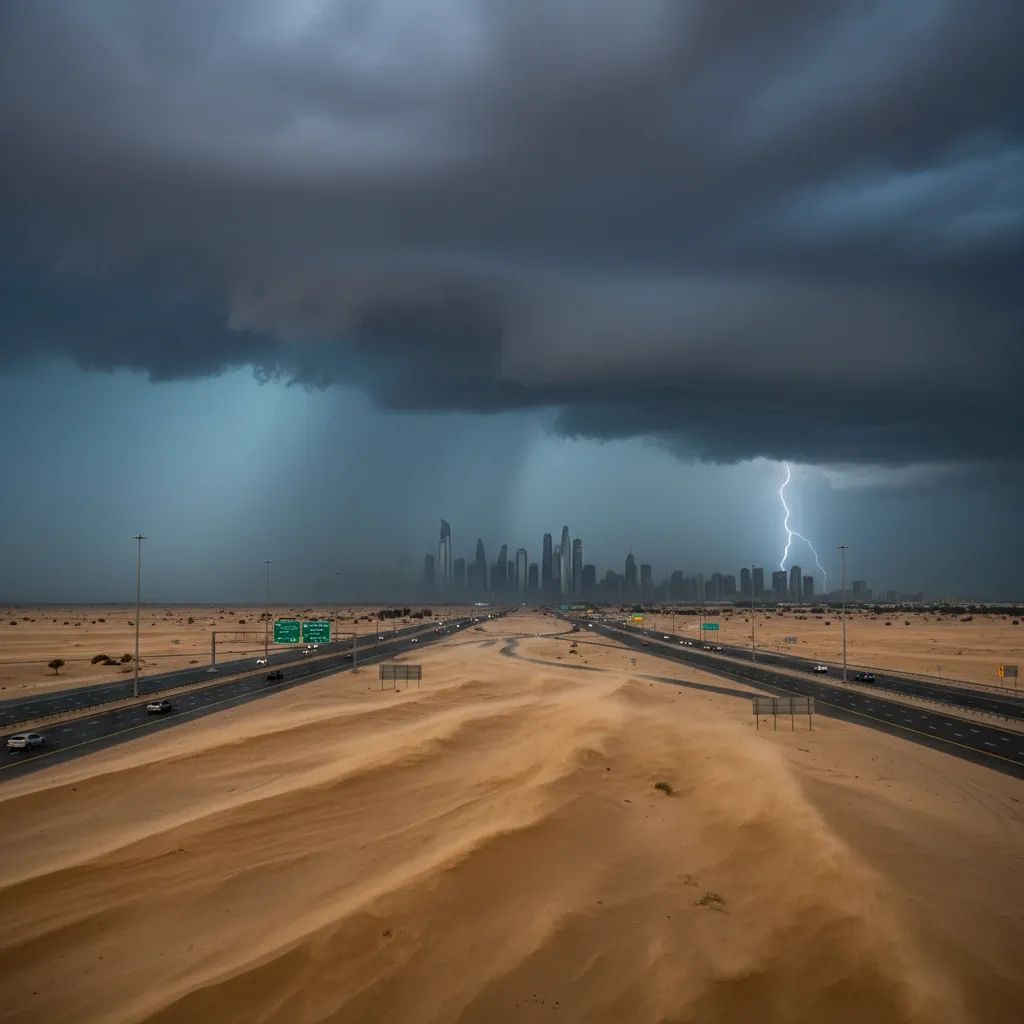
Accompanying this rainfall progression is a substantial wind shift. Wind direction rotates from southeasterly to northeasterly, traveling at baseline speeds of 10 to 25 km/h but accelerating to gusts exceeding 45 km/h during periods of active rainfall. This wind acceleration creates dual hazards: blowing dust and sand reduce horizontal visibility in exposed, inland, and western sectors. Driving conditions deteriorate markedly; visibility drops from kilometers to meters in affected areas.
The Ministry of Interior has already begun variable speed enforcement on major expressways, reducing permitted speeds to 80 km/h during periods of active dust and precipitation. This regulatory tightening reflects genuine danger: vehicles lose traction, brake distances extend, and rear-end collisions cluster in low-visibility zones.
Temperature Shift: Relief and Surprise
A secondary but measurable phenomenon accompanies the moisture influx: temperatures will decline noticeably, particularly across inland settlements and Al Ain. Residents accustomed to warm March afternoons—typically ranging from 25°C to 32°C—should anticipate cooler readings, potentially 5–8 degrees Celsius lower than seasonal norms. While temporary, it offers relief from the pre-summer heat that typically characterizes late March. However, the temperature drop may catch some residents unprepared in terms of clothing.
Maritime Hazards: Arabian Gulf and Oman Sea Conditions
The Arabian Gulf and Oman Sea will experience deteriorating conditions. Sea states will evolve from slight to moderate waves into rough conditions whenever rainfall intensifies. In the Arabian Gulf, high tide occurs at 16:16 and 03:52, with corresponding low tides at 09:57 and 21:22. The Oman Sea follows a similar rhythm: high tides at 13:18 and 00:13, low tides at 18:43 and 07:17.
The United Arab Emirates Ministry of Interior has issued explicit warnings against maritime recreation. Beach outings—swimming, jet skiing, paddleboarding, any waterfront gathering—are unsafe and ill-advised. Anchored vessels and small craft should relocate to protected harbors. Mariners and fishers operating in the Arabian Gulf and Gulf of Oman face genuine risk of capsizing, equipment loss, or personnel injury if they venture into rough conditions. Official guidance prioritizes withdrawal to port.
Infrastructure Activation: Behind-the-Scenes Readiness
The Abu Dhabi Department of Municipalities and Transport has mobilized resources since March 21, establishing 24-hour emergency operations centers across Abu Dhabi city, Al Ain, and Al Dhafra region. These facilities house engineering teams, maintenance technicians, drainage specialists, and equipment operators. Pumping vehicles, earthmoving machinery, and material supplies remain on active standby to respond to roadway flooding and infrastructure strain indicators.
Coordination flows through the National Emergency Crisis and Disaster Management Authority, which has convened strategic briefings with the Ministry of Interior and the National Centre of Meteorology. Business continuity protocols have been formally activated. Critical infrastructure sectors including hospitals, utilities, telecommunications, water treatment, and power generation have confirmed staffing levels and backup systems are operational.
Transportation Challenges: Roads Under Stress
The practical reality for residents and workers is straightforward: road networks will experience congestion from cautious drivers, localized flooding in historically vulnerable stretches, and reduced visibility creating accident clustering. The Abu Dhabi Police has already documented minor flooding along portions of Sheikh Zayed Road in Dubai. This early indicator suggests that Tuesday and Wednesday may bring more severe inundation along similar corridors, potentially forcing temporary lane closures or speed reductions.
Motorists should verify that their vehicles have functional windshield wipers, adequate tire tread, and properly maintained braking systems. Driving at night during heavy rain and strong winds—particularly Tuesday and Thursday evenings—presents heightened collision risk. Employers should consider temporary work-from-home arrangements for positions where office presence is not operationally critical. Schools across the emirates remain open absent formal closure orders, but parents should remain flexible; early dismissals or alternate scheduling could be implemented if conditions deteriorate faster than forecast.
The Ministry of Interior's penalty structure for attempting to cross flowing water or entering flooded valleys—AED 2,000 fine, 23 demerit points, and 60-day vehicle impoundment—is not a bureaucratic formality. Flash floods in UAE wadis move with extraordinary velocity and force, capable of sweeping vehicles downstream, trapping occupants, and causing fatalities. This enforcement mechanism exists because previous rainfall events resulted in deaths from drivers ignoring warnings. The financial and licensing consequences are intentionally severe as a life-saving deterrent.
Air Travel Disruption: Visibility and Scheduling Delays
Major carriers operating from Dubai International Airport, Abu Dhabi International Airport, Sharjah International Airport, and Ras Al Khaimah International Airport have issued operational alerts. Visibility-dependent runway operations mean that when horizontal visibility drops below regulatory minimums—typically 800–1000 meters during adverse weather—airport capacity reduces, flight delays accumulate, and cancellations or diversions to alternate facilities become necessary.
Passengers with fixed travel schedules should arrive at terminals four hours prior to domestic departures, and longer for international routes. Real-time flight status confirmation immediately before leaving home is essential; carriers have not hesitated to cancel or reschedule departures during previous unstable weather periods. Those with scheduling flexibility should consider postponing travel to dates after March 27, allowing the weather system to pass entirely. Baggage claim systems and ground operations also slow under adverse conditions, creating secondary delays beyond airborne operations.
Supply Chain Implications: Retail and Logistics
Businesses dependent on road transport face measurable supply chain friction. Shipments moving through northern emirates or Al Ain—key distribution hubs—may experience delays if routes close temporarily or if drivers exercise caution reducing throughput. Companies relying on just-in-time inventory models should consider building temporary inventory buffers this week. Perishable goods and time-sensitive shipments face elevated spoilage or obsolescence risk if rerouting adds hours to transit times.
The retail sector, particularly grocery and pharmaceutical distribution, should verify backup logistics plans with suppliers. Pharmacies and supermarkets typically maintain multi-day inventory reserves; however, extended transportation disruptions can deplete stocks faster than resupply can replenish.
Practical Resident Checklist for the Week Ahead
Verify vehicle insurance includes comprehensive coverage; parked vehicles sustaining water damage claim reimbursement under comprehensive policies, not collision or liability. Maintain accessible emergency supplies: phone chargers, flashlights, bottled water, first-aid kits, and medications for several extra days. Monitor official weather and traffic updates through NCM, Ministry of Interior, and emirate-level municipality apps and websites—these channels prioritize factual information and regulatory updates, while social media platforms often amplify speculation and secondhand reports.
If commuting to Al Ain or northern emirates, confirm road status with authorities before departure; certain routes may close temporarily if flooding becomes severe. Pet owners should bring animals indoors during heavy precipitation; outdoor pets face drowning risk in flash-flood situations, and loose animals can obstruct drainage systems or create public safety hazards.
Employees with schedule flexibility should initiate temporary work-from-home discussions with management this week. Reducing unnecessary traffic volume both accelerates commute times for essential workers and minimizes accident clustering during low-visibility periods.
Property managers and homeowners should inspect drainage channels, gutters, and downspouts; clear accumulated debris and leaf matter to maximize water throughput. Residents in historically low-lying neighborhoods or properties with inadequate drainage systems should move valuables to elevated storage as a precautionary measure.
The United Arab Emirates government has systematically prepared through coordinated response architecture, emergency operations center activation, and mutual aid agreements between departments. The remainder of risk mitigation depends on individual judgment and adherence to official guidance. Exercise conservatism regarding travel and outdoor plans through Friday. The weather event is temporary; the safety infrastructure deployed is proportionate and necessary.


