
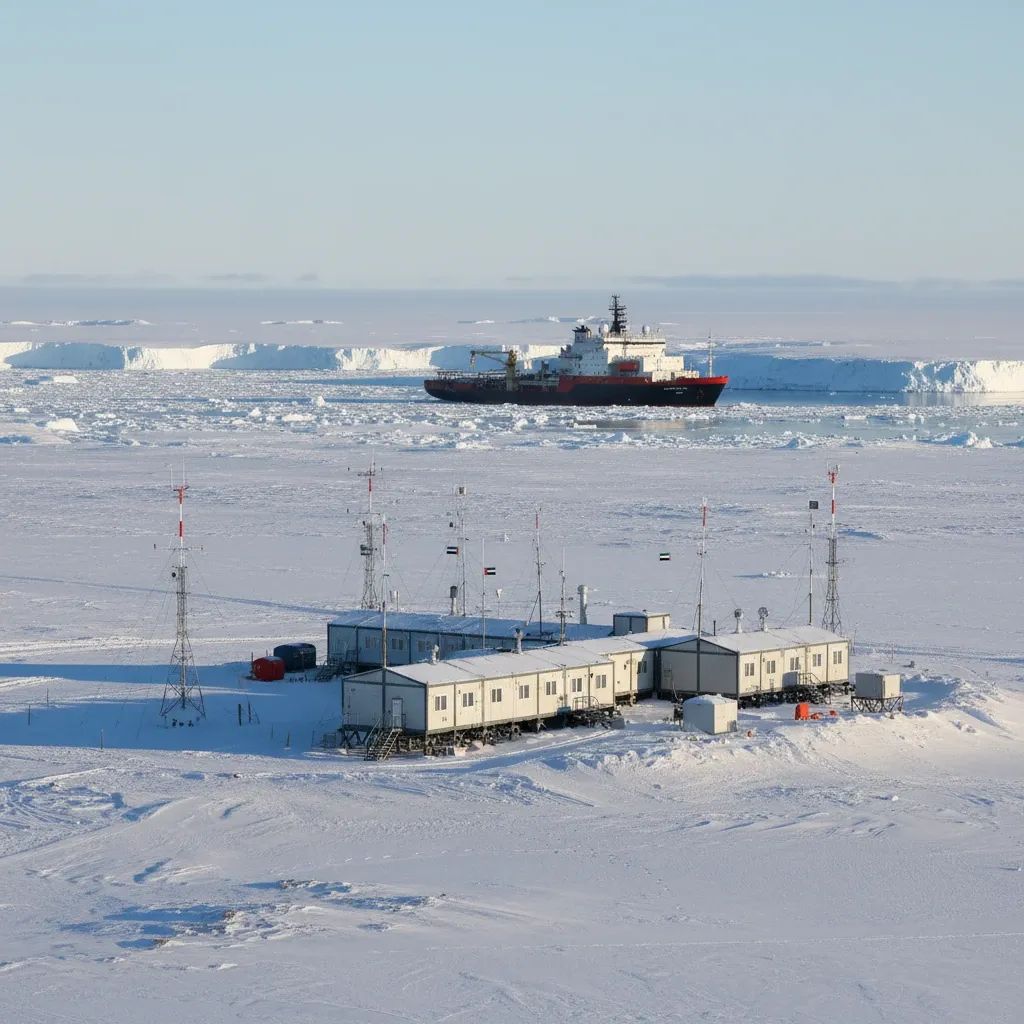
The United Arab Emirates National Centre of Meteorology has wrapped up its second straight field season in Antarctica, a milestone that places the Emirates among the handful of nations running year-round scientific hardware on the frozen continent.
Why This Matters
• Reliable climate data: Instruments installed by Emirati engineers will feed live readings to Abu Dhabi’s forecasting models as early as next winter.
• Scholarship pipeline: Two new postgraduate fellowships, ring-fenced for UAE nationals, open in September for polar-science degrees at Khalifa University.
• Insurance pricing: Tide-gauge outputs from Livingston Island will influence regional sea-level risk calculations that underwrite coastal real-estate policies in Dubai and Sharjah.
From Cargo Bay to Cryosphere: How the Mission Unfolded
The 50-day voyage began in Varna aboard Bulgaria’s research vessel “Saints Cyril & Methodius,” crossed the notoriously rough Drake Passage, and reached Livingston Island in early January. On board were four Emirati specialists—Ahmed Al Kaabi, Badr Al Ameri, Omar Al Attas, and Abdullah Al Raisi—tasked with unloading 7 tonnes of lab kits, weather masts and seismic gear. The team’s arrival coincided with the start of Bulgaria’s 34th Antarctic Research Season, giving the UAE immediate access to a fully operational base and helicopter logistics.
What the Team Actually Built
First Emirati climate laboratory: A double-insulated module now hosts continuous atmospheric chemistry sampling, including methane flux tests that detect thawing permafrost.
Second UAE weather station: Calibrated to WMO standards, the unit relays temperature, wind, and humidity every 10 minutes via Iridium satellite.
Tidal & tsunami gauge: Bolted to a granite outcrop 10 m above mean sea level, the sensor array logs micro-changes in sea height—vital for modelling storm-surge threats to the Gulf coastline.
Upgraded seismic node: The device fine-tunes global earthquake grids and supports early-warning apps already used by UAE Civil Defence.
UAE’s Expanding Seat at the Polar Table
Last year Abu Dhabi ratified the Antarctic Treaty System and secured observer status on the Arctic Council—twin moves that open doors to consultative votes and collaborative grant pools. Memoranda with Argentina and New Zealand guarantee runway rights and lab bench space, cutting expedition costs by an estimated 12 % compared with chartering private icebreakers.
What This Means for Residents
• Better storm alerts: Coupling Antarctic readings with the UAE’s Doppler radar network should trim the lead time for flash-flood warnings by up to 20 minutes.• STEM careers: The Emirates Polar Programme plans to recruit 30 new Emirati technicians before the 2027 season—roles that count toward Emiratisation quotas in the federal R&D sector.• Green-bond credibility: Hard climate data strengthens disclosure frameworks required for Sukuk issuances earmarked for sustainable infrastructure.
The Road to 2030: What’s Next
Officials confirm blueprints for a permanent 50-bed UAE research station and a dedicated polar-class vessel, both slated for tender by 2028. Budget figures remain classified, but insiders place the package at “mid-single-digit billions of dirhams.” For everyday investors, that translates into long-term contracts for UAE shipyards, satellite companies, and renewable-energy suppliers who will power the future base with hybrid solar-wind microgrids.
Here is the reality: a decade ago, Antarctica was a distant abstraction for most Gulf residents; today, it is quietly shaping the algorithms that predict the next dust storm, calculate mortgage premiums on beach villas, and train a generation of Emirati earth scientists. The ice is far away, but its data is coming home.


