
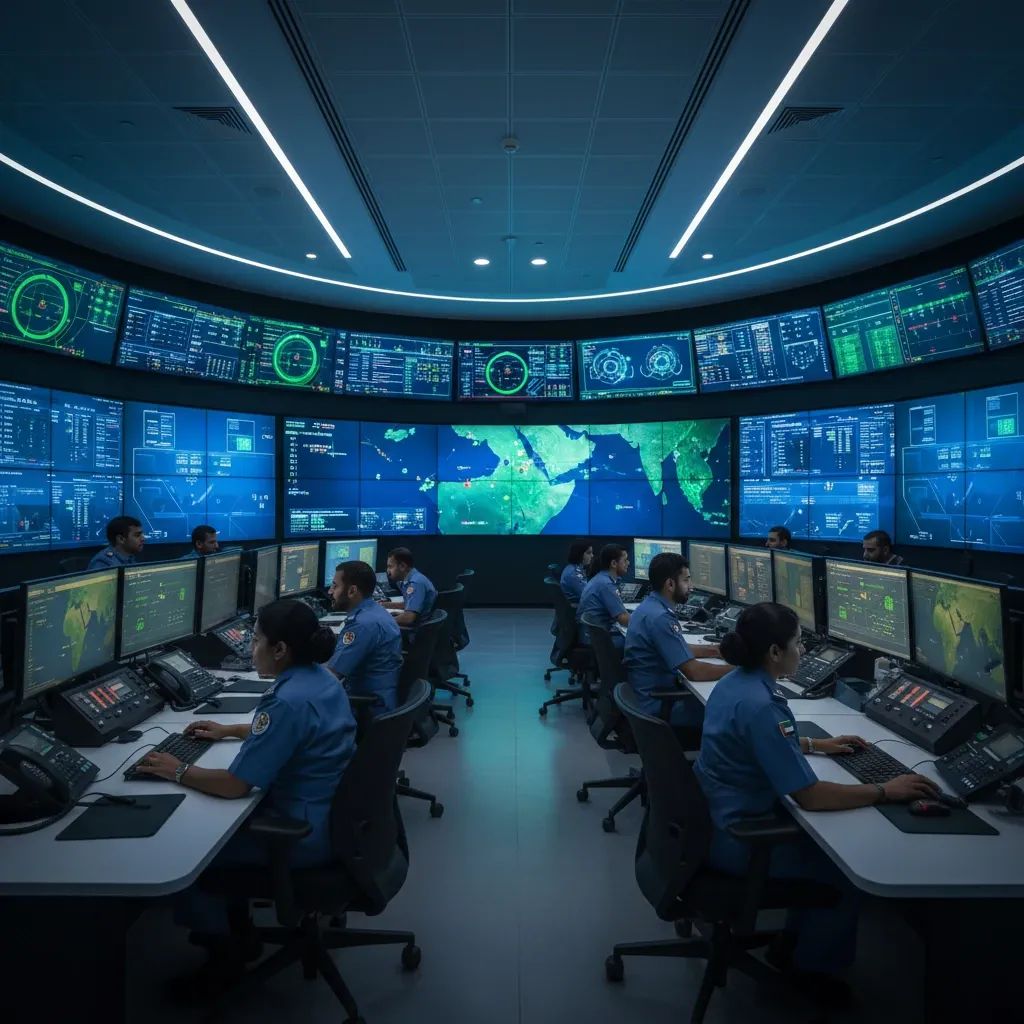
The shift to distributed workforces has created an emerging challenge in the United Arab Emirates' digital defenses. Attackers, recognizing that home networks lack the security layers protecting corporate data centers, have fundamentally reoriented their operations—and the consequences are measurable. Over the past year, cyberattacks exploiting remote work vulnerabilities have surged by over 40%, according to the UAE Cybersecurity Council, marking a decisive pivot in how criminals target the country's economy and residents.
Why This Matters
• 38% of cyberattacks now concentrate on home routers and VPNs rather than enterprise firewalls, forcing security priorities to shift from offices to living rooms.
• The UAE faces between 90,000 and 200,000 attempted breach attempts daily, with significant confirmed incidents recorded throughout 2025 and into 2026.
• Ransomware attacks specifically surged 267% in 2024 compared to 2023, averaging $2.9 million in losses per affected business.
• 92% of security professionals globally confirm remote work amplifies breach risk due to consumer-grade equipment and behavioral vulnerabilities.
The Evolving Threat Landscape
For decades, the calculus of cybercrime centered on fortress-breaking. Criminal syndicates invested millions in tools designed to penetrate corporate firewalls, compromise centralized servers, and breach government networks protected by redundant systems and specialized defense teams. But as the United Arab Emirates embedded remote and hybrid work into its economic fabric—particularly in finance, professional services, and technology sectors—the strategic incentives shifted fundamentally.
Today's attacker faces a different decision: invest substantial resources attempting to breach a hardened enterprise network defended by AI systems and trained security analysts, or target a professional working from a spare bedroom in Dubai, connected through a consumer-grade router, using a personal laptop and a budget VPN service. That laptop contains client files, financial spreadsheets, customer databases, and corporate communications—all accessible through a single credential compromise.
The UAE Cybersecurity Council confirmed this shift through incident data. Approximately 38% of recorded cyberattacks now focus explicitly on infrastructure supporting remote workers: home routers that serve as initial infiltration points, Virtual Private Networks vulnerable to misconfiguration, and video conferencing platforms exploited for credential harvesting. This concentration reflects a calculated reallocation of criminal resources toward the path of least resistance.
The Architecture of Modern Extortion
The ransomware ecosystem has matured into a sophisticated financial operation bearing little resemblance to disruption-focused attacks of the previous decade. Groups historically dominant—like LockBit, which claimed 31% of UAE ransomware activity in 2023—have been displaced by faster, more opportunistic collectives. RansomHub, DarkVault, and Everest now represent the emerging threat landscape, and their operational model reveals why the shift matters.
These organizations employ what security professionals term "double extortion": steal sensitive data first, encrypt systems second, then extort the victim regardless of whether backups exist. The innovation lies in recognizing that operational recovery—restoring systems from backups within 48 hours—no longer constitutes defense. The real vulnerability is regulatory exposure, legal liability, customer notification requirements, and reputational damage. A company that recovers infrastructure quickly still faces weeks of regulatory investigation, potential fines under Federal Decree-Law No. 34 of 2021 (expanded in 2026 to mandate explicit data protection protocols), mandatory customer disclosure, and erosion of market confidence.
For criminals, this evolution means victims pay not to avoid operational disruption but to prevent public exposure of stolen information. Financial institutions, healthcare providers, and government contractors face pressure transcending immediate business continuity concerns—they face existential reputational risk if compromised data becomes public.
52% of cyberattacks in the UAE are financially motivated, according to recent analysis. The average organization absorbing a cyber incident incurs approximately $2.9 million in direct costs alone, excluding indirect losses, litigation expenses, and regulatory penalties. For mid-sized enterprises operating distributed workforces across the UAE, a single successful attack can cascade into operational shutdown and customer attrition.
Why Humans Remain the Weakest Link
Technology operates within defined parameters. It identifies known threats, detects anomalous network behavior, and blocks recognized attack signatures. But technology cannot predict human judgment in a moment of pressure or distraction. This explains why phishing—email-based social engineering designed to capture credentials or deploy malware—represented 43% of initial breach attempts in remote environments during 2025, according to UAE Cybersecurity Council observations.
Phishing is not sophisticated hacking; it is psychological manipulation at scale. A remote worker receives an email appearing to originate from their finance department requesting urgent credential verification for a system update. The message includes corporate branding, references recent projects, and creates artificial urgency. The worker, amid afternoon distractions, provides credentials in seconds. Within minutes, the attacker gains access to internal systems.
The threat landscape continues to evolve. Security analysts project that advanced, personalized phishing campaigns powered by artificial intelligence will pose increasingly sophisticated challenges beyond 2026. These AI-generated messages can be contextually aware, personalized to target individuals, and dynamically adapted based on research about the target organization. They do not read like spam; they read like legitimate communications from recognized colleagues or vendors. Detection requires skepticism of the implausible, which cognitive load makes increasingly difficult.
Modern tools have accelerated the progression from initial compromise to lateral network movement—the attacker's progression from entry point to sensitive data. This acceleration reflects both the speed of automated tools and the narrow detection window for security teams. The critical insight is unavoidable: technology cannot defend against an employee clicking a malicious link before systems intervene. The human element therefore remains the first and most critical line of defense, positioning individual awareness as the foundation of national cybersecurity resilience.
Overlooked Vulnerabilities in the Connected Home
Remote work vulnerabilities extend well beyond obvious targets. Home networks often include multiple connection points requiring attention. Smart devices connected to household networks, shared Wi-Fi passwords, and continuously active connected systems can introduce risk vectors most users do not consciously recognize as security failures.
Public Wi-Fi networks present a parallel threat extending beyond the home. A professional accessing work systems from a coffee shop without a secure VPN broadcasts login credentials, financial data, and confidential communications to anyone on that network equipped with basic packet-capturing software. The convenience of location flexibility introduces vulnerability that stationary office work historically contained.
Regulatory Mandate Replaces Voluntary Compliance
The UAE government has concluded that voluntary adherence to security best practices is insufficient infrastructure for national defense. The National Cybersecurity Strategy (2025-2031), released in 2025, signals a fundamental shift in governance approach: organizations and individuals now operate under legal mandate rather than advisory guidance.
The strategy introduces five pillars centered on active defense rather than reactive capacity-building. This reflects a policy determination that the UAE's economic and security interests depend on preventing compromise, not merely recovering from it. Supporting this strategy is the National Cyber Accreditation Programme (NCAP), rolling out across 2026, which restricts operators of critical information infrastructure from engaging unaccredited cybersecurity service providers. Compliance is not optional; it is a licensing requirement for continued operations.
Federal legislation has expanded in parallel. Federal Decree-Law No. 34 of 2021, substantially expanded in 2026, now mandates explicit user consent protocols for data collection, requires personal data storage within UAE-approved, regulated data centers, and imposes strict security guidelines for servers and application programming interfaces. Non-compliance triggers substantial financial penalties and potential operational suspension. Federal Decree-Law No. 26 of 2025, enacted in January 2026, further mandates that digital platforms and internet service providers implement active content filtering and age verification systems, often necessitating AI-powered moderation infrastructure.
For remote workers and organizations, this regulatory environment means several practical requirements: remote work agreements must include robust data protection and cybersecurity clauses specifying confidentiality obligations, protocol adherence requirements, and secure access mandates. For individuals, this translates to using approved organizational tools and VPN systems rather than personal solutions, maintaining compliance with employer security policies, and understanding that remote work agreements now include legal obligations regarding data security. Organizations bear responsibility for ensuring employees understand these requirements and have access to compliant tools and training.
Practical Defense: Individual and Organizational Responsibility
The UAE Cybersecurity Council provides actionable recommendations grounded in recognized attack vectors. Effective implementation requires sustained discipline and ongoing attention across both professional and domestic environments.
For individuals working remotely: Update antivirus software and device firmware on defined schedules—this is foundational security hygiene, not optional maintenance. Utilize the VPN services and security tools provided by your employer when accessing work systems or transmitting sensitive information; these organizational tools are selected to meet UAE regulatory standards for data protection. Approach email communications with systematic skepticism; verify unexpected requests through separate communication channels before providing credentials or accessing embedded links. Exercise particular caution on video conferencing platforms by confirming participant identities before sharing screens, managing privacy settings to restrict recording, and avoiding public link distribution. When possible, maintain separate personal and work devices; when shared equipment is unavoidable, enforce strict digital discipline through separate user accounts and browser profiles.
For organizations managing distributed workforces: Implementation of Multi-Factor Authentication (MFA) across all systems prevents unauthorized access even when credentials are compromised through phishing or credential theft. Adoption of Zero Trust Network Access (ZTNA) frameworks limits sensitive data exposure based on verified user identity and device compliance status, rejecting the assumption that network access itself implies trustworthiness. Deployment of AI-driven threat detection and real-time network monitoring systems provides continuous visibility into network behavior, enabling rapid identification of anomalous activity. Mandatory incident response planning ensures that when breaches occur—and statistical probability indicates they will—organizations can contain and recover with minimal operational disruption.
The private sector increasingly recognizes that cybersecurity is not an IT department responsibility but a business continuity imperative. Organizations investing in these measures now avoid the trajectory of those that discovered their vulnerabilities through breach notification rather than proactive assessment.
How the UAE Compares Regionally and Globally
The UAE achieved "role-modeling" tier 1 status in the United Nations International Telecommunication Union Global Cybersecurity Index 2024, recognition reflecting years of strategic investment and coordinated government action. Yet this prominence carries competitive risk. The nation's rapid digital transformation, concentration of wealth, and status as a regional technology hub make it an attractive target for international cybercrime syndicates.
Across the broader Gulf Cooperation Council, cybersecurity spending is projected to exceed $3.5 billion in 2025, concentrated in AI-driven defense systems, cloud security infrastructure, and Zero Trust architecture deployment. Yet the region simultaneously faces a critical shortage of skilled cybersecurity professionals, a capacity constraint that becomes more acute as threat sophistication accelerates. Middle East data breaches ranked second globally for cost in 2024, underscoring the financial stakes of inadequate defense infrastructure.
The UAE's threat landscape exhibits distinct characteristics despite alignment with global trends. While ransomware and phishing remain universal concerns, the nation's economic profile, geopolitical position, and rapid digital adoption create specific vulnerabilities requiring localized, tailored defenses rather than standardized international frameworks.
The Permanent Shift in Work Architecture
Home office arrangements are not a temporary pandemic-era accommodation; they are structural features of the UAE's economic model, particularly in professional services, finance, technology, and government sectors. This permanence means the vulnerabilities introduced by distributed workforces are not transient management challenges but persistent strategic concerns requiring sustained defensive investment.
The 40% increase in home-network attacks represents a recalibration of the threat environment. Attackers have recognized opportunity and adapted tactics accordingly. Defending against this shift requires equally fundamental changes: how individuals approach digital security responsibility, how organizations structure remote work agreements and technology infrastructure, and how government policy enforces resilience through regulatory mandate rather than voluntary compliance frameworks.
Residents of the United Arab Emirates should understand that their home network now represents both their workspace and an environment requiring active security attention. Organizations should recognize that distributed workforces require equally distributed security responsibility across employees. Policymakers should continue enforcing the regulatory frameworks and accreditation standards that transform security from voluntary compliance into operational reality. The security trajectory of 2026 will determine whether the UAE maintains its position as a regional cybersecurity leader or faces escalating attack sophistication and volume.


