
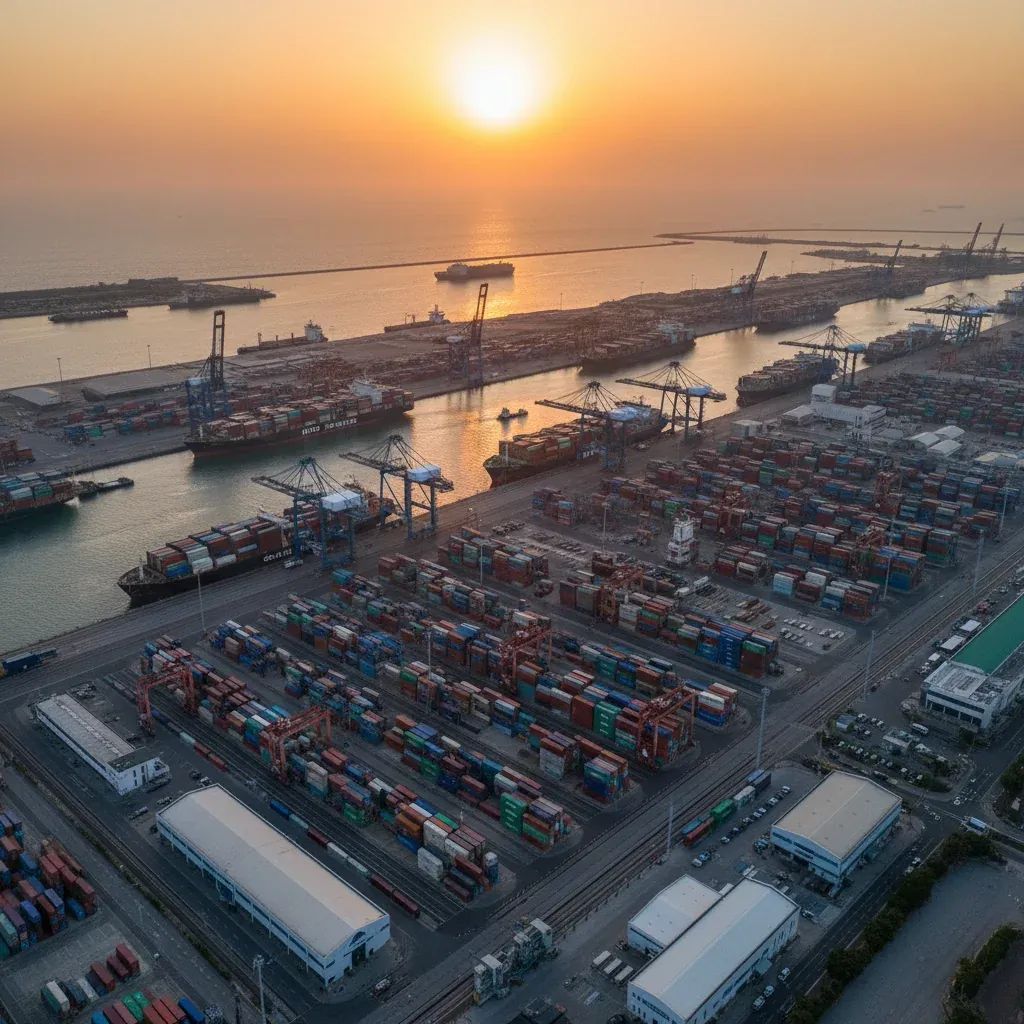
The Muslim Council of Elders, a pan-Islamic organization headquartered in Abu Dhabi, has issued a formal condemnation of a drone strike on two gas vessels at Egypt's Damietta Port, signaling regional consensus that maritime attacks now demand coordinated international deterrence and accountability. The incident, which occurred on July 29, underscores escalating vulnerabilities across Middle Eastern shipping infrastructure and has triggered a tangible security response: a 14-nation maritime coalition mobilized within hours of the attack.
Why This Matters
• Attribution remains open: Egyptian investigators are analyzing recovered drone components; no group has claimed responsibility, though Yemen's Houthis and Iran both deny involvement. The ambiguity creates strategic implications for shipping insurance and diplomatic liability.
• Port resilience tested and confirmed: Emergency protocols contained fires that spread between two vessels; operations resumed within days at functioning berths, preventing economic cascade.
• Regional coalition launched immediately: Saudi Arabia and Egypt announced a Multinational Maritime Defense Coalition on July 30, comprising 14 states committed to coordinated patrols and intelligence sharing across Red Sea shipping corridors.
What Happened and Why Speed Mattered
A single drone targeting the Energos Winter, a US-owned floating liquefied natural gas facility, ignited fires that spread to the nearby GasLog Salem, a Greek-registered LNG tanker moored at Damietta Port on Egypt's Mediterranean coast. Egypt's Prime Minister Mostafa Madbouly confirmed via cabinet statement that preliminary forensic analysis linked the incident to drone weaponry. No fatalities were reported.
What distinguished this incident from worst-case maritime scenarios was the containment response. Port fire crews suppressed the blazes before structural catastrophe could unfold. Within hours, authorities relocated both damaged vessels offshore, allowing uninterrupted operations at functioning container and general cargo berths. The efficiency mattered: any prolonged port closure would have cascaded across Egypt's maritime economy and raised insurance costs across the region.
Yet efficiency alone does not erase the signal sent. A successful strike against critical energy infrastructure at one of Egypt's primary Mediterranean gateways demonstrated both technical capability and operational intent. For traders, shipping lines, and port authorities, the incident exposed genuine vulnerability in previously considered secure infrastructure.
The Investigation and Attribution Puzzle
As forensic teams in Cairo examine recovered drone components, the perpetrator identity remains classified. Yemen's Houthi movement, which has sustained a campaign of Red Sea strikes throughout 2026, publicly distanced itself from the Damietta attack. The group's military operations target Saudi Arabia exclusively, their statement indicated, and do not extend to Egyptian ports. Iran similarly denied involvement.
This absence of claimed responsibility creates uncertainty. Security analysts posit three scenarios: a state actor testing American asset vulnerability in the region; a non-state proxy signaling capability without claiming ownership; or an operational probe by a faction seeking to destabilize maritime commerce independent of established combatants. Supply chains for advanced drone components are intentionally opaque, routed through middlemen across multiple jurisdictions. Attribution could require weeks or months of procurement network analysis.
Why This Strike Arrives in a Fractured Shipping Environment
The Damietta attack occurs amid already-strained Red Sea maritime patterns. Throughout 2026, Houthi operations have escalated markedly. On July 20, the movement declared a maritime embargo targeting Saudi Arabia. Within days, they claimed strikes on two Saudi oil tankers (July 24) and assaults on the Aramco refinery in Jizan and export infrastructure at Yanbu (July 26). The cumulative effect: combined traffic through the Suez Canal and Bab el-Mandeb Strait has declined 42.9% between June 2023 and June 2026.
Most international carriers responded by rerouting around the Cape of Good Hope—adding 10 to 14 days per voyage and exponentially raising fuel, crew, and operational costs. While selective operators tested cautious returns to Suez routes earlier in 2026, renewed hostilities in March and July extinguished those experiments.
Insurance markets have hardened accordingly. London's marine underwriting sector now classifies the Red Sea as a high-risk corridor, commanding elevated premiums across legitimate transit even for vessels without visible threat. For United Arab Emirates-based energy traders, petrochemical exporters, and logistics operators, the environment compounds existing pressure. Every weeks-long diversion represents frozen capital and postponed revenue. For companies with Egyptian market exposure, the Damietta incident underscores the precariousness of energy export channels Egypt depends on for foreign currency stability.
Impact on UAE Residents and Businesses
Expatriates with family ties to Egypt—particularly the estimated 200,000 Egyptian nationals earning remittances in the UAE—now grapple with knowledge that critical homeland infrastructure remains vulnerable. Egypt's national income relies heavily on Suez Canal tolls (exceeding $8 billion in 2025) and energy exports; any disruption cascades through household savings and employment stability across the Gulf.
Logistics and shipping professionals operating from the UAE should anticipate continued Red Sea uncertainty. While the Damietta Port incident did not sever Suez Canal operations, it demonstrated that even Mediterranean-facing infrastructure serving energy commerce falls within hostile reach. Companies maintaining operations across Egypt, the Arabian Peninsula, or East Africa should audit airspace monitoring, perimeter security, and crisis communication protocols.
Investors in renewable and conventional energy projects along Red Sea or eastern Mediterranean corridors face genuine risk quantification. Projects depending on uninterrupted shipping or port access now encounter repriced insurance premiums and force-majeure reassessments. The incident forces revaluation of contingency planning and supply chain diversification.
Diplomatic Architecture Takes Shape
The Muslim Council of Elders, headquartered in Abu Dhabi, issued formal condemnation characterizing the attack as a flagrant violation of international law threatening regional and international peace. The Council expressed unequivocal solidarity with Egypt's government and endorsed all measures to safeguard Egyptian national security and vital facilities. The statement called for firm international accountability to deter future hostile acts and prevent encroachment on state sovereignty.
This diplomatic posture reflects more than rhetoric. Gulf state endorsement of Egypt's response legitimizes Cairo's security actions and signals shared conviction that maritime attacks represent unacceptable escalation. The Council's statement underscores a regional consensus hardening across Gulf capitals: incidents once treated as isolated attacks are now understood as systemic instability demanding coordinated response.
On July 30—one day after Damietta—Saudi Arabia and Egypt formally announced the Multinational Maritime Defense Coalition, mobilizing 14 states around a mandate centered on freedom of navigation across the Red Sea, Bab el-Mandeb Strait, and Gulf of Aden. Founding members include Kuwait, Bahrain, Qatar, Pakistan, Turkey, Jordan, Yemen, Bangladesh, Nigeria, Sudan, Djibouti, and Somalia. The coalition commits to coordinated patrols, real-time intelligence sharing, and joint operational protocols.
Notably, Saudi and Egyptian leadership rejected Western proposals to "internationalize" Red Sea security, insisting littoral Arab and African states retain exclusive responsibility. This stance reflects sovereignty concerns and practical recognition: coalition members understand their own shipping lanes and political dynamics better than distant naval powers.
Investigation and Operational Path Forward
Egyptian authorities have prioritized forensic analysis of recovered drone components, targeting identification of procurement networks, operational signatures, and responsible parties. Success in attribution could narrow suspicion to specific state or proxy actors, enabling targeted deterrence. Analysis will require time but remains the most viable pathway to clarity.
Meanwhile, the Maritime Defense Coalition must translate political commitment into operational capability. Coordinating 14 nations with varying naval resources, intelligence systems, and strategic priorities presents substantial administrative and diplomatic challenges. Success depends on sustained focus and resource commitment from member states over coming months.
Damietta Port has resumed normal operations at unaffected terminals, signaling both recovery capacity and confidence in enhanced security measures. However, the broader Red Sea and eastern Mediterranean maritime environment remains classified as high-risk throughout 2026, with no imminent prospect of de-escalation absent broader political settlement to underlying regional conflicts.
For people living in the UAE with business or personal ties to Egypt and shipping-dependent supply chains, the operational reality is clear: immediate crisis containment succeeded, but structural maritime stress persists. Expect continued insurance premium elevation, periodic shipping delays on alternative routes, and sustained government maritime coalition operations through year-end and beyond. The incident serves as concrete evidence that regional maritime infrastructure now requires fundamentally reassessed risk protocols and insurance architecture.


