
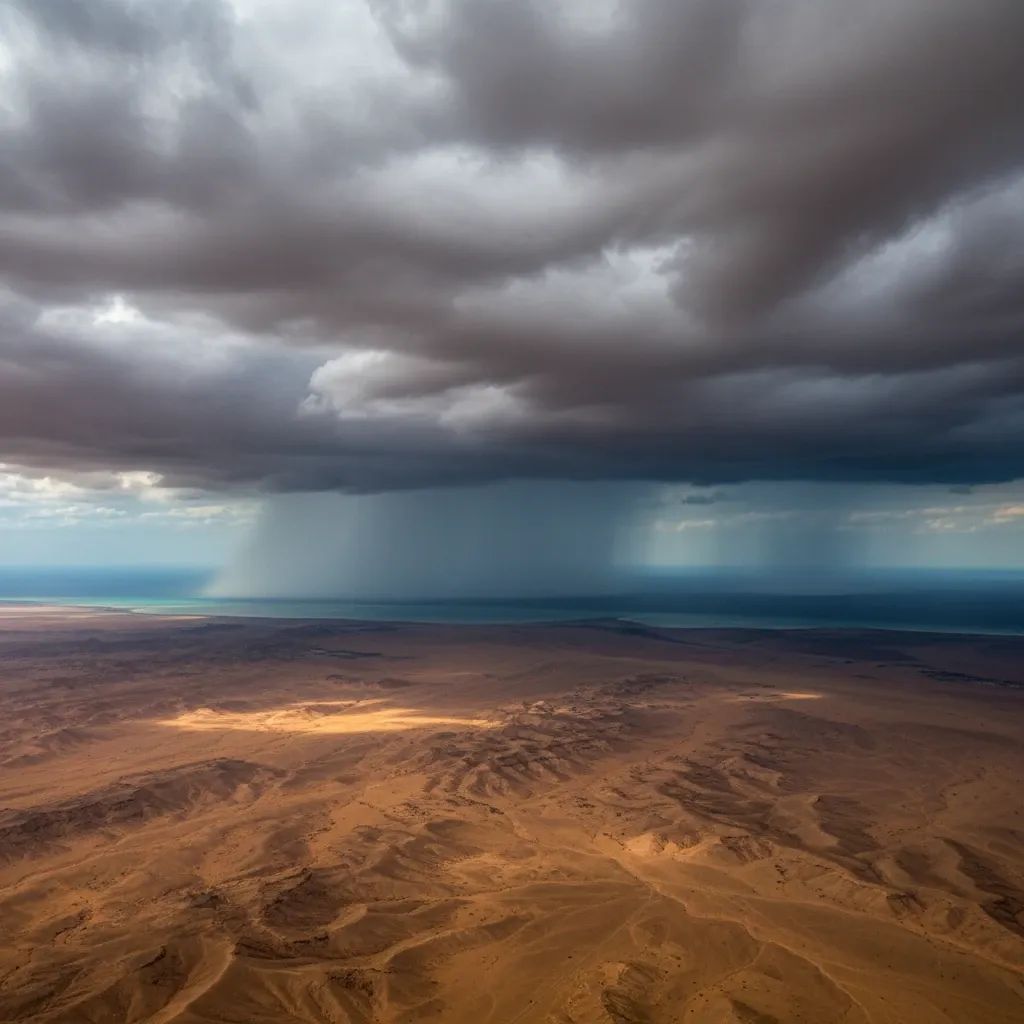
An Offshore Hub Takes Nearly Half Its Annual Rain in a Single Day
The National Centre of Meteorology recorded a stark reminder of atmospheric transformation on Tuesday: Das Island, an oil and gas installation roughly 160 kilometers northwest of Abu Dhabi's coast, absorbed 47.9 millimeters of rain—approaching the entire emirate's typical yearly precipitation in mere hours. The surge arrived as a surface low-pressure system collided with upper-level atmospheric divergence, triggering convective cloud development that scattered water across multiple emirates in patterns so uneven that neighboring communities faced wildly different conditions.
Why This Matters
• Nearly 48 mm fell on Das Island — equivalent to nearly a full year's worth of rain for much of Abu Dhabi — disrupting offshore operations and straining drainage systems engineered for perpetual aridity.
• Peak danger arrives Thursday through Friday with wind gusts potentially reaching 55 km/hr and meteorologists cautiously monitoring the rare but increasingly possible scenario of tornado activity.
• Authorities have closed beaches and warned residents to avoid wadis until all-clear signals arrive; standing water has already claimed attention from traffic management teams across the region.
The Geographic Lottery of Desert Rainfall
The peculiar mathematics of Tuesday's storm illustrate why precipitation here defies intuition. The United Arab Emirates receives roughly 60 millimeters annually—a figure that seems quaint until rain arrives not as steady drizzle but as concentrated bursts over specific zones. Dayyinah Island in the Al Dhafra Region registered 39.7 millimeters, while mountainous zones of Ras Al Khaimah experienced orographic enhancement that wrung additional moisture from passing air masses. Jebel Mebrah measured 33.3 millimeters and Jebel Yanas recorded 31.6 millimeters, their elevated terrain acting as natural precipitation accelerators. Even the Abu Dhabi Corniche, the capital's gleaming waterfront promenade, logged 28.3 millimeters—enough to overwhelm stormwater systems calibrated for aridity.
This patchiness matters operationally. A delivery driver commuting from the coast toward the interior might encounter bone-dry conditions while colleagues 30 kilometers away navigate flooded streets. Emergency services must maintain readiness across the entire emirate despite knowing the storm's actual footprint remains concentrated and unpredictable until it occurs.
When Once-Rare Events Become Routine
The rhythm of recent years illuminates a troubling trajectory. In 2024, the UAE experienced a wet anomaly that delivered 129 millimeters of rainfall annually—more than double the long-term average and establishing it as the wettest year in four decades. Then spring 2025 inverted expectations entirely, proving brutally dry at 38% below the historical average while also setting the record for the hottest April in instrumental records. The volatility isn't random drift; it reflects what climate science predicted about warming atmospheres.
Warmer air holds approximately 7% more moisture for each degree Celsius increase, translating directly into convective engines capable of producing far heavier downpours when atmospheric conditions align favorably. The Sarayat season—the local name for March through early May's transitional instability—is intensifying rather than moderating. Meteorologists tracking multi-decade trends now speak with genuine concern about what the region faces within two decades. Research models suggest maximum one-day rainfall totals could increase by 200% compared to historical norms by 2050. For a nation whose urban infrastructure was planned around assumptions of perpetual dryness, this prospect represents not merely inconvenience but systemic risk to drainage, transportation networks, and public safety.
On the Ground: Immediate Disruptions and Response
The Al Dhafra Region's emergency teams logged 420 weather-related incidents within 12 hours of the Tuesday rainfall—fallen vegetation obstructing roads, water pooling in underpasses, temporary access restrictions to flood-prone areas. That region achieved 100% resolution on immediate emergency responses, a logistical accomplishment demonstrating municipal capability while simultaneously underscoring the relentless crisis-management cycle these events now impose.
For workers stationed on Das Island, the downpour posed operational and human logistics complications. Helicopter transfers connecting offshore installations to the mainland face delays or cancellation when visibility collapses or wind gusts exceed operational safety limits. Oil and gas operators maintain contingency protocols, yet Tuesday's intensity exposed the fragile margins separating normal operations from disruption.
The UAE's Ministry of Interior activated emergency protocols addressing three dominant hazards: standing water capable of stalling vehicles in seconds, horizontal visibility reduced to 1 kilometer or less when winds gust toward 55 km/hr, and flash flood risk in wadis—dry riverbeds that transform into dangerous torrents when mountain runoff concentrates. Police cordoned off routes near elevation zones in Ras Al Khaimah. Beaches remain closed through Friday, and coastal zone activities have been officially discouraged—effectively eliminating weekend recreation patterns families typically pursue.
Infrastructure Racing Against Climate Acceleration
The AED 30 billion Tasreef drainage expansion underway in Dubai represents the United Arab Emirates's most ambitious infrastructure response to this emerging reality. Completion is targeted for 2033, a direct response to April 2024's catastrophic flooding that submerged Dubai International Airport's runways and triggered 1,200 flight cancellations. Yet even these investments appear to lag behind atmospheric acceleration. Drainage networks across Abu Dhabi and smaller emirates were dimensioned for precipitation totals far below what the region now regularly experiences. When a single location records nearly 48 millimeters—roughly 60% of average annual totals in one day—existing systems face unprecedented stress. Municipal authorities engage in perpetual catch-up: emergency response, damage assessment, network inspection, infrastructure upgrades, then bracing for the next major system within months.
What Remains Uncertain: Thursday's Intensification
The National Centre of Meteorology forecasts that unstable conditions will persist through March 28, with successive rainfall waves, thunderstorm activity, and potential hail. The system's peak intensity window spans Thursday night through Friday morning, when heavy precipitation, lightning, and strong winds converge. International meteorological models have not entirely dismissed the rare but alarming possibility of tornado development—a phenomenon virtually unknown in Arabian Peninsula history but increasingly plausible as atmospheric energy intensifies. While formal tornado warnings have not been issued, emergency planners have elevated vigilance accordingly.
Temperatures in affected areas hover around 27–28°C, but elevated humidity levels create oppressive, muggy conditions that feel unfamiliar and psychologically taxing for residents accustomed to dry desert heat. The sticky atmosphere amplifies discomfort despite cloud cover.
Official guidance emphasizes:
• Never drive through standing water—depths deceive and currents exceed expectations.
• Avoid wadis and topographically low areas until all-clear signals arrive.
• Stay clear of beaches and coastal zones until marine warnings lift.
• Monitor official weather channels; conditions deteriorate rapidly and shift unexpectedly.
The Paradox Defining Water Security Here
Despite dramatic flooding scenes and overwhelmed drainage systems, the UAE remains one of Earth's most water-scarce nations. The Standardized Precipitation Evapotranspiration Index projects increasingly negative values through the century's end, signaling intensifying drought pressure on groundwater reserves and agricultural viability. The paradox is counterintuitive but fundamental to arid-region hydrology: intense rainfall doesn't automatically become usable water. When precipitation arrives in concentrated bursts rather than steady, moderate showers, much runs off to sea or evaporates before capture systems harness it.
The UAE employs cloud seeding technology to stimulate precipitation during meteorologically favorable windows, yet even augmented rainfall demands sophisticated infrastructure to convert into meaningful water supply. For a nation that desalinates the majority of its drinking water and imports substantial portions of food supply, every major rainfall event serves dual purposes: immediate hazard to navigate and potential water resource to capture. This tension—danger and opportunity locked simultaneously into the same atmospheric system—increasingly defines how the UAE must conceptualize extreme weather in an era of climatic volatility.


