
Infrastructure at the Breaking Point: What the UAE's Record Rainfall Week Reveals
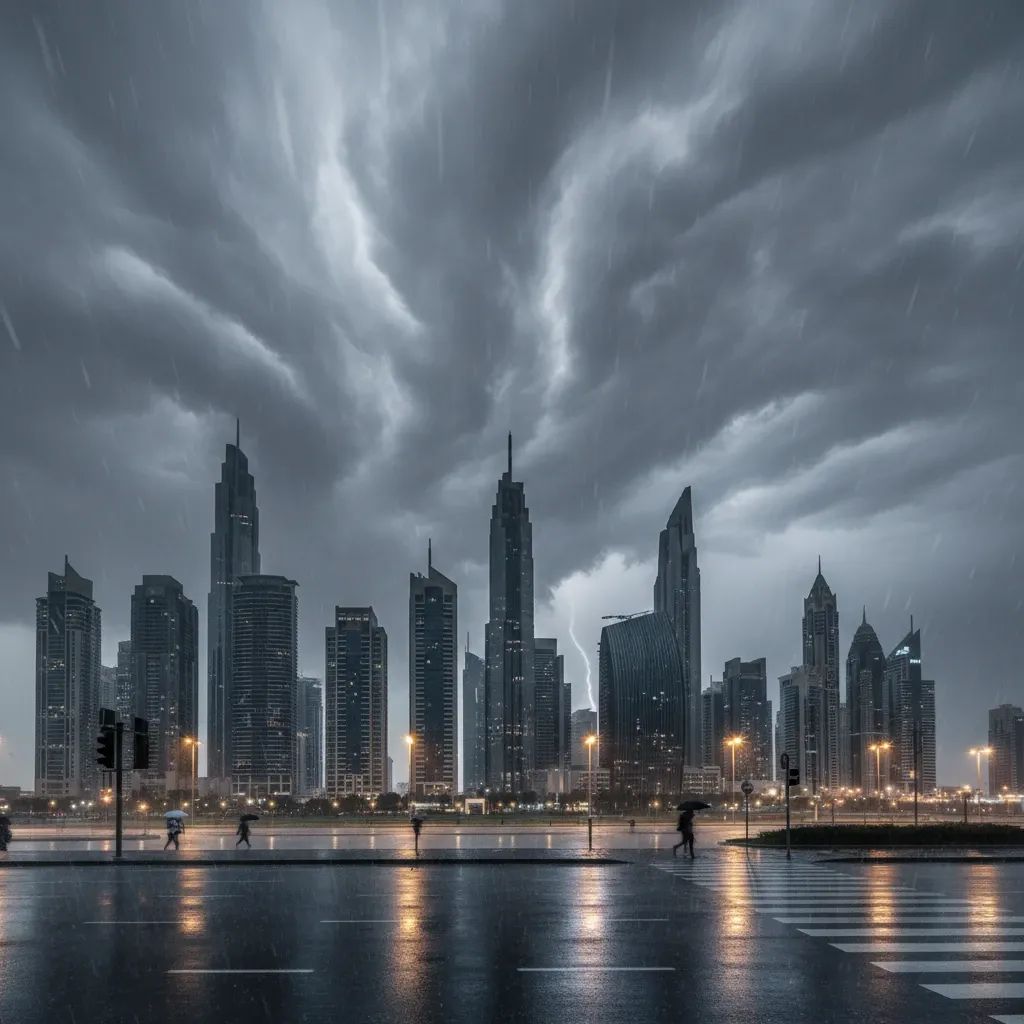
Heavy rains across the United Arab Emirates during the final week of March have delivered a sobering message: the country's infrastructure and emergency systems are being tested by weather events that historical planning never fully anticipated. The National Centre of Meteorology documented what amounts to several months of precipitation in concentrated bursts, with Al Manama in Ajman receiving 93.3 mm on a single day—a stark shift from the modest, predictable rainfall cycles that engineers designed drainage systems around.
Why This Matters
• Annual totals in hours: The 93.3 mm that fell on March 24 represents roughly 70% of Ajman's typical yearly rainfall, forcing residents and businesses to adapt to disruptions usually spread across 12 months compressed into days.
• Operational chaos sustained: Flight delays continue through March 27, roads remain periodically impassable, and municipal crews are working around the clock to manage standing water that drainage networks simply weren't built to handle at this velocity.
• Adaptation now urgent: The United Arab Emirates Government faces hard questions about whether current stormwater infrastructure, designed for desert conditions, can accommodate what climate science suggests will become more frequent extreme events.
When the Desert Fights Back
Ajman isn't accustomed to drama. The emirate typically receives somewhere between 86 mm and 134 mm of rain across an entire year. February—its wettest month—normally sees 22 mm to 35 mm. On Monday, March 24, the skies erased that distinction.
The slow-moving weather system pulled moist air from both the Red Sea and Mediterranean, parking itself over the Emirates long enough to dump concentrated rainfall across multiple locations. Beyond Ajman's 93.3 mm, Ghayathi in Abu Dhabi's Al Dhafra region received 91 mm. Al Wathba logged 88.2 mm. Mohammed bin Zayed City recorded 78.7 mm. Al Ruwais measured 75.7 mm. These weren't scattered showers; they were sustained downpours that exposed how quickly desert watercourses and urban drainage systems become overwhelmed.
The Ajman Municipality shifted into crisis mode, deploying field teams on a 24-hour rotation to manage flooding and clear drainage infrastructure. In Abu Dhabi, the Abu Dhabi City Municipality activated specialized units to handle water accumulation in low-lying neighborhoods, though authorities acknowledged that despite advance preparation of stormwater networks, the volume exceeded design assumptions in several districts.
Roads became temporary rivers. One Ajman resident lost a vehicle's front license plate to surging runoff—a minor loss that illustrated the raw power of water moving through urban corridors that rarely see it. Dubai Airports and carriers including Emirates and Air Arabia issued repeated advisories warning passengers to expect cascading delays and cancellations as visibility dropped and runways remained in marginal conditions through Friday.
The Pattern Nobody Wants to Acknowledge
This wasn't an isolated freak event. The United Arab Emirates has experienced three extraordinary rainfall episodes in recent years, each one shattering assumptions about what the desert atmosphere can deliver. In April 2024, Dubai received 142 mm in 24 hours—exceeding its typical annual average in a single day. During the same system, Khatm Al Shakla in Al Ain recorded an astounding 254 mm, the highest total documented since 1949. In March 2016, the Shuwaib station measured 287.6 mm.
When scientists examined the April 2024 event in detail, they identified a collision of atmospheric conditions: a vorticity streamer, a Red Sea Trough, and an upper-level jet stream converging to transport warm, moisture-rich air from the Arabian Sea. Sea surface temperatures measured 2°C above the 20-year average, creating what amounted to a fuel depot for convection.
Climate modeling revealed something that should concern urban planners: human-driven warming made that 2024 deluge 30 times more likely than it would have been in a pre-industrial climate. The mechanism is straightforward. For every degree Celsius of atmospheric warming, air can retain approximately 7% more moisture. That additional water vapor becomes ammunition for convective storms. The Arab region is warming at nearly twice the global average, according to climate assessments, meaning the conditions that trigger such events are intensifying.
Research measuring UAE rainfall patterns since 2000 shows an increase of up to two additional stormy days per year—a trajectory projected to accelerate. Extreme rainfall events specifically have become between 10% and 40% more intense due to human-caused climate change. Scientists emphasize that natural cycles like El Niño can amplify these effects temporarily, but the underlying driver remains fossil fuel emissions altering the atmospheric baseline.
Real-World Consequences for People Living Here
The immediate fallout has reshaped how residents navigate daily life. The Ministry of Interior issued driving advisories recommending reduced speeds, headlights on regardless of daylight, and routes avoiding flood-prone valleys. Traffic management teams deployed across major highways to prevent pile-ups on water-covered asphalt.
In Sharjah, authorities implemented free public parking temporarily to ease congestion as people navigated around inundated streets. Private employers received government guidance suggesting flexible work arrangements, allowing staff to avoid hazardous commutes during peak rainfall periods. The practical effect: many office workers simply stayed home, demonstrating how climate disruptions now factor into business continuity planning.
Dubai Airports alone issued multiple advisories as flight schedules unraveled. Passengers found themselves rebooking across multiple days, rental car companies adjusted inventory, and hotel blocks filled with stranded travelers. For business travelers and tourists on tight schedules, the event meant lost productivity and unexpected expenses. For families planning trips, it meant revised travel plans and forfeited deposits.
Beaches and parks across Abu Dhabi remained closed as of March 24, with authorities warning that water velocity and debris made recreation unsafe. The National Emergency Crisis and Disaster Management Authority emphasized adherence to official updates, avoidance of low-lying areas during active rain, and staying clear of waterfronts.
Infrastructure Wasn't Built for This
The conversation about drainage and water management in desert cities usually focuses on scarcity. How do you find enough fresh water? How do you recycle and conserve it? The March rainfall forced a different question: what happens when the desert receives several years' worth of precipitation in 72 hours?
The answer: systems designed for arid-climate gradual management struggle. Abu Dhabi's stormwater networks, maintained in anticipation of the storm system, still faced saturation in lower-lying districts. Ajman's 24-hour emergency operations reflected the reality that even with advance warning and trained crews, managing that volume of water overwhelms infrastructure designed around historical norms.
Climate scientists and urban planners now face a planning paradox. Historical precipitation data from the past 50 years is becoming less reliable as a basis for infrastructure design. The April 2024 event that dumped 254 mm on a single location, the March 2016 287.6 mm reading, and the recent March rainfall concentrated at 93.3 mm across wider areas suggest the distribution of extreme rainfall is shifting.
For the United Arab Emirates Government, this raises questions about reservoir capacity, retention pond design, and whether current stormwater systems should be recalibrated around new intensity benchmarks rather than averages based on decades when such events were genuinely rare.
What Comes Next
The National Centre of Meteorology forecast that unsettled weather would persist through Friday, March 27, with rain of varying intensity, thunderstorms, strong winds, and the potential for hail in limited areas. Reduced visibility from blowing dust and sand would accompany wind gusts. By the weekend, meteorologists anticipated conditions stabilizing.
That forecast assumed the current system would behave predictably. The broader reality, supported by climate data and atmospheric science, is that predictability itself has become a casualty of changing climate patterns. The May-to-September dry season that defines Ajman's summer may remain reliable, but the winter-spring rainfall window is becoming erratic—some years sparse, occasionally producing events that erase entire seasons' worth of precipitation in hours.
For residents navigating this environment, the practical imperative is straightforward: stay informed through official NCM updates, follow safety protocols during active weather, and recognize that extreme rainfall isn't meteorological curiosity anymore—it's become a regular feature of the atmospheric calendar that the UAE must now plan around.


