
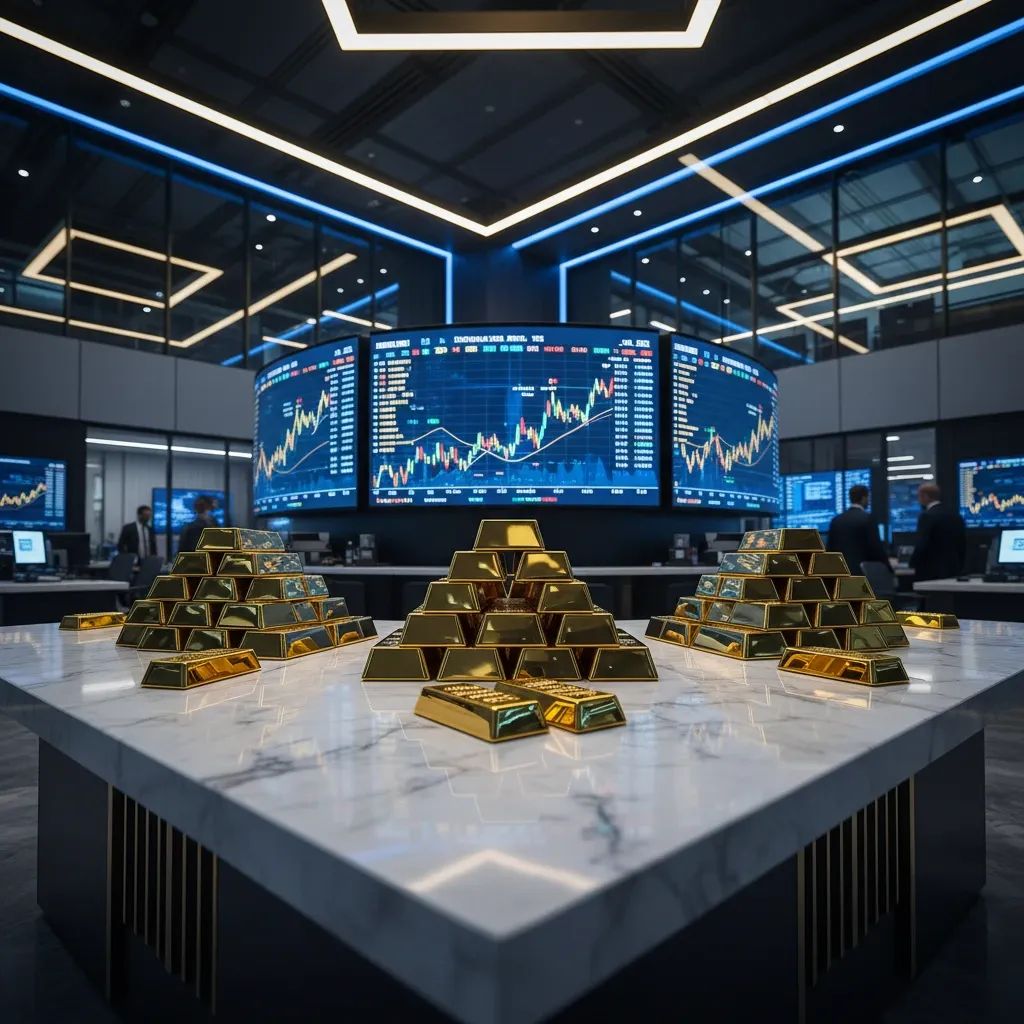
Diplomatic signals from the United States over the weekend sparked an immediate reshuffling in commodity markets on Monday, with gold prices climbing as energy costs retreated and investors recalibrated their inflation expectations. The shift reveals deeper tensions within financial markets: central banks remain hungry for bullion, yet retail investors continue pulling back, leaving precious metals in a state of impasse that will likely persist through the remainder of August.
Why This Matters
• Real-time pricing: Gold touched $4,068.54 per ounce (approximately AED 14,935), with US futures at $4,066.60—practical reference points for jewelry buyers and portfolio managers in the United Arab Emirates
• Broader metal movements: Silver, platinum, and palladium all posted gains, indicating sector-wide momentum rather than isolated bullion strength
• Regional implications: The United Arab Emirates' role as a gold trading and re-export hub means these fluctuations directly influence jewelry margins, structured products, and import pricing across the emirate
The Geopolitical Reprieve and Its Market Translation
Monday's precious metals rally stemmed from a very specific catalyst: the Trump administration's deliberate pause on military action against Iran in favor of negotiating an accord. The shift signals reduced probability of an immediate Middle Eastern supply disruption. Oil prices consequently softened, deflating the immediate inflation panic that has kept commodity markets on edge throughout 2026.
For the United Arab Emirates market participants, the timing carries tactical significance. When oil—the region's lifeblood—stabilizes, so too does the inflation outlook. A moderation in energy prices creates space for monetary authorities to resist aggressive rate increases, which in turn makes gold more competitive against fixed-income instruments. Here's why: gold produces no coupon or dividend, so when competing financial assets offer less yield, bullion becomes relatively more attractive.
US gold futures climbed 0.9% to $4,066.60, while spot silver accelerated faster—up 1.4% to $58.46 per ounce. Platinum gained 0.5% to $1,650.63, and palladium added 1.6% to $1,293.50. This broad-based ascent across the precious metals complex signals that Monday's move reflected general risk-off sentiment recalibrating rather than specialized demand for specific metals.
What This Means for Residents and Investors
The direct implications for those navigating the United Arab Emirates marketplace are threefold and require careful attention.
For jewelry buyers and retailers: The current price level around $4,068 represents meaningful value compared to the $5,598 all-time high hit in late January 2026. That said, prices remain elevated relative to pre-2024 levels. Merchants operating in the Dubai Gold Souk and retail outlets across the emirates are facing margin pressure; transaction volumes tend to spike when consumers perceive prices as having "fallen sufficiently" to warrant purchasing. Monday's uptick may dampen near-term retail enthusiasm, suggesting a quieter trading environment before any decisive breakout.
For wealth managers and portfolio custodians: The investment picture has fractured into competing narratives. Central banks globally purchased 289 tonnes in Q2 2026—a staggering 62% increase year-over-year—signaling that institutional reserve managers view gold as essential to portfolio resilience. Yet this demand contrasts sharply with outflows from gold ETFs in North America and Europe, where retail investors have been net sellers. The United Arab Emirates' position as a regional financial center means local wealth advisors must reconcile these opposing flows when counseling clients on allocation.
The central bank buying spree reflects genuine structural anxiety. Poland, China, and the Czech Republic have led recent acquisitions, motivated partly by sanctions concerns crystallized when Russian foreign exchange reserves were frozen in 2022. For investors domiciled in the United Arab Emirates—many of whom hold cross-border portfolios—this geopolitical anxiety is neither abstract nor distant.
For import-dependent manufacturers: The gains in palladium (up 1.6% to $1,293.50) and the broader precious metals basket matter for businesses sourcing catalytic converters, electronics components, and specialty materials. While the United Arab Emirates maintains limited heavy manufacturing, import pricing for finished goods and raw materials sensitive to palladium costs will shift correspondingly.
Interest Rates Remain the Fundamental Constraint
The US Federal Reserve held its benchmark rate steady at 3.5%-3.75% on July 29, but the decision carried unmistakable signals of internal division. Three committee members dissented in favor of raising rates, and Chair Kevin Warsh's subsequent press conference language was notably hawkish despite softening inflation data. The market has internalized this messaging: 60.1% probability is currently assigned to a September hike.
This "higher-for-longer" environment creates genuine headwinds for gold. When real interest rates (nominal rate minus inflation) are elevated, holding non-yielding bullion becomes increasingly uncompetitive. June's Consumer Price Index showed 3.5% year-over-year growth, while the Personal Consumption Expenditures index climbed 3.7%—both above the Fed's 2% target. Until inflation genuinely retreats or the Federal Reserve commits to rate cuts, gold faces structural resistance.
The implications ripple through the United Arab Emirates' monetary system via the country's currency peg to the US dollar. When Washington raises rates, the dirham zone automatically inherits those monetary conditions regardless of local economic circumstances. This mechanical linkage means United Arab Emirates residents with dollar-denominated debt, mortgages, or savings accounts all feel Federal Reserve policy decisions with a lag of weeks to months.
Gold's Technical Confinement and August's Decision Point
Since late June, gold has occupied a $3,945 to $4,172 trading range—a six-week consolidation that most technical analysts interpret as a prelude to significant movement. The metal sits 28% below its January 2026 high of $5,598, a decline that reflects both the Fed's holding pattern and the ebb and flow of retail investment enthusiasm.
Key technical reference points matter because they determine where buy-side and sell-side conviction forms:
Support levels: A breach below $3,900 would expose gold to further declines toward $3,552, a level that would represent capitulation by institutional holders and potential margin-forced selling.
Resistance levels: A convincing move above the current range could trigger buying toward $4,300 to $4,400, territory that would require either a genuine geopolitical escalation (triggering fresh safe-haven demand) or visible clarity that the Federal Reserve intends to abandon its rate-hiking trajectory.
Most forecast models converge on August as a decisive month. The combination of potential FOMC commentary, monthly inflation data releases, and the evolving Iran negotiation dynamics create multiple catalysts for decisive directional movement. Analysts widely expect that volatility compression will terminate in the coming weeks, forcing gold into either a genuine uptrend or a deeper correction.
Divergent Forecasts Paint an Uncertain Horizon
Professional forecasters have staked out wide-ranging positions, reflecting the genuine ambiguity in gold's near-term direction:
Conservative positioning: MUFG projects gold anchored near $4,000 through 2026, implying that current geopolitical relief proves temporary and rate risks resurface.
Moderate bullishness: UBS forecasts a rebound to $5,200 by mid-2027, contingent on the Federal Reserve avoiding further tightening and central bank demand remaining robust.
Aggressive optimism: J.P. Morgan Global Research predicts $6,000 per ounce by Q4 2026, potentially reaching $6,300 by end-2027, assuming geopolitical tensions intensify and monetary authorities pivot dovish.
For United Arab Emirates-based investors, the practical strategy involves recognizing that gold occupies an increasingly crowded middle ground. It is neither genuinely cheap (relative to 2020-2021 valuations) nor sufficiently expensive to suggest a peak. The metal remains valued primarily as portfolio insurance rather than as a yield-generating asset or industrial commodity. This positioning leaves it vulnerable to both upside surprises (geopolitical shock) and downside pressure (Fed hawkishness).
Central banks continue accumulating because their time horizons span decades and their mandates encompass systemic risk mitigation. Retail investors have retreated because their return expectations clash with current real yields. Monday's modest bounce reflects this equilibrium temporarily favoring bullion, but nothing structural has shifted. Gold will likely meander through the $3,900 to $4,200 corridor until August delivers the direction-setting event that financial markets have been awaiting.


