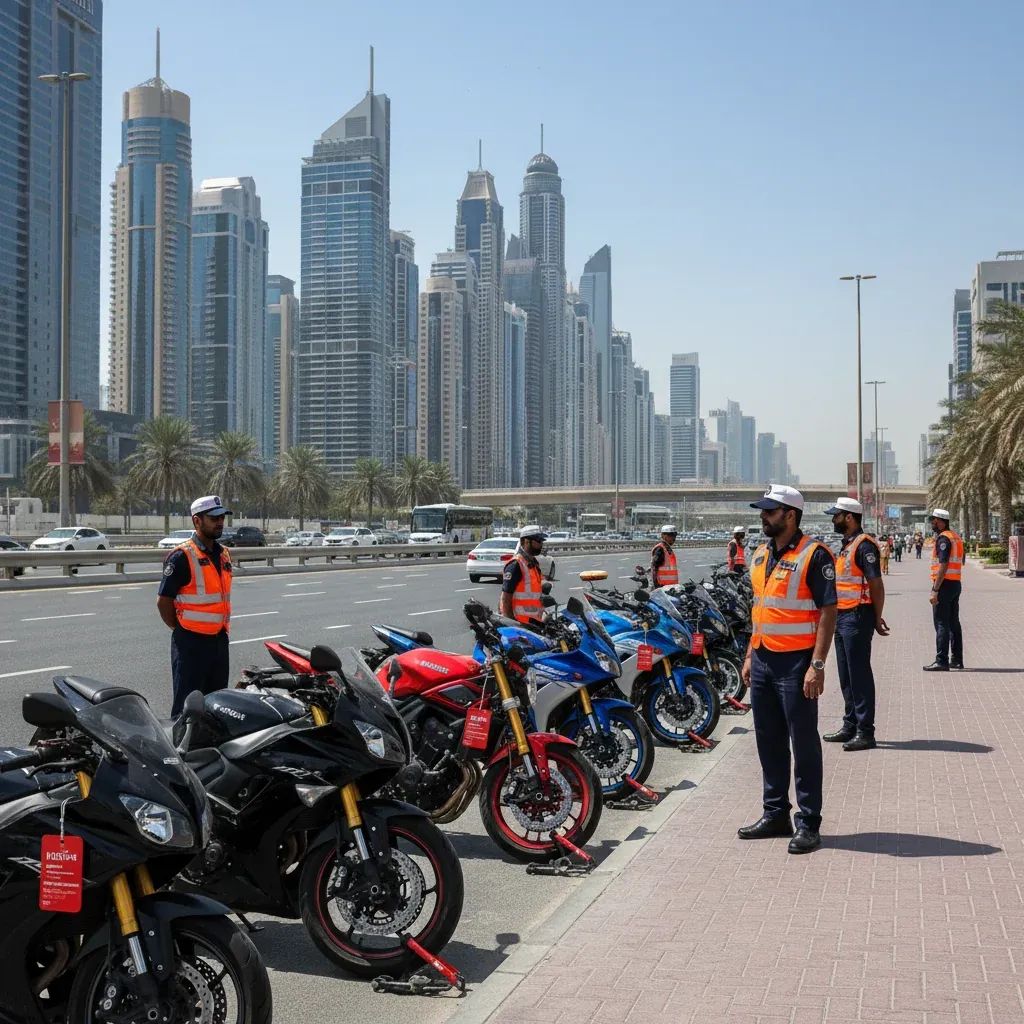
The Dubai Police General Department of Traffic has launched another round of enforcement against motorcycle riders caught performing wheelies and weaving through traffic, part of a widening campaign to stem the influence of social media stunt culture on the emirate's roads. Seized bikes, summoned parents, and a barrage of warnings signal that authorities are treating this not as isolated misbehavior but as a pattern fueled by viral videos.
Why This Matters:
• Over 17,000 motorcycle violations have been logged under the "Quiet Roads" initiative since the program began in 2021, with 1,230 vehicles seized.
• Fines start at AED 2,000 and 23 black points for reckless riding; release fees for impounded bikes can hit AED 50,000 for serious offenses.
• Delivery rider crashes reached 962 in the first nine months of 2025, underlining the urgency behind the crackdown.
• Parents face legal action if their children are caught riding illegally, a shift that puts the onus on families to monitor young riders.
The Social Media Amplification
Brigadier Jumaa Salem bin Suwaidan, who heads the traffic directorate, did not mince words: the problem is no longer just teenage recklessness; it is imitation of viral trends. Riders film themselves balancing on one wheel or cutting across lanes at speed, then upload clips for likes and shares. The cycle repeats as peers attempt to replicate the stunts, often without understanding the physical risk or the criminal liability.
Dubai Police social media channels now publish enforcement footage—impounded motorcycles lined up in storage yards, officers issuing citations—to counter the glamour of stunt videos. The strategy is direct: show the consequence in real time, erode the appeal of the content. Officials have explicitly labeled these performances "deadly challenges," a term borrowed from warnings around global social media dares that have resulted in injuries and fatalities.
Youth in residential neighborhoods have been the most visible offenders. During Ramadan 2025, police seized multiple bikes after residents complained of noise and dangerous riding after iftar hours. Teenagers on motorcycles and quad bikes were racing through streets designed for low-speed family traffic, prompting a wave of reports through the "Police Eye" feature in the Dubai Police app. Parents of first-time offenders were summoned and required to sign pledges barring their children from riding on public roads.
A case in point: In February 2025, a family living in Al Khawaneej faced legal action after their 17-year-old son was caught performing stunts on a borrowed motorcycle. His parent was required to sign a custodial pledge, and the family enrolled him in a mandatory road safety awareness course at a licensed driving institute—a process that took two weeks and cost approximately AED 1,500. The experience made the enforcement personal rather than abstract for the household and their expat neighbors who heard similar cautionary tales.
What the Numbers Show
The enforcement push sits against a backdrop of rising concerns. Dubai recorded 962 delivery rider accidents through October 2025, reflecting ongoing safety challenges on two wheels even as overall traffic fatalities in the emirate dropped significantly in recent quarters. The divergence suggests that while broader road safety measures—AI cameras, upgraded infrastructure, public campaigns—are working, motorcycle behavior remains a persistent concern.
Authorities issued 78,386 traffic violations to delivery motorcyclists in the first nine months of 2025 alone, a figure that climbs when recreational riders are added. The "Quiet Roads" initiative, which began in 2021 and targets noise pollution, unauthorized modifications, and dangerous riding in residential zones, has tallied 33,372 fines and seized more than a thousand vehicles. Breaking that down: 17,117 motorcycle violations, 1,178 cases of unauthorized modifications, 412 noise offenses, 341 reckless driving charges, and 230 misuse-of-horn citations.
In November 2025, a week-long sweep across Al Khawaneej, Al Nad Al Shabaab, Jumeirah Street, and Al Qudra netted 210 motorcycles and scooters, with 270 traffic violations issued for infractions such as driving against traffic and operating bikes on highways where they are banned.
Understanding "Reckless Riding" and Practical Compliance
Under UAE traffic law, "reckless riding" is specifically defined as:
• Performing stunts such as wheelies, stoppies, or one-wheeled riding
• Lane weaving at high speed or between vehicles
• Tailgating or aggressive acceleration and braking
• Unauthorized modifications to exhaust systems (resulting in excessive noise)
• Operating on restricted routes, including highways and certain residential areas during specified hours
For expat parents with teenage children, the compliance path is clear: riders must possess a valid UAE Category B motorcycle license (for bikes up to 125cc and 11kW) or Category A license (for unrestricted motorcycles). Minors under 18 cannot legally ride on public roads unless supervised by a licensed adult, and many insurers refuse coverage for riders under 21, making unauthorized underage riding doubly risky.
For expat residents seeking legal riding outlets, Dubai offers designated motorcycle tracks and riding zones:
• Jebel Ali Raceway offers track days and training courses
• Dubai Autodrome hosts motorcycle events and provides rider training
• Several private riding schools provide license training and advanced safety courses
These venues allow enthusiasts to satisfy the adrenaline-seeking impulse that drives social media stunts while remaining within legal bounds.
The Legal Hammer
The penalties are designed to sting. Reckless riding carries a AED 2,000 fine and 23 black points—one point shy of the 24-point threshold that triggers an automatic three-month license suspension. Accumulate 24 points again within a year, and the suspension extends to six months; a third offense means a full year without a license, plus a mandatory retest.
Vehicle impoundment periods range from 30 to 90 days, depending on the violation. Red-light runners lose their bikes for a month; those caught on recreational off-road motorcycles on paved streets face 90-day confiscation and a AED 50,000 release fee. Fail to pay, and the bike goes to auction. Serious road-rage incidents—defined as aggressive maneuvers endangering others—carry the same AED 50,000 release fee on top of a 30-day hold.
Black points remain on a driver's record for a full year. Drivers can shave off a few points—typically 3 to 5—by completing approved awareness courses at licensed driving institutes, though serious violations are non-negotiable. The system is explicitly punitive: it forces repeat offenders off the road before they cause catastrophic harm.
For expat drivers and riders, black point accumulation has direct insurance consequences. Most UAE insurers treat black points as a significant risk factor, raising premiums by 10-30% depending on the number of points and the type of violation. Riders with 12 or more black points may find their policies cancelled or face substantial premium hikes. This financial burden often exceeds the initial fine and becomes a lasting incentive for compliance.
Impact on Residents and Expats
For anyone living in Dubai—whether citizen, long-term resident, or expat family—the campaign translates into stricter scrutiny of motorcycle ownership and use. Parents who allow underage or unlicensed children to ride face legal action themselves, a departure from the assumption that traffic violations are solely the rider's problem. The police have made clear that family supervision is part of the enforcement equation, particularly when social media trends blur the line between entertainment and criminal recklessness.
Important distinction for tourists and short-term visitors: The penalties apply universally. Tourists renting motorcycles or scooters are bound by the same traffic laws as residents; rental companies are now required to provide documentation on UAE traffic rules as part of the rental agreement. A tourist caught performing a stunt faces the same AED 2,000 fine and potential bike impoundment, though their situation differs logistically—many rental companies have shifted liability clauses to pass violations and fees directly to renters.
Residents in neighborhoods like Al Khawaneej and Al Nad Al Shabaab have already witnessed the effect: fewer late-night disturbances, reduced noise complaints, and visible police presence in known hotspots. The "We Are All Police" reporting service and the "Police Eye" app feature have turned residents into de facto community monitors, with complaints triggering rapid patrols.
For delivery riders—who account for a disproportionate share of motorcycle traffic and accidents—the message is operational: compliance is now enforced at scale. AI-driven traffic cameras detect tailgating, lane swerving, and red-light violations automatically, generating fines without human intervention. The technology has been rolled out across the emirate, meaning no street is exempt.
What Comes Next
Dubai Police have signaled that the crackdown will persist. Brigadier bin Suwaidan's call for early education on road safety and the establishment of designated riding areas reflects a twin approach: enforcement coupled with prevention. The broader UAE context reinforces the urgency: motorcycles account for a disproportionate share of road fatalities despite comprising a smaller percentage of overall traffic, making behavioral intervention a national priority.
The tension between viral content and public safety is unlikely to resolve quickly. As long as social media platforms reward attention-grabbing stunts with views and engagement, young riders will face the pull of online fame. What has changed is the cost of participation: impounded bikes, suspended licenses, fines that can equal months of rent, direct insurance premium increases, and parents dragged into legal proceedings. Authorities expect that making the consequences immediate and visible will disrupt the cycle before the next tragedy.