
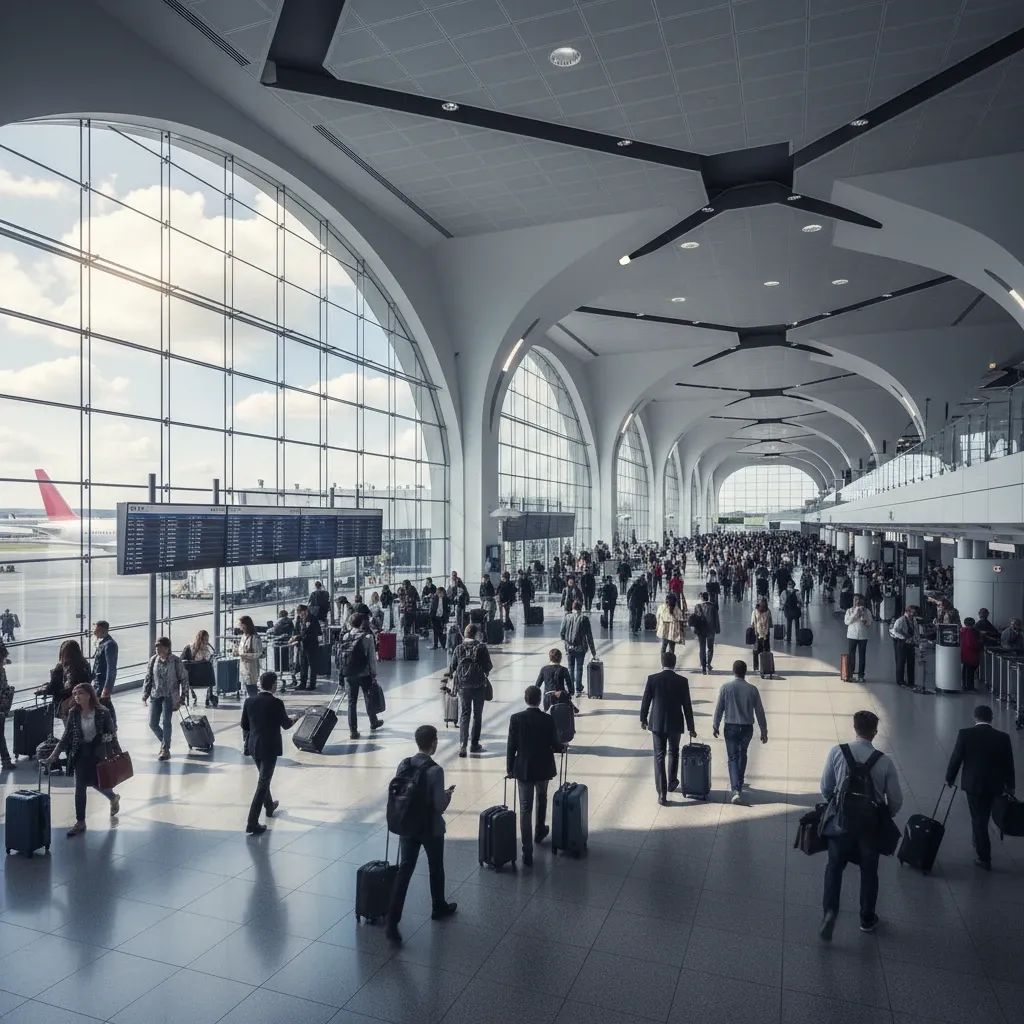
Imagine trying to direct 9 million people through a single gateway in just 30 days. That's the magnitude of what Dubai International Airport accomplished in August 2026, solidifying its reign as the planet's most-used international aviation corridor. With 4.54 million one-way seats scheduled across international routes—a figure that climbed 4.4% from July—the airport absorbed an additional 190,000 seats as airlines accelerated operations during peak summer travel.
Why This Matters
• Seat surge reflects demand explosion: August's 190,000 additional seats signal airlines' confidence in sustained travel appetite, meaning more departure options and potentially better fares for UAE residents booking leisure or business trips.
• Approaching operational ceiling: DXB is now running at near-maximum capacity with 99.5 million passengers forecasted for 2026—just shy of its 100 million threshold—raising questions about congestion during peak hours.
• Al Maktoum timeline critical: The $35 billion expansion airport at Dubai World Central won't reach full operation until 2032, creating a five-year window of potential bottlenecks.
The Numbers Behind the Crown
London Heathrow trails significantly with 4.26 million scheduled seats, while Seoul Incheon posted 3.95 million. Amsterdam Schiphol managed 3.85 million, and Istanbul Airport rounded out the global top five with 3.80 million. The gap between Dubai and its closest rival underscores the United Arab Emirates' structural advantage: geography that places it equidistant from Europe, Asia, and Africa, transforming the emirate into what aviation strategists call a modern "New Silk Road" intersection.
This dominance isn't a one-month anomaly. Dubai International claimed the title of world's busiest international passenger airport for the 12th straight year in 2025, welcoming a then-record 95.2 million travelers—a 3.1% year-on-year increase. The momentum has carried into 2026. First-quarter figures hit 18.6 million passengers, and the airport is on pace to serve nearly 100 million before year-end. By virtually any metric—seats, passengers, connections, or destination reach—Dubai operates at a scale that no other international hub matches.
Why Emirates and Dubai Are Inseparable
The United Arab Emirates' aviation story cannot be told without Emirates Airlines, the state-owned carrier that funnels approximately 70% of its passengers through connecting flights at Terminal 3. That terminal was purpose-built for transfer operations, designed as a high-efficiency machine where thousands of connecting travelers move between long-haul flights with minimal friction. Emirates' fleet of Airbus A380s and Boeing 777s extends the geographic reach of the hub-and-spoke model, enabling routes from London to Singapore or Mumbai to New York that simply couldn't function without a midpoint refueling and passenger exchange.
The symbiosis works because scale breeds efficiency. Dubai International now serves 256 destinations across 102 countries via more than 90 international carriers. That breadth means for residents and visitors transiting through, there's genuine choice—multiple daily options to most major cities, flexible schedules, and the network effects that come with routing density.
What Living and Traveling Through This Capacity Means
For expatriates and UAE nationals planning trips, August's surge translates to practical benefits—and emerging friction. The immediate upside: more flights, wider destination menus, and during off-peak booking windows, competitive pricing. If you're connecting to Europe or South Asia, the sheer frequency of departures reduces the financial sting of missed flights or inconvenient schedules.
The downside is becoming increasingly unavoidable. At 99.5 million passengers annually, the airport operates with little margin for error. Peak hours—typically morning and evening—now see terminal congestion, longer queues at immigration, and stress on ground infrastructure. Security lines, once efficient, have begun to stretch during summer months. Baggage handling remains reliable but is tested during simultaneous aircraft arrivals. Travelers should expect 90-minute check-in windows rather than the historical 60 minutes during August and December peaks.
Noise pollution is another resident concern. Neighborhoods near flight paths, particularly areas around Dubai Islands and older residential zones, experience aircraft noise reaching 70 decibels—equivalent to heavy traffic or a vacuum cleaner. This burden falls unevenly on poorer communities adjacent to the airport, while affluent downtown districts see minimal impact.
Infrastructure and Sustainability Moves
Dubai Airports is not sitting idle. The organization deployed advanced hand baggage scanning technology to accelerate security processing, reducing passenger bottlenecks. More ambitiously, a 39-megawatt solar energy project featuring 62,904 photovoltaic panels is now operational across both Dubai International and Al Maktoum International. The system generates 60,346 megawatt-hours annually, offsetting 23,000 tonnes of CO2 and covering 6.5% of Dubai International's power demand—meaningful progress within the UAE's Net Zero by 2050 Strategic Initiative.
Yet sustainability remains a tension. The airport's environmental footprint is expanding alongside passenger volumes. While solar installation is laudable, aviation's inherent carbon intensity means near-term emissions will continue climbing. The Dubai Clean Energy Strategy 2050 targets 100% clean energy production by mid-century, but the aviation sector ranks among the hardest to decarbonize globally.
How Competitors Are Recalibrating
The dominance of Dubai International is real, but competitive pressures intensify across the sector.
Seoul Incheon ascended to second place in Skytrax's World's Best Airports 2026 rankings, fueled by South Korea's aggressive investment in passenger experience, cleanliness (ranked second globally), and transfer convenience. The airport's smart technology integration and family-friendly design are luring premium passengers willing to endure longer layovers for superior service.
London Heathrow invested £1 billion in new security scanners, a transformation that allows passengers to keep liquids and laptops in carry-ons—genuinely reducing friction. Heathrow earned the 2026 Skytrax award for best airport shopping and was named Europe's most punctual major hub in the first half. However, geopolitical tensions and Middle East instability are forecast to depress Heathrow's 2026 traffic by 1.1% to 5.2%, potentially dropping passenger volumes to 80.1 to 83.6 million from 2025's 84.48 million.
Amsterdam Schiphol secured 11 new or returning carriers in 2025/2026 and achieved its highest-ever capacity in the third quarter. A €10 billion renovation program is underway, with €801 million invested in the first half of 2026 alone. The airport is transitioning toward quieter aircraft; 38% of its flights now operate the two most acoustically efficient aircraft types.
Istanbul Airport targets 90 million passengers for 2026 and is completing its fourth main runway by August. It ranks 8th globally in Skytrax's 2026 rankings and leads Europe in daily flight operations and air freight volume.
The Transition Problem
Here lies the existential challenge: Dubai International cannot expand indefinitely within its current footprint. The eventual migration to Al Maktoum International Airport at Dubai World Central—designed for 260 million passengers annually and initially targeting 150 million—is essential for preventing gridlock. Yet that transition isn't expected until 2032, leaving a five-year window where demand will almost certainly outpace comfortable capacity.
For residents, this means planning travel conservatively. Book earlier than usual. Arrive at the airport with extended buffer time. Expect potential delays during peak months. And recognize that the airport you use daily is operating at an unsustainable utilization level, albeit one masked by excellent operational management.
Dubai's aviation dominance is not accidental or fragile—it's the product of strategic geography, visionary infrastructure investment, and an airline partner aligned with the hub model. But dominance has its costs, and for ordinary travelers moving through Dubai International, those costs are becoming tangibly apparent.


