
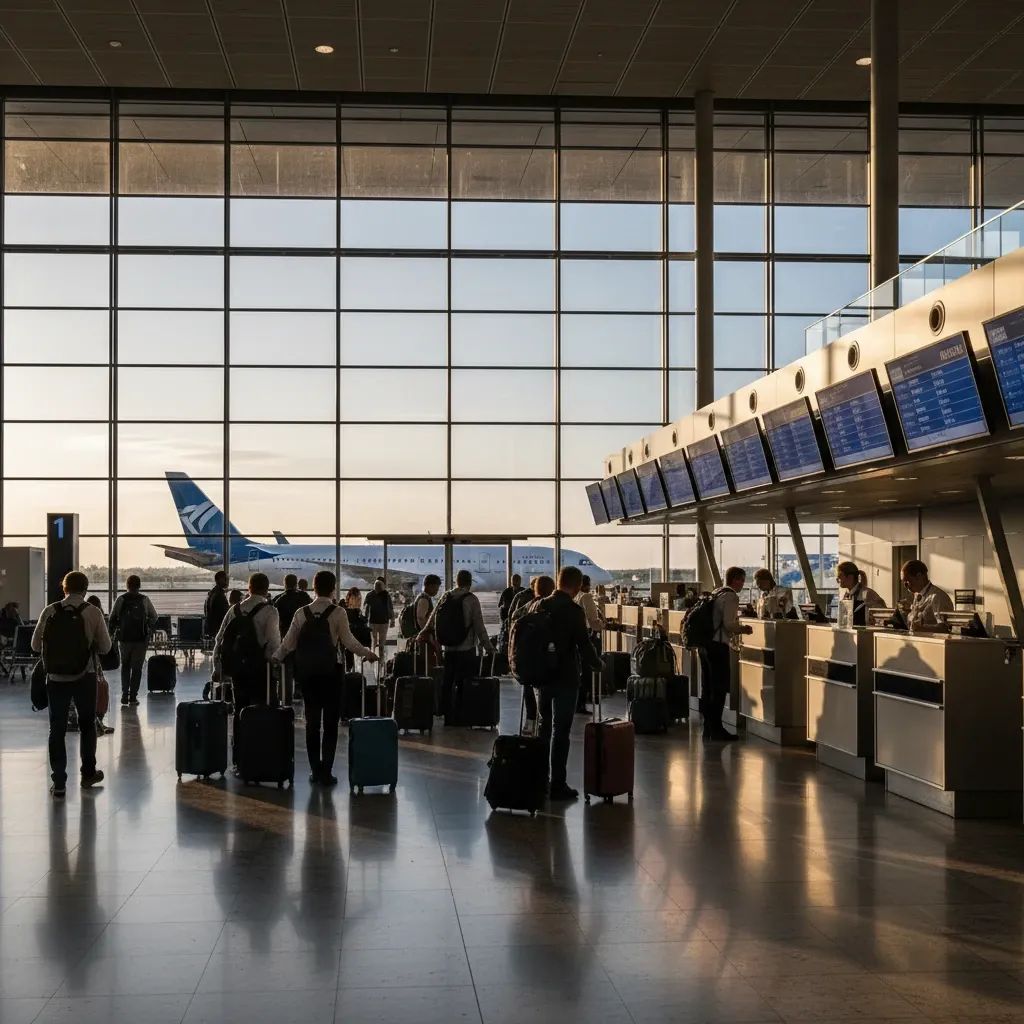
Wizz Air's candid acknowledgment that second-quarter revenues will decline even as the airline expands capacity reveals the deepening structural fracture within European budget aviation—and what it means for anyone planning economy travel from the United Arab Emirates to Central Europe. The Budapest-based carrier absorbed a €183.3 million operating loss in its first quarter and now faces a full fiscal year of uncertainty, a situation that reflects not temporary market turbulence but a fundamental challenge to how ultra-low-cost airlines generate profit.
Why This Matters
• Ticket prices unlikely to drop: Fares are heading upward across summer and autumn as fuel hedges expire; expect 10-15% increases from September onward if current market conditions persist.
• Capacity stays; margins compress: Wizz Air continues aggressive expansion despite losses, meaning flights will remain available but fewer budget alternatives exist if you shop for the cheapest fares.
• Geopolitical disruption is structural: Middle East airspace closures and oil supply anxiety won't disappear quickly—this affects route planning and fuel costs indefinitely, not just this quarter.
• Investor risk rising: Multiple analysis firms are reducing airline profit forecasts; those with exposure to Wizz Air's debt face materially higher refinancing costs if profitability remains elusive through 2027.
The Paradox of Expansion Amid Contraction
On the surface, Wizz Air's strategy appears counterintuitive: announcing capacity growth in the high-twenties percentage range while simultaneously projecting revenue per available seat kilometre to decline. This seeming contradiction reflects a deliberate calculation. The airline believes it can capture market share from competitors who pull back, or that leisure demand in Eastern and Southern Europe remains sufficiently robust to absorb additional flights even if per-seat pricing weakens.
Yet the mathematics expose real vulnerability. When fuel costs consume 31% of operating expenses—a sharp rise from 25% just 12 months earlier—an airline cannot simply grow its way to profitability by adding flights at lower yields. Each additional aircraft burns more fuel. The airline's CEO, József Váradi, acknowledged the bind: fuel prices have not declined as quickly as expected, a euphemism for sustained market pressures that the carrier cannot control.
Jet fuel is averaging approximately $152 per barrel in 2026 according to industry forecasts, representing a significant climb from 2025 levels. For a carrier flying 130 million-plus passengers annually, this translates to billions in incremental annual costs. Most of Wizz Air's 2026 fuel consumption was locked in via hedging contracts negotiated before the latest geopolitical escalation. Those hedges provided insufficient protection; the airline is now exposed to spot-market pricing for fuel beyond its contracted volumes.
How Wizz Air Differs From Europe's Dominant Carriers
The widening performance gap between budget and legacy carriers in 2026 crystallizes how business model and balance sheet depth create divergent outcomes from identical market forces. Legacy carriers like Lufthansa, Air France-KLM, and IAG have implemented more extensive fuel hedging strategies than budget operators, protecting themselves against sudden price spikes. This strategic advantage reflects both their financial capacity to commit to long-term hedges and their access to more sophisticated commodity risk management tools.
More critically, legacy carriers command pricing power that budget operators lack. Premium cabins, frequent-flyer programs, and corporate travel relationships allow them to offset fuel inflation through revenue optimization rather than pure volume growth. When Lufthansa or Air France raise business-class fares or modify surcharges, revenue-per-passenger climbs despite fuel headwinds. Wizz Air, dependent on leisure travelers and price-sensitive point-to-point connections, cannot employ the same lever.
Flight network composition compounds the divergence. Direct Europe-to-Asia routes have surged 15% versus 2025, as passengers and shippers avoid Middle East routing corridors. These long-haul, premium-intensive connections play to legacy carriers' operational and commercial strengths. Conversely, Europe-to-Middle East traffic has collapsed 25% year-over-year. Wizz Air operates multiple routes through regional Middle Eastern hubs; this traffic disruption directly undermines the network logic that justifies the airline's growth trajectory.
Operationally, legacy carriers are reducing exposure to unhedged fuel by retiring inefficient aircraft. Lufthansa grounded Boeing 747-400s temporarily and accelerated retirement of Airbus A340-600s, both fuel-intensive platforms. These moves accept near-term capacity reduction to lower structural costs. Budget carriers, operating on 1-3% net margins, cannot afford to idle revenue-generating aircraft.
The Unhedged Future and Refinancing Risk
Wizz Air's management repeatedly asserts the airline maintains ample liquidity to weather prolonged weakness. The assertion merits scrutiny. The airline's debt-to-equity ratio ranks among the highest in the European budget sector. The €183.3 million first-quarter loss, arriving after a profitable prior year, has materially eroded covenant headroom. Refinancing existing debt in a period of sustained losses or razor-thin margins becomes substantially more expensive.
The ultra-low-cost carrier model faces significant pressures during periods of simultaneous fuel-price and fare-pressure conditions. Thin margins, high leverage, and structural cost shocks create a precarious financial environment. While Wizz Air operates in a different regulatory and geographic context than some competitors, the financial vulnerability of leveraged ultra-low-cost operators during structural cost shocks remains acute.
Wizz Air's hedging provides temporary insulation. But hedges are contracts with expiration dates. As existing fuel-price locks roll off and the airline purchases new fuel at current spot prices, unhedged exposure accelerates. The airline's suspended annual financial guidance signals tacit acknowledgment that management cannot project full-year profitability with confidence. That visibility collapse alone raises refinancing risk; lenders price uncertainty into terms.
What This Means for Residents and Route Planners
United Arab Emirates residents booking European travel should prepare for a structural shift in budget-airline pricing through 2027. Current ultra-low fares—the €30-€50 tickets that made Wizz Air competitive—are unlikely to return if fuel costs stabilize near $140-$150 per barrel (a realistic near-term scenario according to commodity analysts). Travelers booking September 2026 flights onward should anticipate fares 10-15% higher than current levels, reflecting expired fuel hedges and tighter cost control by the carrier.
Capacity expansion means route availability will likely persist. Wizz Air is not scaling back flights; it is expanding despite margin pressure. This provides booking options even if the cheapest seats vanish. Secondary routes from regional hubs—Krakow, Bucharest, Budapest—will remain more affordable than direct flights from major European capitals, preserving some arbitrage opportunities for flexible travelers.
For business planners and investors with aviation exposure, the implications are more acute. Wizz Air's second-quarter deterioration, combined with similar warnings from Ryanair and easyJet, signals that the ultra-low-cost model is entering structural stress. The International Air Transport Association has slashed its 2026 profit forecast for global airlines nearly in half, attributing much of the revision to Middle East conflict ripple effects on fuel costs.
Budget airlines that survive the next 18-24 months will likely emerge as hybrid operators: maintaining ultra-low-cost discipline on certain routes while introducing selective premium offerings—ancillary services, assigned seating, priority boarding—to widen margin. Those backed by deeper balance sheets or parent company support (such as carriers owned by conglomerates) will have advantages over standalone operators like Wizz Air.
Strategic Pivots and Long-Term Positioning
Wizz Air's next moves will signal whether the airline can stabilize. The carrier may explore consolidation opportunities or strategic partnerships to bolster balance sheets and secure cost-reduction levers unavailable to standalone operators. Alternatively, the airline could implement more aggressive yield management—using artificial intelligence to optimize pricing and capacity allocation—to extract higher revenue from existing seat inventory without reducing flight frequency.
Fleet modernization also offers a path forward. Newer, more fuel-efficient aircraft reduce unit costs over time, though aircraft orders placed today arrive 3-5 years hence—too late to address immediate margin compression. The Boeing 737 MAX series, operated by some competitors, consumes roughly 20% less fuel than earlier Boeing 737 variants. Fleet refresh across the entire Wizz Air fleet could permanently lower cost structures, but financing such transformation during a period of margin erosion is materially more difficult.
The immediate outlook hinges on three variables: whether jet fuel prices stabilize and eventually drift lower (plausible if Middle East tensions ease), whether Wizz Air's summer demand cushion proves robust enough to generate positive cash flow despite narrow margins, and whether European aviation demand remains resilient in autumn—traditionally a softer season for leisure carriers.
The Bigger Picture: A Sector Reassessing Risk
Wizz Air's distress is not an isolated operational mishap but rather a visible indicator of broader industry reassessment. The ultra-low-cost model thrived in an era of predictable, declining fuel prices and vigorous leisure demand growth. That era is ending. Survivors will be operators that blend relentless cost discipline with either financial depth (balance sheet strength to absorb losses) or operational flexibility (ability to quickly shift capacity and mix).
For travelers from the United Arab Emirates and investors monitoring the sector, the takeaway is straightforward: the budget airline pricing bonanza of the past 15 years is likely behind us. Fares will remain competitive relative to legacy carriers but will lack the shock-value discounts that made €30 fares to Eastern Europe feel like arbitrage. Investors exposed to standalone budget carriers should factor in heightened refinancing risk and lower normalized margins than historical precedent suggests.
Wizz Air's trajectory over the next two quarters will clarify whether the airline can engineer cost transformation sufficiently rapid to offset structural fuel inflation, or whether the carrier slides into refinancing stress or consolidation. The answer matters not only for the airline's stakeholders but for the broader question of whether ultra-low-cost aviation remains a durable long-term business model or a cyclical phenomenon now entering maturity and margin compression.


