
Bottom Line: How Ajman's Newest Tree Campaign Changes Your Real Estate, Utility Bills, and Quality of Life
The Ajman Municipality's commitment to plant over 5,400 trees this year isn't a landscaping footnote—it's a direct intervention in three things that matter to everyone: property values, cooling costs, and whether you can actually walk outside during summer without becoming overheated. The initiative pins sustainability progress to measurable outcomes, transforming what was once aspirational environmental policy into quantifiable infrastructure with immediate utility to residents and investors alike.
Why This Matters
• Documented cooling effect: Native species like Ghaf deliver up to 15°C surface temperature reductions on surrounding materials like concrete and asphalt, directly cutting air conditioning demand during peak summer months when electricity bills spike.
• Regulated reporting deadline: The United Arab Emirates Climate Change Law mandates that municipalities document emissions reductions by May 30, 2026—Ajman's tree inventory now feeds directly into mandatory national climate accounting, making these plantings legally consequential rather than optional.
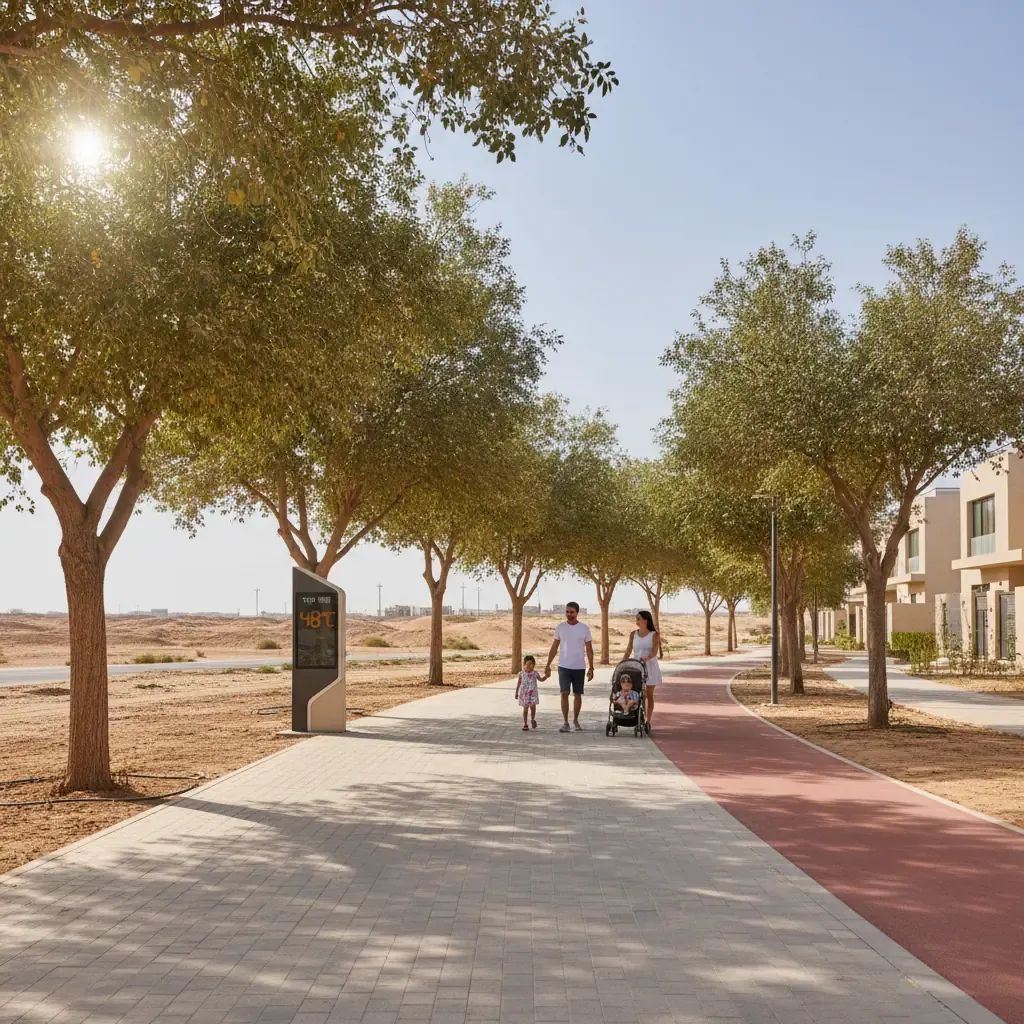
• Neighborhood accessibility: The combination of expanded green corridors and 2,500 meters of new Corniche cycling paths makes outdoor living genuinely feasible year-round for the first time in many residential zones.
What Drives the Scale: Vision 2030 and Real Infrastructure Constraints
Ajman's 5,465 trees planted in 2025 connect directly to the emirate's larger "15-minute city" framework—an urban model where residents access work, schools, groceries, and recreation within walking or biking distance. This model fails without shade infrastructure. Summer temperatures regularly exceed 45°C, making car-free mobility impossible unless tree canopy exists over pedestrian pathways.
The Ajman Energy Strategy 2030, finalized in December 2024, identified tree planting as a critical passive cooling layer within a comprehensive sustainability roadmap. The strategy addresses the real economic tension facing Northern Emirates: balancing growth ambitions with the environmental costs of operating buildings and transportation networks in an arid climate where energy consumption remains the region's largest operational expense.
Federal-level commitment reinforces local action. The United Arab Emirates has committed to extensive green initiatives, including mangrove tree planting and urban forestry expansion through 2030, with each specimen contributing to measurable carbon sequestration benefits. While Ajman's geography favors inland desert species over mangrove expansion, the national framework creates reporting systems that credit municipalities for all tree-planting carbon benefits. This legal-structural change means Ajman's trees now represent measurable progress toward the nation's Net Zero 2050 targets—transformed from environmental symbolism into mandatory climate accounting data.
The Species Strategy: Why Indigenous Trees Matter More Than You'd Expect
Ahmed Saif Al Muhairi, directing the Agriculture and Public Parks Department, has deliberately prioritized Ghaf, Sidr, and Samar over ornamental imports. This isn't aesthetic preference; it's a practical water and survival calculation.
Ghaf trees (Prosopis cineraria), the UAE's national tree, require minimal irrigation once their root systems establish. They're evergreen, providing year-round shade, and thrive without the dormancy cycles that challenge many imported species in desert climates. Research from cooling studies and thermal analysis in the region demonstrates that native species achieve significant surface temperature reduction in their immediate microclimate. A mature Ghaf can cool surrounding surfaces—like concrete, asphalt, and building materials—by 12–15°C compared to exposed hardscape, making it functionally equivalent to providing substantial passive cooling.
Sidr trees deliver complementary benefits. Their deep root systems stabilize soil and reduce erosion—critical in regions experiencing accelerating groundwater depletion. Critically, these species attract pollinators and birds. The Al Zorah Natural Reserve, located in Ajman, harbors over 200 native and migratory bird species. Expanded green corridors throughout the emirate function as intermediate feeding and resting habitat for these populations, particularly during migration seasons when food sources become scarce.
Samar (Acacia tortilis) offers the largest canopy surface area among indigenous species, maximizing transpiration and therefore cooling efficiency. Fruit-bearing varieties complement these three through ecological function rather than decoration—they create micro-habitats supporting insects, birds, and other wildlife that maintain ecosystem resilience.
Dr. Eng. Khalid Maeen Al Hosani, heading the Public Health and Environment Sector at Ajman Municipality, framed species selection in terms of carbon sequestration efficiency and irrigation water consumption—a metric recognizing that freshwater scarcity remains an existential constraint in the region, not merely an environmental preference.
The Technology Layer: Turning Trees Into Measurable Climate Action
What distinguishes 2025 planting efforts from previous campaigns is integration with national monitoring systems. Municipalities now have access to centralized tracking of environmental benefits from urban forestry initiatives, enabling data-driven management.
This infrastructure makes tree impact legible. Instead of estimates, planners reference peer-reviewed research on cooling benefits, air quality improvements, and environmental impact. Environmental monitoring networks across Ajman track PM2.5, nitrogen dioxide, and ozone concentrations—pollutants that spike during summer months and substantially exceed safe thresholds in areas without significant tree canopy.
For residents with respiratory conditions or caring for elderly family members, this distinction becomes consequential. Areas with established green infrastructure show measurably lower ambient air pollution during the warmest months, enabling outdoor activity that would otherwise trigger symptoms or heat stress in vulnerable populations.
The UAE Climate Change Law mandates that designated entities, including municipalities, submit comprehensive emissions inventories. Urban forestry carbon sequestration will feature prominently in Ajman's environmental reporting. This reporting framework creates sustained political and budgetary pressure to maintain and expand tree planting targets through the decade.
Asset Management Through Tree Cataloguing
The Local Tree Numbering initiative has grown to document a significant increase in inventoried trees across Ajman. Each specimen now carries unique identifiers, enabling maintenance crews to track health metrics, water consumption patterns, survival rates, and maintenance history. This database has become essential infrastructure for developers and urban planners.
New construction projects increasingly reference tree location data, incorporating existing mature vegetation into site designs rather than clearing land entirely for redevelopment. Preserving established trees costs substantially less than removal, replanting, and waiting 5–7 years for new specimens to reach comparable canopy size and cooling capability.
Property investors evaluating development feasibility now scrutinize tree inventory datasets. Sites with existing mature specimens command valuation premiums, as environmental compliance costs decrease and landscaping timelines compress significantly.
The Economic Reality: Air Conditioning and Monthly Household Budgets
Studies suggest that mature trees provide cooling equivalent to multiple air conditioning units—relevant to households where air conditioning typically consumes up to 60% of residential energy expenditure. For a family paying substantially in summer cooling costs, strategic tree placement around their residence can contribute to measurable utility bill reduction.
A villa surrounded by mature Ghaf trees experiences noticeably lower cooling loads during peak afternoon hours when solar heat gain peaks. For expatriate families budgeting tightly—a substantial constituency across Northern Emirates—this represents potential monthly savings extending through the entire summer season.
Beyond individual household mathematics, expanded green spaces create outdoor recreation zones previously unusable during heat-intensive months. The Al Safia district transformation and Corniche revitalization projects incorporate expanded green infrastructure specifically to enable year-round outdoor activity. This shift supports public health objectives outlined in the UAE Quality of Life Strategy 2033, influencing planning priorities across Northern Emirates.
Recreation and the "Walkable Neighborhood" Thesis
The 15-minute city framework depends on shade-protected pedestrian infrastructure. Summer temperatures exceeding 45°C render traditional car-free mobility strategies unworkable without continuous tree canopy overhead. Walking or cycling to shops, schools, or workplaces becomes feasible—and genuinely desirable—only when pedestrian pathways offer reliable shade.
The Ajman Corniche revitalization includes 2,500 meters of dedicated cycling paths and tree-lined pedestrian zones. Combined with the emirate's achievement of a 100% eco-friendly taxi fleet by October 2024—six years ahead of the original 2030 target—these investments create a coherent mobility ecosystem. Residents can reasonably expect to walk or cycle for daily needs, accessing services and recreation without dependence on private vehicles or air-conditioned transport.
Complementary infrastructure amplifies this trajectory. New green spaces are being created within developments like Al Zorah, including expanded public beach access. Bicycle paths, green buildings, and tree-lined streets bind these disparate projects into a functional urban system.
The Community Dimension: Neighborhood Greening Programs
The Ajman Excellence Program is launching a community environmental initiative in December 2025 focused on "greening neighborhoods." This framework encourages residents to participate in supplemental tree planting within private compounds, villa communities, and local parks. Such programs serve dual purposes: expanding measurable green cover while building environmental literacy among younger generations who will manage this infrastructure through 2050.
Community participation also addresses a practical budget constraint. Municipal resources, while substantial, cannot achieve the scale of greening required for a genuine 15-minute city model. Resident contribution creates distributed planting efforts throughout residential neighborhoods, accelerating canopy coverage expansion beyond what municipal budgets alone could deliver.
School and university partnerships—mirroring successful models in Abu Dhabi and Dubai—mobilize thousands in tree-planting campaigns. These programs educate participants on long-term benefits of green spaces while simultaneously expanding total planted acreage.
Green Building Integration and Closed-Loop Systems
Ajman has seen significant growth in certified green buildings in recent years, with these structures incorporating water recycling systems, solar panels, and native landscaping, reducing both environmental footprint and operational costs.
Trees planted adjacent to green buildings amplify sustainability benefits through infrastructure integration. Buildings with water recycling systems can direct treated greywater toward tree irrigation, creating closed-loop systems minimizing freshwater consumption. Solar-equipped buildings provide power for landscaping maintenance equipment.
Organic waste from tree trimming and landscaping operations feeds into composting facilities, creating nutrient-rich soil amendments supporting future planting cycles. This regenerative approach transforms landscaping from linear resource consumption into cyclical systems where byproducts become inputs for subsequent efforts.
What This Means for Different Stakeholders
For property developers and investors: Proximity to established green corridors influences valuations and property appeal measurably. Residential and commercial units within 500 meters of major parks or tree-lined streets are increasingly sought after compared to units lacking green infrastructure access. Tenants increasingly prioritize walkability and outdoor amenities, making green proximity an important investment criterion.
For business owners: Retail and hospitality sectors benefit materially from foot traffic drawn to shaded pedestrian zones. The Corniche revitalization transforms waterfront areas into year-round destination zones rather than seasonal venues attracting visitors only during cooler months. Businesses locating along tree-lined pedestrian corridors capture customers spending extended time outdoors.
For expatriate families: Residential decision-making should explicitly incorporate proximity to Vision 2030 green infrastructure projects. New developments incorporating environmental standards and native landscaping offer lower utility costs, superior outdoor living environments, and greater long-term property appeal compared to older, concrete-heavy developments relying entirely on mechanical cooling.
For health-conscious residents: Documented improvements in air quality and expanded shaded outdoor space availability support long-term health outcomes. Families managing respiratory conditions or caring for elderly relatives benefit substantially from access to tree-covered outdoor environments that reduce heat stress and enable outdoor activity during seasons previously confining residents indoors.
The emirate's commitment to annual tree planting quotas through 2030 suggests sustained green infrastructure investment. Residents can reasonably expect incremental but consistent improvements in urban microclimate conditions, air quality metrics, and accessible outdoor recreation spaces—factors that collectively enhance livability in one of the world's most thermally challenging urban environments.


