
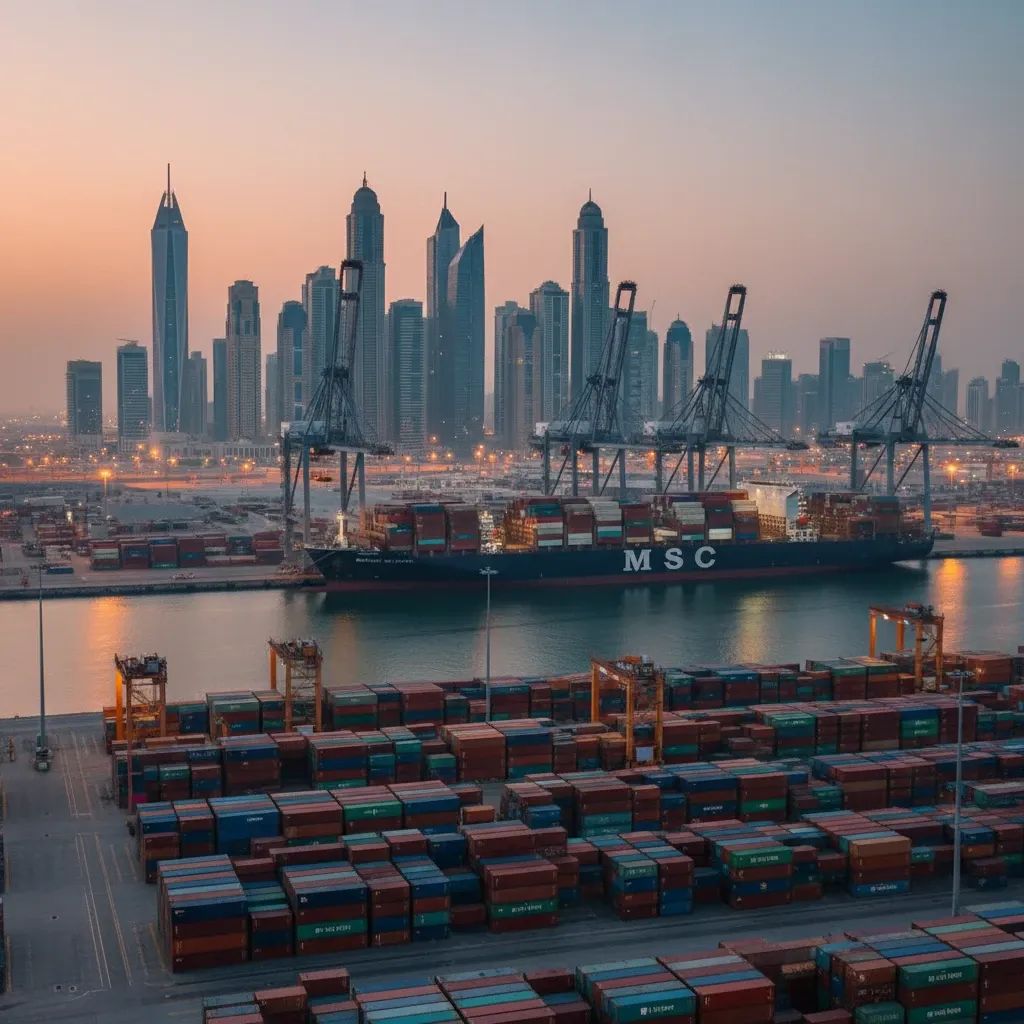
Bilateral trade between the United Arab Emirates and Serbia is quietly reshaping supply chains across two continents. A ministerial exchange on May 7th, 2026 between Saeed Al Hajeri, the UAE's Minister of State, and Jagoda Lazarević, Serbia's Trade Minister, signals that the commercial partnership forged last year has moved from political gesture into operational reality—and that shift carries potential consequences for businesses and consumers across the Emirates.
Why This Matters
• Food imports from Serbia are now duty-free, positioning Serbian products to compete with traditional suppliers and potentially affecting restaurant sourcing and grocery pricing in the UAE
• Serbian companies are increasingly establishing operations in Dubai, with growing commercial activity throughout 2025
• UAE investors can now access low-cost manufacturing in Serbia to serve European markets with reduced customs friction
• Renewable energy deals between the nations are accelerating, offering UAE developers and investors exposure to Balkan infrastructure projects
How the Trade Framework Changed the Calculus
When the Comprehensive Economic Partnership Agreement (CEPA) came into force on June 1, 2025, it eliminated tariffs on 96% of product lines between the two countries. For context, this was no ordinary bilateral accord. The UAE rarely signs comprehensive trade agreements with non-WTO members, making Serbia the exception to an established pattern. The decision to do so reflects the strategic value both capitals see in the relationship: Serbia as a gateway into Central Europe for UAE exporters, and the UAE as a capital and technology source for Serbian industrial ambitions.
Serbian agricultural goods now flow into the UAE without tariffs: live animals, fresh and processed meats, fish, dairy, fruits, grains. For a nation where over 80% of food consumption depends on imports, this diversification represents a significant shift in sourcing options. The UAE is no longer purely dependent on traditional suppliers in distant regions; Serbian products are now positioned to be price-competitive and logistics-efficient.
The ministerial meeting in January 2026 underscored both nations' commitment to translating the trade framework into sustained commercial action. The outcome demonstrates the tangible shift from diplomatic warming to practical business engagement, with growing Serbian commercial participation in UAE markets.
The Strategic Geometry of the Partnership
Serbia's location is its most valuable asset. Positioned at the crossroads between the Balkans and Central Europe, with EU candidate status, it functions as a logistics fulcrum for UAE enterprises targeting European markets. A manufacturing company based in Dubai can now establish production in Serbia at significantly lower labor costs, assemble goods under EU regulatory standards, and re-export to European Union markets with tariff advantages that Serbia's EU candidacy promises.
Conversely, Serbian exporters gain access to UAE free zones—particularly those in Dubai and Abu Dhabi—as duty-free re-export hubs into GCC countries and Africa. This creates a two-way arbitrage opportunity that the CEPA framework explicitly enables.
The renewal of focus during the May 7th meeting reflects both capitals' recognition that implementation requires sustained attention. Trade frameworks don't execute themselves; they require quarterly reviews, dispute resolution protocols, and coordinated regulatory alignment. The discussions between Al Hajeri and Lazarević centered on three sectors identified as capable of delivering immediate economic returns.
Food Security: The Immediate Opportunity
The UAE's heavy reliance on imported food in its desert climate makes food sourcing a critical national concern. Serbia's agribusiness sector—competitive by European standards, with lower costs than Western European producers—is now positioned to compete directly with traditional suppliers in countries like Denmark, France, and Australia.
What this means operationally: refrigerated containers bearing Serbian dairy could arrive in Dubai with no tariff burden. A hotel operator in Abu Dhabi could now source European-standard meats from Belgrade at potentially competitive pricing compared to existing suppliers. A juice manufacturer could access Serbian fruit at cost levels that may improve margins. The tariff elimination creates conditions for competitive pressure from new entrants that could lead to price rationalization across entire categories—benefits that could eventually flow through to consumers, though indirectly.
The CEPA's investment chapter also encourages joint ventures in agribusiness. UAE capital is flowing toward Serbian cold-chain infrastructure and farm modernization projects that boost productivity. This isn't charity; it's capital seeking returns, but it strengthens Serbia's capacity to supply the UAE market at volume and consistency.
Energy and Renewable Transitions
Serbia's energy infrastructure remains heavily coal-dependent, a structural legacy of the industrial era. Yet the CEPA identifies renewable energy as a priority sector for collaboration. For UAE investors, this represents opportunity. The Emirates' sovereign wealth funds and real estate developers have begun exploring Balkan exposure—solar and wind projects that could deliver predictable returns within European regulatory frameworks and benefit from EU alignment.
Masdar, the Abu Dhabi-based renewable energy giant, has signaled interest in Balkan expansion. Serbia, with its lower construction costs and government appetite for energy diversification, becomes a potential testing ground for models that can later scale into other European markets. The regulatory certainty of EU-aligned standards reduces investment risk compared to operating in less-developed energy markets elsewhere.
Digital and Technology Cooperation
The CEPA contains specific provisions eliminating customs duties on electronic transmissions and establishing cybersecurity cooperation frameworks. In practical terms, this enables Serbian tech companies to export software and digital services to the UAE with reduced friction, while UAE venture capital gains access to a growing base of software developers and engineering talent in the Balkans.
Serbia's IT sector has expanded substantially over the past five years. Labour costs remain significantly lower than Western Europe, and the time zone alignment with European markets makes Serbian developers attractive for UAE firms building products or services for European clients. This is another arbitrage opportunity: capital and product vision from the Emirates, engineering talent and compliance infrastructure from Serbia.
The Exhibition as Catalyst
The "Make it in the Emirates" exhibition, where Lazarević and Al Hajeri met, featured 1,245 exhibitors across the UAE's seven emirates and international participants. The event functions as both a platform for the UAE's Operation 300bn initiative—an industrial strategy targeting AED 300B ($81.7B) in manufacturing output by 2031—and a recruitment venue for countries seeking integration into UAE-anchored supply chains.
Serbia's participation at ministerial level signals commitment to the partnership's visibility. It wasn't a booth in a trade show; it was the nation's trade minister using a major industrial forum as a backdrop for serious policy conversation.
What the Diplomatic Messaging Accomplished
The ministerial meeting included Serbia's condemnation of Iranian attacks targeting UAE civilians and infrastructure, which both nations characterized as violations of sovereignty and international law. Such statements matter diplomatically, signaling alignment with UAE foreign policy and strengthening bilateral trust while adding a European voice to the UAE's regional security positioning.
For residents and businesses in the UAE, the significance is practical: such statements indicate that the partnership has moved beyond transactional trade into a framework comprehensive enough to encompass political alignment and shared security concerns.
Where the Partnership Heads
The commitment between UAE President Sheikh Mohamed bin Zayed Al Nahyan and Serbian President Aleksandar Vučić signals high-level dedication to the relationship's trajectory. Both governments have tasked trade ministries with quarterly implementation reviews, suggesting the partnership has institutional momentum and regular checkpoints to address bottlenecks.
The real test lies ahead: whether tariff elimination translates into sustained investment flows, whether joint ventures materialize at scale, and whether technology and capital transfer actually occur. Trade frameworks are often written with optimism; they're executed with friction. The May 7th meeting represents a moment when both sides reaffirmed readiness to navigate that friction—through quarterly reviews, sector-specific working groups, and continued political attention at the ministerial level.
For businesses in the UAE, the opportunity remains clear: Serbian sourcing for food and industrial inputs is now positioned to be cost-competitive and logistics-efficient. For investors, Serbia presents infrastructure and technology opportunities that fit within European regulatory frameworks. For consumers, increased competition in categories like dairy and processed meats positions them to potentially benefit from price pressures over time.
The partnership isn't revolutionary. But it's real, measurable, and actively being expanded. That distinction matters in assessing which trade initiatives actually change commercial behavior versus those that remain ceremonial.


