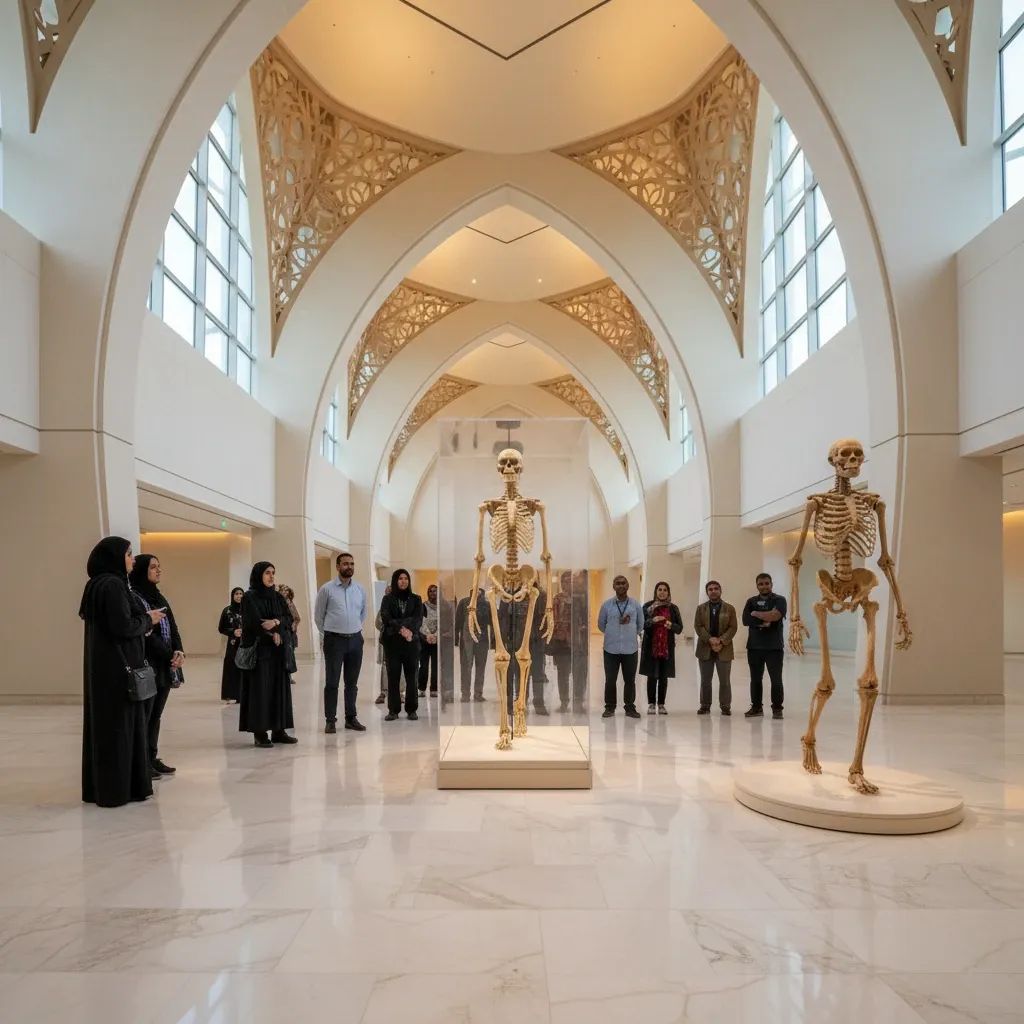
The United Arab Emirates Natural History Museum Abu Dhabi has secured a fleeting visit from “Lucy,” the 3.2 million-year-old fossil ancestor, giving Gulf residents an unprecedented chance to stand face-to-face with early humanity—and to see how new imaging science is rewriting the story.
Why This Matters
• Last day is 23 March 2026 – plan weekend trips before the specimen heads back to Addis Ababa.
• Tickets are part of the standard museum entry (AED 30 for adults; free for school groups), making the encounter affordable.
• Cutting-edge 3D scans on display reveal fresh findings about growth rates, diet and even Lucy’s running ability.
• Arabian fossils exhibited alongside Lucy underline a shared ecological past, reshaping how schools teach regional prehistory.
A Fossil Celebrity Arrives in the Gulf
Lucy, catalogued scientifically as Australopithecus afarensis, left Ethiopia only three times in five decades. Her current stop in Saadiyat Cultural District is therefore more than a high-profile loan; it is a diplomatic handshake between the United Arab Emirates Ministry of Culture and the Ethiopian Heritage Authority. The fossil—around 40 % complete—lies at floor level, exactly as she was found in 1974, while a life-size reconstruction stands nearby. The curatorial choice invites visitors to toggle visually between raw evidence and scientific interpretation, mirroring the museum’s broader ethos of discovery over spectacle.
Science in Real Time: What New Tech Is Revealing
Over the past two years, researchers working with digital copies of Lucy’s bones have used high-resolution CT, 3D musculoskeletal modelling and enamel micro-scanning to press questions that would have been impossible a decade ago.
Childhood length – Daily growth lines in tooth enamel suggest infancy lasted longer than in chimpanzees, hinting at extended learning and social reliance.
Life expectancy – Wear patterns across multiple A. afarensis individuals point to an average lifespan of roughly 30 years—not far off from wild great apes today.
Locomotion limits – Virtual reconstructions of 36 pelvic and lower-limb muscles show Lucy was a competent walker but a poor runner, underscoring that endurance sprinting came later in human evolution.
Hand dexterity – Enthesis analysis on 3D-printed hand bones indicates the fine motor control needed for elementary tool use, challenging the view that such skills began only with the Homo lineage.
Visitors can watch looping animations of these findings in the gallery’s “Digital Lab” alcove, where Emirates University students often demonstrate the software in Arabic and English.
Arabia’s Prehistoric Mirror
Lucy’s presence is leveraged to connect East African and Arabian deep time. The museum positions her beside seven-million-year-old proboscidean fossils from Al Dhafra and touchscreen maps that plot human and animal migrations across what is now the Red Sea. Recent desert-lake excavations in Saudi Arabia—featuring 120 000-year-old footprint trails of humans, elephants and camels—are highlighted to argue that a once-green Arabia served as a key corridor out of Africa.
By juxtaposing these finds, curators want visitors to grasp that climate-driven “green windows” periodically turned today’s arid landscapes into savannas, encouraging movement between regions. For school teachers designing lesson plans, the exhibit supplies downloadable data sets that merge African and Arabian fossil records into a single timeline.
What This Means for Residents
• Families & educators: The museum’s weekday morning slots are block-reserved for UAE school groups. Teachers can book free guided tours and borrow 3D-printed Lucy bone kits for classroom use under a new Ministry of Education partnership.
• University students & researchers: The institution’s behind-the-scenes collections lab offers limited internships in CT-data processing and comparative anatomy. Emirati students receive priority placement.
• Investors & tourism operators: With spring-break travel likely to spike footfall before Lucy departs, Abu Dhabi hoteliers are rolling out “Fossil Weekend” packages. Early booking could translate into higher room rates and stronger first-quarter revenue.
• General public: If you cannot visit in person, the museum’s website streams a 4K virtual tour free of charge. However, only on-site visitors can see the real fossil—digital copies do not replicate the texture or subtle colouring that still hold traces of manganese oxide from the Ethiopian sediment.
Looking Ahead
Curators confirm that once Lucy returns home, her gallery will rotate in Arabian paleontological discoveries, including a soon-to-be-announced exhibit on 465-million-year-old horseshoe crab fossils from Saudi Arabia’s AlUla. Meanwhile, Emirati and Ethiopian scientists have signed an agreement to share CT data sets, potentially allowing Abu Dhabi-based AI labs to run biomechanical simulations on early hominin gait.
For residents, Lucy’s departure need not mark the end of the story. The United Arab Emirates Natural History Museum Abu Dhabi is positioning itself as a regional research hub, ensuring that the fossil’s brief stay sparks a lasting curiosity about our shared prehistoric roots—and about how the sands beneath our feet were once wetlands teeming with life.